
Myanmar Spring Chronicle – Scenes from October 13
(MoeMaKa), October 14, 2026
Myanmar’s Civil War, Soaring Commodity Prices, and the Limits of Public Resilience
One of the health-related stories making headlines in recent days concerns the military authorities’ decision to suspend the free healing services offered by a charitable practitioner named Nay Lin Aung at a Buddhist monastery in Ward 42 of North Dagon Township, Yangon.
The military-controlled health and administrative authorities reportedly ordered Nay Lin Aung to stop providing treatment after videos circulated on social media showing him attempting to heal patients by striking or pressing parts of their bodies with his knee.
Nay Lin Aung, widely known as a charitable healer, had been offering free treatment at Maha Gandhayon Monastery in North Dagon for several years. However, it was only after videos of his unusual healing practices went viral and sparked public criticism that the authorities intervened and ordered the services suspended.
According to media reports, Nay Lin Aung previously explained in an interview that his treatments involved applying a special oil commonly known as si-man, or consecrated oil, and using traditional mystical healing methods associated with weikza practices. He claimed to treat bone, muscle, nerve, and other ailments through these methods.
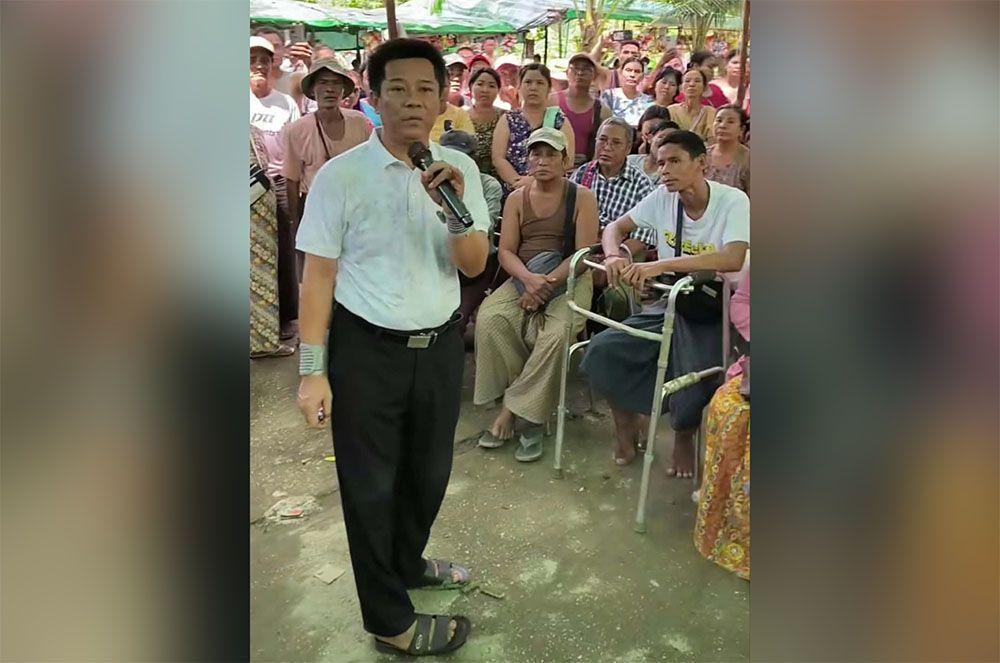
Videos circulating on social media showed hundreds of patients lining up beneath the monastery’s covered areas, waiting for treatment. Reports suggested that the number of people seeking his services ranged from several hundred to more than a thousand each day.
In the videos, Nay Lin Aung could be seen speaking to patients through a microphone, rubbing affected parts of their bodies with his palms, and pressing or striking certain areas with his knee as part of his healing procedures.
He reportedly did not charge any fixed fees for treatment. Instead, patients could make voluntary donations according to their financial circumstances.
The monastery also provided free meals to patients every day. Those traveling from other regions could stay at the monastery without charge.
According to one person who had previously received treatment there, the accommodation consisted mainly of basic sleeping spaces, such as benches, rather than private rooms or secure lodging.
There were also accommodations available at a nearby Buddhist nunnery, where visitors could stay overnight with electric fans and mosquito nets in exchange for donations of approximately 3,000 to 4,000 kyats.
The popularity of Nay Lin Aung’s free healing services reflects a much broader problem facing Myanmar today: the inability of ordinary people to afford medical treatment.
For many patients, particularly those with limited incomes, these faith-based healing centers have become an alternative to conventional medical care. Religious beliefs, traditional practices, and hopes of miraculous recovery are closely intertwined with the economic hardship that drives people to seek such services.
Public discussions surrounding the incident have included considerable criticism.
Many social media users have questioned why patients choose to visit faith healers rather than hospitals or medical clinics. Others have criticized the public’s reliance on consecrated oils, mystical healing methods, and traditional remedies, attributing such choices to inadequate health education and limited medical knowledge.
However, these criticisms often overlook the financial realities faced by ordinary people.
At private hospitals and clinics in Myanmar, a consultation with a specialist typically costs between 20,000 and 26,000 kyats. Hospitals may charge an additional 20,000 to 25,000 kyats in service fees.
This means that a patient may have to spend approximately 50,000 kyats simply to see a doctor, even before purchasing any medication.
Once prescription medicines are included, a single visit to a private hospital or clinic can cost at least 70,000 kyats and sometimes more than 100,000 kyats.
These expenses do not include diagnostic procedures such as urine tests, blood tests, X-rays, ultrasound examinations, or other medical scans.
When such tests are required, the additional costs can range from tens of thousands to several hundred thousand kyats.
One resident of a major city, commenting on social media about personal experiences with private healthcare, noted that blood tests and X-rays at private hospitals in cities such as Yangon and Mandalay could cost approximately 200,000 kyats.
The same person said that patients requiring hospitalization or surgery might have to pay an advance deposit of around 3 million kyats for a five-day hospital stay.
Such amounts are far beyond the financial reach of daily wage earners, pensioners, elderly retirees, and people who are no longer able to work.
For families already struggling to afford food, housing, and other daily necessities, the cost of private medical care is simply unaffordable.
Public hospitals may not charge the same consultation and service fees as private facilities, but patients are often required to purchase their own medicines and medical supplies. Consequently, treatment at government hospitals still involves substantial expenses.
Under these circumstances, low-income patients who cannot afford conventional healthcare may come to regard charitable healing centers and faith healers as their only source of hope.
Their suffering is not limited to physical illness. They are also experiencing severe economic hardship.
Therefore, judging faith-based healing practices solely from a medical perspective, while harshly condemning those who seek such treatments as ignorant or uneducated, demonstrates a lack of compassion.
It also reflects a failure to understand the deeper socioeconomic crisis affecting Myanmar today.
In a country where the public healthcare system has deteriorated severely, people at the bottom of the socioeconomic ladder often have little choice but to rely on informal and unregulated forms of treatment.
These include mixed medicines sold at betel shops, traditional healers who claim miraculous powers, and various home remedies or folk treatments.
Many patients turn to public hospitals only when their illnesses become life-threatening, when ordinary clinics refuse to treat them, or when their conditions have reached an advanced stage.
Even before the 2021 military coup, Myanmar’s healthcare system lagged far behind those of many neighboring developing countries.
Following the coup, tens of thousands of healthcare professionals participated in the Civil Disobedience Movement (CDM), while public healthcare spending was significantly reduced.
These developments have contributed to the severe deterioration of Myanmar’s public healthcare system.
Against this background, the growing reliance on faith healers and traditional remedies should not be viewed simply as a matter of superstition or inadequate medical knowledge.
Instead, it must be understood in the context of poverty, desperation, and the collapse of accessible healthcare.
People suffering from illness, unable to afford proper medical treatment, may turn to anyone who promises relief, whether a faith healer or a practitioner of traditional remedies.
Their situation resembles that of a drowning person desperately grasping at a straw in the hope of survival.
The central point is not to endorse unproven healing practices, but to recognize the circumstances that compel people to seek them.
Compassion and understanding are essential when examining the choices made by those who have been pushed into such desperate situations.
Ultimately, Myanmar’s growing dependence on faith-based healing reflects not merely a crisis of medical knowledge, but a much deeper crisis of poverty, public healthcare, and social survival.