
Myanmar Spring Chronicle – Scenes from September 2
(MoeMaKa), September 3, 2026
Military Flotilla Attacked Again on the Irrawaddy Between Shwegu and Bhamo; More Than 100 Reportedly Surrender
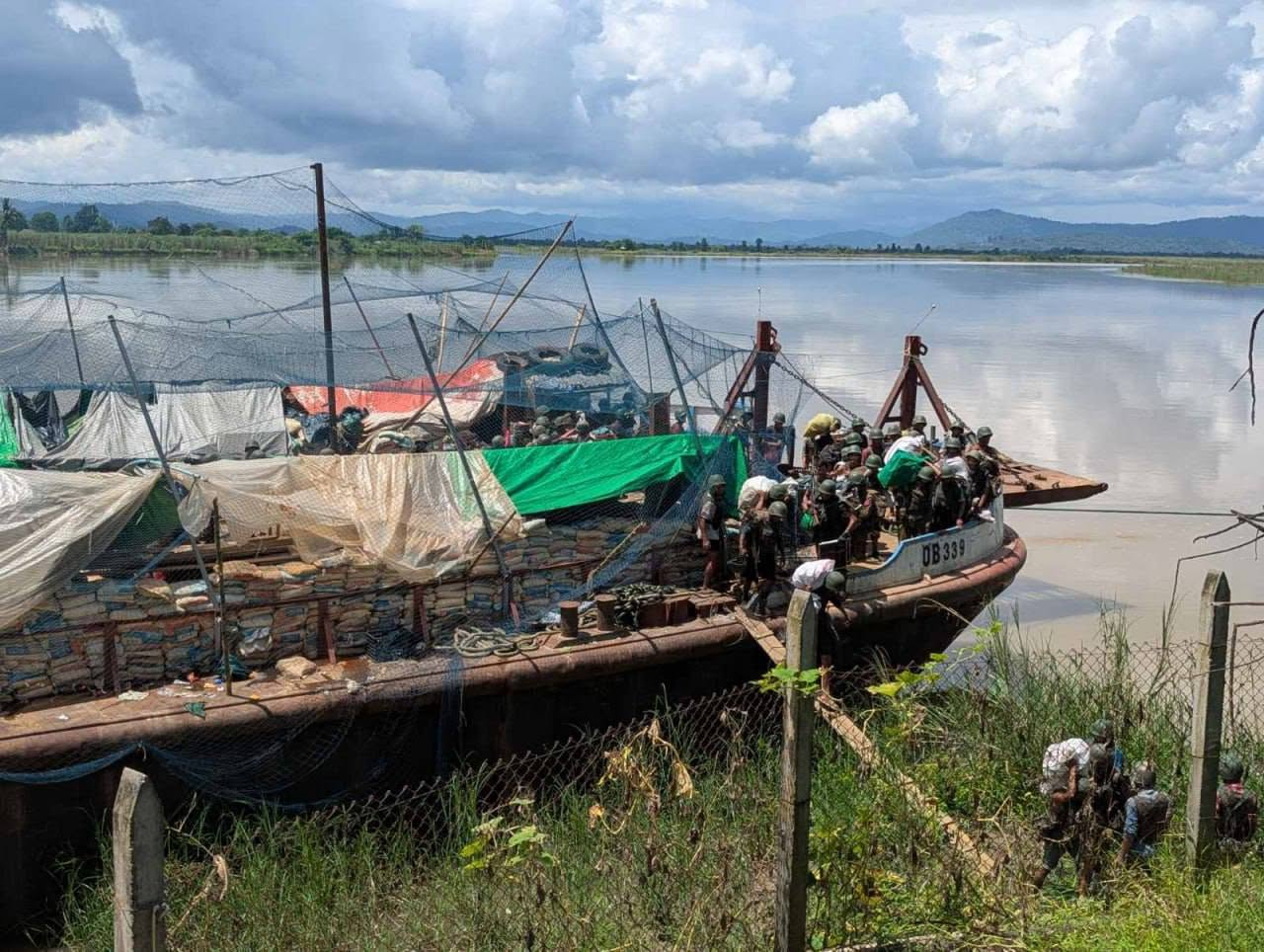
As it did in 2025, Myanmar’s military has once again used the Irrawaddy River during the middle of the rainy season, when water levels are at their highest, to send a flotilla north from Mandalay toward Bhamo in Kachin State. The vessels were carrying supplies, weapons and ammunition, as well as troop reinforcements.
With only a few months remaining before the battle for Bhamo reaches its second anniversary, neither the Kachin Independence Army (KIA) nor the military has been able to gain complete control of the city. Bhamo therefore remains an active and contested front. Because of both the city’s military significance and the strategic importance of the surrounding areas, neither side has been willing to withdraw, and fighting has continued.
In the third week of August, a flotilla departed from Gaw Wein Port in Mandalay. The convoy reportedly consisted of 15 vessels, including two combat vessels and eight cargo vessels.
On September 2, as the flotilla traveled through a narrow stretch of the Irrawaddy River north of Shwegu, it came under a major attack. Two vessels were damaged, and more than 100 military personnel aboard the vessels reportedly surrendered.
The flotilla had already been attacked by the KIA before September 2, with some vessels reportedly damaged. However, the September 2 attack appears to have been significantly more serious. A military vessel caught fire and was forced to reach the riverbank, while military personnel surrendered.
One factor believed to have given the KIA an advantage was the use of what have been described as FPV drones equipped with jammers or technology resistant to signal disruption, combined with the relatively short engagement distances around the narrow section of the Irrawaddy River.
Of the original 15 vessels, approximately five have reportedly been damaged so far. The remaining vessels are said to have continued traveling upstream toward Bhamo.
Photos and videos said to show the September 2 attack began circulating on social media on the same day. However, some social-media pages specializing in fact-checking and information verification have said that certain photographs being circulated were actually images from earlier incidents.
Regardless of whether all the photographs and video footage circulating online were taken during the September 2 incident or came from previous events, reports of the attack itself and the surrender of more than 100 military personnel have been independently corroborated. The incident therefore represents a significant setback for the military.
Military flotillas traveling from Mandalay toward Bhamo also faced attacks in July and August last year. This year’s attacks, however, appear to have caused substantially greater damage, particularly because more than 100 personnel reportedly surrendered.
The battle for control of Bhamo has been underway since late 2024. During the middle of each rainy season, the military has relied on river convoys to transport food, ammunition, weapons and troop reinforcements. During other periods, it has largely had to depend on air transport to supply its forces.
Even aerial resupply has faced difficulties. Military helicopters conducting such missions have previously come under attack and suffered damage, meaning the military’s ability to deliver reinforcements and supplies by air also appears to be constrained.
Bhamo occupies an important strategic position. It lies on the Irrawaddy River and near a road junction connecting the Mansi area with the Chinese border. It is also part of the north-south transportation network linking Myitkyina and Bhamo with Mandalay farther south. These geographic factors make the city strategically important from a military perspective.
The latest attack does not necessarily mean that the KIA will succeed in capturing Bhamo. However, had the military flotilla been able to reach Bhamo without suffering major losses, the reinforcements and supplies it carried could almost certainly have affected the military balance in the ongoing battle for the city.
The battle for Bhamo began in the first week of December 2024. Neither the KIA nor the military has officially disclosed comprehensive casualty figures for the fighting, making it impossible to determine the exact number of deaths and injuries on either side.
In September 2025, Pyichitthar, a website associated with military propaganda, published figures claiming that more than 4,400 KIA and PDF fighters had been killed and more than 4,800 wounded. According to the website, more than half of the reported 4,400 deaths involved members of the KPDF, Bhamo PDF, Myitkyina PDF, Shwegu PDF, Sagaing PDF and other locally organized PDF forces.
These figures cannot be independently verified. Nevertheless, considering military casualties on both sides as well as civilian deaths, it is reasonable to conclude that the overall death toll connected to the prolonged battle for Bhamo may already number in the thousands.
Following the latest attack on the military flotilla, reports indicate that the military has intensified its air operations in the area.
Some reports claimed that the military conducted attacks involving more than 100 aircraft sorties in a single day. That figure cannot currently be independently confirmed. However, available information suggests that the military carried out air operations numbering at least in the dozens.
In April, after coup leader Min Aung Hlaing assumed the presidency, he invited armed groups to participate in peace talks connected with a proposed 100-day peace initiative. The KIA was not among the groups participating.
At present, fighting around Bhamo and Shwegu in Kachin State is instead intensifying, and there are few visible signs that ceasefire negotiations between the two sides are likely in the immediate future.