
Myanmar Spring Chronicle — November 4 Perspective
(MoeMaKa), November 5, 2026
Have Pro-Democracy Forces Really Won the U.S. Midterm Elections?
The United States held its midterm elections on November 3, two years after the presidential election and more than 21 months after the president took office. The elections determined representatives for both chambers of Congress, as well as governors in several states.
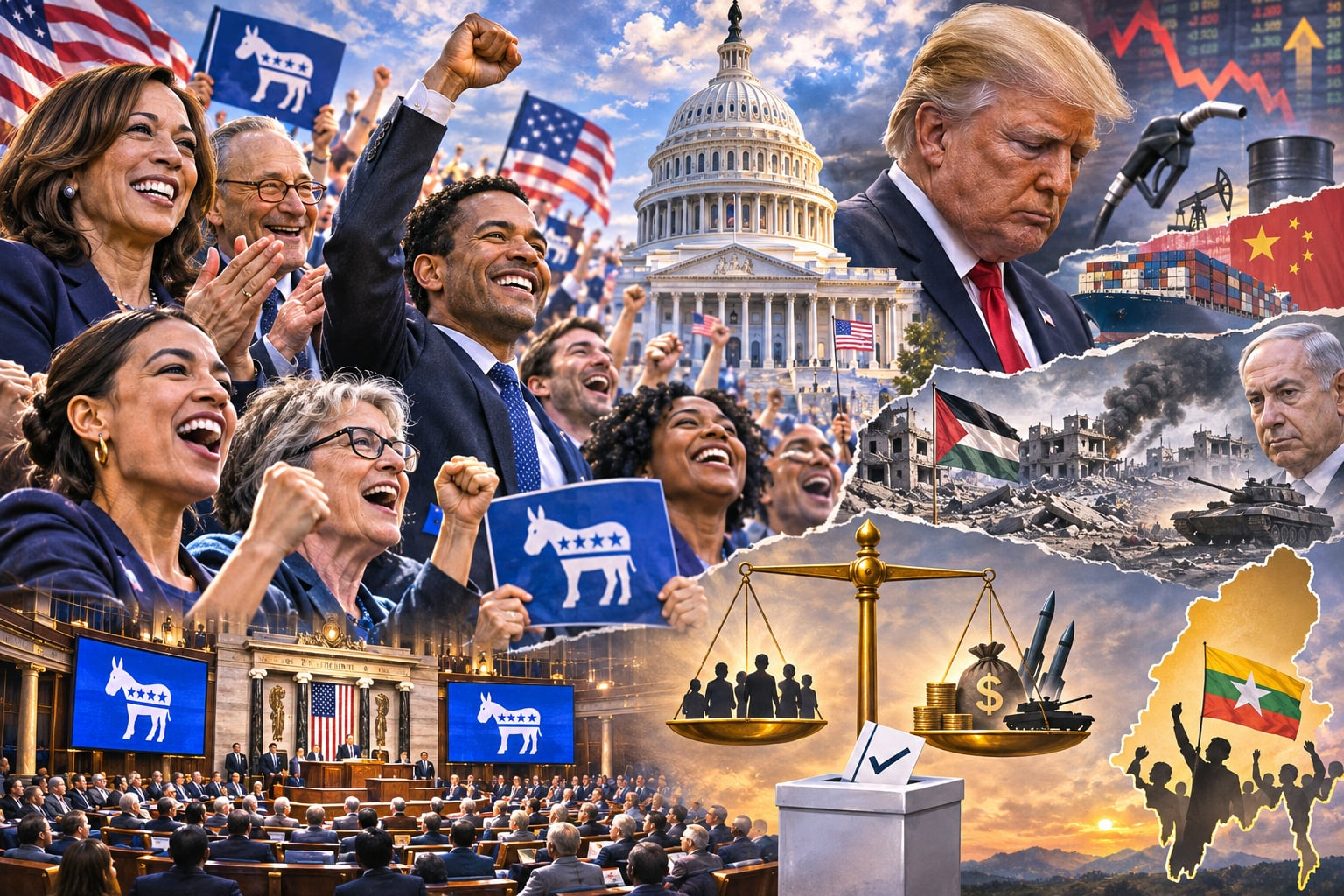
According to media reports based on election results emerging on the night of November 3 and the morning of November 4, U.S. time, Democratic Party candidates secured majorities in both the Senate and the House of Representatives.
President Donald Trump, who had employed various campaign messages and tactics throughout the election period, appeared to accept that Republicans had lost their majority positions in both chambers of Congress. Rather than continuing his previous confrontational rhetoric, Trump reportedly offered congratulatory remarks acknowledging the Democratic Party’s electoral success.
Democratic candidates also reportedly won in traditionally Republican strongholds, including Texas and Georgia.
Many observers have characterized this midterm election as a referendum on President Trump’s policies and his administration’s performance.
Since assuming office on January 20 of last year, Trump introduced sweeping policy changes within days and weeks of his inauguration. During his first 100 days, he announced substantial tariff increases on dozens of countries, disrupting relations with traditional allies and triggering a trade war with China.
His administration also established the Department of Government Efficiency (DOGE) through executive action rather than as a department created by legislation. Billionaire Elon Musk was appointed to lead the initiative, which resulted in the dismissal or suspension of tens of thousands of federal employees.
Although relations between Trump and Musk subsequently deteriorated and DOGE’s operations were discontinued after several months, legal disputes involving employees affected by the initiative have continued. Some cases remain unresolved.
Beyond his first 100 days, Trump’s statements concerning territories belonging to Western allied nations, along with rhetoric perceived as coercive and inconsistent with traditional alliances, further strained diplomatic relationships.
Earlier this year, the United States also entered into a military conflict with Iran. The article argues that the conflict was influenced by Israeli Prime Minister Benjamin Netanyahu’s ambitions to expand Israel’s territory and regional influence, and by his efforts to persuade the Trump administration to support those objectives.
The war contributed to rising global oil prices and disruptions to the international economy.
Higher prices for petroleum, natural gas, fertilizers, and other petroleum-derived products were among the most immediate factors contributing to the Republicans’ electoral defeat, according to this analysis.
The article interprets the election results as an expression of public dissatisfaction with Trump’s domestic and foreign policies. By withholding their votes from Republican candidates, voters effectively imposed an electoral penalty on the administration.
However, whether Americans’ rejection of Trump’s policies and their support for Democratic candidates will lead the country back toward policies prioritizing democracy and human rights remains uncertain.
The president still possesses substantial executive authority, including the ability to issue executive orders. Political confrontation between Congress and the White House could intensify, producing legislative gridlock rather than meaningful policy improvements.
During the remaining two years of Trump’s presidency, such institutional conflicts could prevent the administration and Congress from implementing policies that benefit the majority of Americans or establishing more constructive foreign relations.
Although the election results can be interpreted as a rejection of Trump’s policies and what critics describe as his increasingly monarchical approach to presidential power, serious questions remain about the Democratic Party’s ability and willingness to deliver meaningful change.
Will Democrats prioritize the interests of ordinary Americans?
Or will they continue to serve the interests of billionaires, trillionaires, major defense contractors, and the military-industrial complex?
Will they continue supporting enormous military budgets and expenditures on foreign wars?
Will they continue providing weapons, financial assistance, intelligence, and other forms of support to Israel’s government under Benjamin Netanyahu, whose Zionist political agenda the article associates with territorial expansion and the destruction of Gaza?
Will major weapons manufacturers and technology corporations continue accumulating wealth through these policies?
These concerns remain unresolved.
The International Criminal Court (ICC) has issued arrest warrants for Israeli Prime Minister Benjamin Netanyahu and former Defense Minister Yoav Gallant in connection with alleged war crimes and crimes against humanity in Gaza. The article characterizes Israel’s actions in Gaza as genocide and notes that the conflict and associated allegations began during Democratic President Joe Biden’s administration.
Arab American voters who opposed the Biden administration’s support for Israel reportedly sought to punish the Democrats during the November 2024 presidential election.
Some voted against Democratic presidential candidate Kamala Harris and supported Donald Trump instead.
Their opposition to Harris reflected dissatisfaction with Biden’s policies concerning Gaza.
However, according to the article, those voters subsequently encountered a different set of problems under Trump’s presidency.
The U.S. midterm elections have attracted attention around the world, including in Myanmar.
Only days before the election, the U.S. Embassy in Yangon, operating under the Trump administration, released a new U.S. strategy concerning Myanmar.
The absence of explicit language about restoring democracy in that strategy disappointed many Myanmar democracy supporters.
Against this background, some Myanmar observers welcomed the electoral defeats of candidates from Trump’s Republican Party.
They hope that renewed Democratic control of Congress might lead to the reemergence of U.S. policies supporting the restoration of democracy in Myanmar.
Nevertheless, the question remains whether Democratic lawmakers will actually pursue such policies and whether those efforts will produce meaningful results.
American voters have demonstrated their ability to hold political leaders accountable through the ballot box. By casting their votes in the midterm elections, they expressed dissatisfaction with the administration and sought to influence the country’s political direction.
Those voters now hope that the election results will lead to policies benefiting the majority of Americans.
While there is no desire to discourage these expectations, the broader global political and economic environment offers reasons for caution.
The world remains heavily influenced by individuals and institutions pursuing their own economic interests.
Billionaires, trillionaires, major corporations, defense manufacturers, and business conglomerates continue to benefit from military expansion, weapons production, and armed conflicts.
The political and economic system increasingly appears to favor those powerful interests over the needs of ordinary people.
Meanwhile, authoritarian leaders and political figures who place personal advantage above public welfare continue to occupy positions of influence and power.
For these reasons, the article urges readers not to assume that electoral victories alone will necessarily bring democratic renewal, social justice, or policies serving the public interest.
The deeper question is not simply which political party wins an election, but whether those entrusted with political power will genuinely act in the interests of the people.