
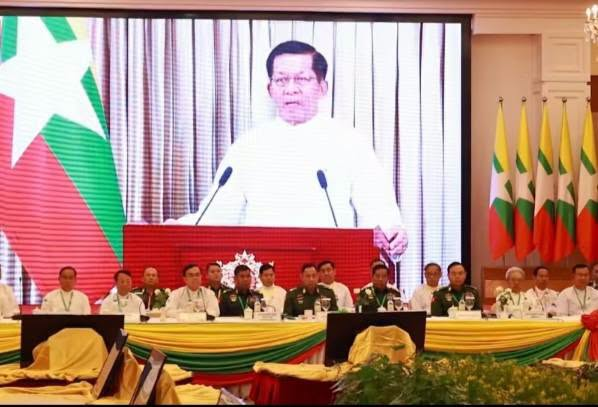
Myanmar Spring Chronicle – Scenes from October 14
(MoeMaKa), October 15, 2026
The Meaning of “Peace” and Myanmar’s Civil War
In modern Myanmar politics, the word “peace” has come to mean something quite different from its original definition. Traditionally, peace means an end to warfare, an agreement between armed groups to stop fighting, and the restoration of conditions in which ordinary civilians can earn their livelihoods and live safely in their homes and communities.
Today, however, “peace” is often understood as a temporary ceasefire designed to achieve military or political objectives, rather than a genuine effort to end conflict. It has increasingly become associated with political maneuvering and tactical arrangements.
Among supporters of Myanmar’s Spring Revolution, those who advocate peace are sometimes viewed with suspicion. They may be accused of giving the enemy an advantage, pursuing personal interests under the banner of peace, or acting as “peace brokers” who profit from negotiations.
The Historical Origins of Peace Agreements in Myanmar
Historical records show that treaties and agreements concluded after the First and Second Anglo-Burmese Wars between the British and Myanmar’s Konbaung dynasty in the nineteenth century were described as peace treaties.
In modern Myanmar politics, however, the terms “civil war,” “peace negotiations,” and “ceasefire” have frequently been used interchangeably since the country gained independence in 1948.
Following independence, armed rebellions emerged involving the Communist Party of Burma (CPB) and various ethnic armed organizations. These conflicts marked the beginning of a prolonged period of internal warfare.
According to historical accounts, the nationwide civil war that erupted in 1949—described in military and government histories as the era of the “multicolored insurgencies”—continued until approximately 1952. Armed clashes in rural areas and villages reportedly declined significantly only around 1956.
Throughout this period, different forms of peace talks and ceasefire negotiations took place among leftist political forces, the Anti-Fascist People’s Freedom League (AFPFL) government, the Communist Party of Burma, and ethnic armed organizations.
On May 15, 1948, Prime Minister U Nu of the AFPFL government introduced a 14-point proposal commonly known as the “Nu Plan.” It was intended to promote unity among leftist political forces.
At the time, the civil war had not yet escalated into widespread fighting, although the Communist Party of Burma had recently gone underground and begun its armed struggle.
After the civil war intensified in early 1949, the AFPFL government increasingly relied on amnesty offers rather than genuine peace or ceasefire negotiations. Proclamations issued in 1949, 1951, 1955, and 1958 offered amnesty to armed insurgents who surrendered their weapons.
Thakin Kodaw Hmaing and the Movement for Internal Peace
One of the most important figures in Myanmar’s early peace movement was the respected writer, poet, and nationalist leader Thakin Kodaw Hmaing.
Historical records indicate that just weeks after the Communist Party of Burma went underground—an event widely regarded as the beginning of the civil war—Thakin Kodaw Hmaing attempted to revive the Dobama Asiayone, or We Burmans Association, to promote internal peace.
He also worked through an organization known as the State Peace and Welfare Association, seeking to reconcile former independence movement colleagues who had fought together against colonial rule but were now fighting one another after independence.
Thakin Kodaw Hmaing advocated negotiations based on the principle of reconciliation without causing harm or humiliation to either side.
His message was straightforward: those who had once united to fight colonialism should stop fighting among themselves and resolve their differences through dialogue.
Historical accounts indicate that even the AFPFL government refused to meet with the peace delegation led by Thakin Kodaw Hmaing.
Throughout the AFPFL era, he and his colleagues continued their peace efforts under organizations such as the Internal Peace Committee and the World Peace Congress (Burma).
However, following the 1962 military coup, the military government ordered the dissolution of the Internal Peace Committee in April 1964.
The Failed Peace Talks of 1963
A year before the committee was dissolved, General Ne Win’s Revolutionary Council government held separate peace negotiations in 1963 with several armed organizations, including the Communist Party of Burma, the Red Flag Communist group, and the Karen National Defence Organisation (KNDO).
However, these talks produced no meaningful peace or ceasefire agreements.
The underlying objective of the military government appeared to be gaining political legitimacy and improving its public image rather than achieving lasting peace.
During the negotiations, representatives of various armed organizations traveled to Yangon.
Photographs from that period captured former members of the Dobama Asiayone visiting their old mentor, Thakin Kodaw Hmaing.
Another memorable photograph showed a Communist Party peace delegate crossing a stream on his way back into the forests of the Bago Yoma mountains after negotiations had failed.
These images became symbolic reminders of how far Myanmar remained from achieving internal peace.
In the following years, public peace negotiations became increasingly rare. Instead, occasional secret meetings took place between the government and individual armed organizations.
One example was the 1981 meeting between the Communist Party of Burma and the Burma Socialist Programme Party (BSPP) government. The public learned about some of these contacts only many years later.
The Ceasefire Era: 1989–2009
Following the nationwide 1988 pro-democracy uprising, Myanmar entered a new phase of ceasefire arrangements.
Beginning in 1989, the military government reached agreements with armed groups in northern Shan State, including the Kokang and Wa organizations.
These agreements allowed the armed groups to retain their weapons while suspending hostilities.
Similar ceasefire agreements followed with the Kachin Independence Army (KIA) in 1994 and the New Mon State Party (NMSP) in 1995.
However, these arrangements did not address the underlying political problems that had caused decades of armed conflict.
The period from 1989 to 2009 can therefore be described as an era of ceasefires without meaningful political dialogue.
In 2009, the military government began pressuring ceasefire organizations to transform their forces into Border Guard Forces under military control.
Groups that resisted the plan, including the Myanmar National Democratic Alliance Army (MNDAA) in Kokang, subsequently came into conflict with the military.
This demonstrated the fragility of ceasefire arrangements that failed to resolve fundamental political disagreements.
The Thein Sein Government and the Nationwide Ceasefire Agreement
Following the 2010 general election, the government of President U Thein Sein initiated a new peace process that sought to combine ceasefire negotiations with discussions of political issues.
Hundreds of meetings were held between government representatives and ethnic armed organizations.
These negotiations eventually led to the signing of the Nationwide Ceasefire Agreement (NCA) in October 2015.
The period beginning in 2011, particularly around the signing of the NCA in 2015, represented perhaps the most hopeful moment in Myanmar’s modern peace process.
For the first time in nearly seven decades, issues that had long been ignored or considered impossible to discuss were brought to the negotiating table.
There was genuine hope that Myanmar might finally move toward ending its prolonged civil war.
However, despite repeated peace conferences between 2016 and 2020, the process failed to make significant progress beyond the initial ceasefire arrangements.
The military appeared determined to obstruct the peace process led by the National League for Democracy (NLD) government.
At one peace conference, military commander-in-chief Min Aung Hlaing used harsh language directed at ethnic armed organizations and the NLD government.
He invoked a Burmese expression equivalent to “hanging up a goat’s head while selling dog meat,” accusing others of presenting one thing while pursuing another.
Such confrontational rhetoric illustrated the deep mistrust and political tensions that continued to undermine the peace process.
The 2021 Military Coup and the Return to Nationwide Civil War
The NLD won the 2020 general election, but before it could form a new government, the military seized power on February 1, 2021.
The coup brought Myanmar back under direct military rule and triggered widespread resistance.
As peaceful protests were violently suppressed, armed resistance expanded across the country.
Myanmar consequently descended into its second period of nationwide civil war in roughly seven decades.
For more than 70 years—approaching eight decades—the people of Myanmar have lived between two opposing realities: war and peace.
Since 2021, the country has once again been engulfed in widespread armed conflict, bringing immense suffering to civilian communities.
The Dilemma of Peace in Today’s Myanmar
Under the present circumstances, peace remains one of the deepest hopes and aspirations of the Myanmar people.
Ordinary citizens want the fighting to end. They want to return to their homes, rebuild their communities, resume their livelihoods, and live without fear.
Yet the political meaning of peace has become increasingly complicated.
In a country where ceasefires have repeatedly been used for military and political advantage, calls for peace are no longer automatically interpreted as sincere efforts toward reconciliation.
Instead, individuals who advocate peace negotiations or ceasefires may face accusations of betrayal, collaboration, or serving the interests of the military.
This is the painful contradiction facing Myanmar today.
Peace is what the people desire most, yet even speaking about peace can expose someone to suspicion and accusations of treachery.
After nearly eight decades of civil war, Myanmar remains trapped in a situation where the word “peace” represents both the nation’s greatest hope and one of its most politically controversial ideas.