
Myanmar Spring Chronicle – Scenes from October 12
(MoeMaKa), October 13, 2026
Myanmar’s Civil War, Soaring Commodity Prices, and the Limits of Public Resilience
A Facebook news page called Burma Voice has reported that transporting Chinese-made consumer goods from Muse, a border town in northern Shan State, to Nawnghkio, near the border between northern Shan State and Mandalay Region, now costs as much as 10 million kyats per ton. This figure includes transportation charges and payments made at various checkpoints along the route.
According to the report, a truck carrying 15 tons of goods must make payments at numerous checkpoints, beginning at the Kyin San Kyawt border crossing in Muse Township. These checkpoints are controlled by different armed organizations, including the Myanmar National Democratic Alliance Army (MNDAA), the Shan State Progress Party/Shan State Army (SSPP/SSA), the Ta’ang National Liberation Army (TNLA), and Myanmar’s military.
Payments reportedly range from 30,000 or 50,000 kyats at some checkpoints to tens of millions of kyats at others.
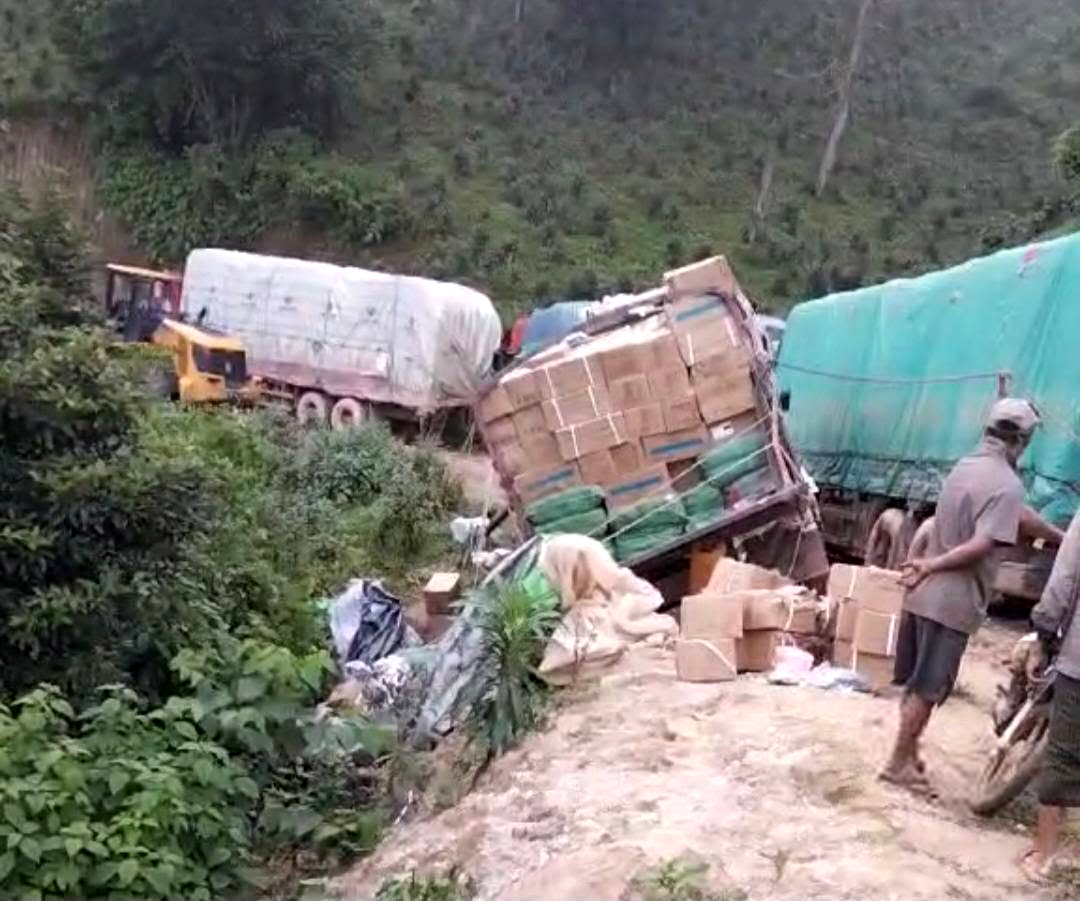
The report also describes the difficulties of transporting goods along unpaved roads. Trucks frequently become stuck in the mud and require bulldozers or other heavy machinery to pull them out. The cost of recovering a stranded truck can reportedly reach approximately 5 million kyats.
These transportation expenses effectively add around 10,000 kyats to the cost of every kilogram of goods imported from China. Consequently, consumers in Myanmar must pay prices several times higher than the original border purchase prices for everyday products, including household necessities, medicines, clothing, and electrical appliances.
Over the past six months to a year, the seizure of imported goods from neighboring China and Thailand, together with increasingly restrictive import licensing requirements, has driven up the prices of essential consumer products.
Food, soap, toothpaste, medicine, and other daily necessities have become extraordinarily expensive.
For example, the price of one viss (approximately 1.63 kilograms) of palm oil has exceeded 20,000 kyats, more than doubling or even tripling compared with the previous year. Even a simple kitchen sponge used for washing dishes and pots can cost as much as 10,000 kyats.
Such prices are astonishing and deeply alarming, particularly for low-income households struggling to meet their basic needs.
Information received in recent months also indicates that transporting one ton of Thai goods without import permits or customs clearance from Myawaddy to Yangon costs approximately 14 million kyats.
Myanmar’s domestic manufacturing sector faces equally serious challenges.
Electricity supplies remain unreliable, while manufacturers encounter numerous obstacles in importing raw materials. In some cases, purchasing finished consumer products from abroad is considerably cheaper than manufacturing them domestically.
Under these circumstances, the military government’s policy of promoting domestic self-sufficiency through local production has become largely ineffective.
Following the outbreak of the Iran–United States war, the military government imposed restrictions on fuel imports. These restrictions, combined with the depreciation of the Myanmar kyat, have significantly increased transportation and travel expenses.
At a time when earning 40,000 to 50,000 kyats for a full day’s work is difficult for many people, taxi fares within Yangon have risen to between 20,000 and 30,000 kyats, sometimes reaching 40,000 or 50,000 kyats.
If prices are already this high in major cities such as Yangon and Mandalay, where goods can still be traded relatively freely, the situation in conflict-affected and blockaded regions must be considerably worse.
Residents of Kachin, Chin, Shan, Sagaing, and Rakhine face additional costs resulting from checkpoint fees, transportation restrictions, and various taxes imposed along supply routes.
In Myitkyina, for example, a bag of rice costs significantly more than in Yangon or Mandalay. For people living in blockaded areas of Rakhine State, the prices of rice, fuel, and medicine are likely to be even more burdensome.
The economic hardship experienced by these communities can be understood simply by considering the cumulative costs of transporting essential goods through conflict zones.
An examination of the factors behind Myanmar’s extraordinarily high commodity prices reveals three principal causes.
First, the military government’s misguided import and economic policies have disrupted trade and restricted the availability of essential goods.
Second, armed organizations collect taxes and fees on the transportation and importation of goods to finance their military operations.
Third, insecurity and unpredictable regulations create substantial financial risks for traders, forcing them to add significant profit margins to compensate for potential losses.
Together, these factors have created a system in which the financial burden of the civil war is increasingly transferred to ordinary consumers.
Myanmar’s military government requires both domestic currency and foreign exchange to finance its military operations.
To obtain Myanmar kyats, it relies on taxes collected in major cities, revenue from trade and commercial activities, and the printing of additional currency.
To acquire foreign currency for purchasing weapons and military equipment, it draws on several sources.
These include foreign exchange earned through the sale of natural resources, revenue obtained through compulsory currency conversion requirements imposed on exporters at exchange rates below prevailing market rates, and income generated from taxes and remittances associated with Myanmar citizens working abroad.
These represent revenue streams connected to the formal economy.
However, money also flows to armed organizations and authorities through illegal and criminal activities, including narcotics trafficking and online scam operations.
No one has reliable figures showing the total amount of money generated by these illicit businesses or how much ultimately reaches armed groups and powerful authorities.
On the other side of the conflict, ethnic armed organizations, the National Unity Government’s People’s Defence Forces (NUG/PDF), and locally organized resistance forces known as Local People’s Defence Forces (LPDFs) also depend on revenue to finance their military operations.
Much of this funding comes from taxes on natural resource extraction and commercial trade.
Some armed organizations also reportedly generate income by protecting online scam operations or taxing narcotics production and trafficking.
As armed organizations on different sides of the conflict increasingly depend on natural resource revenues, trade taxes, and other forms of taxation to finance the war, the amount ultimately paid by ordinary citizens continues to rise year after year.
The consequences for Myanmar’s population are devastating.
Millions of people have been forced to abandon their homes, villages, and towns because of armed conflict. Many have spent years displaced, seeking safety in communities away from active fighting.
Meanwhile, even in towns and villages where armed clashes have not yet occurred, livelihoods are gradually deteriorating.
Employment opportunities are shrinking, businesses are struggling, and household incomes are becoming increasingly insecure.
At the same time, people must endure relentless increases in the prices of food, medicine, transportation, and other basic necessities.
The civil war has therefore created a double burden: the destruction of livelihoods and the rising cost of survival.
If the current civil war continues for another three to five years, a deeply troubling question arises: How will ordinary people in Myanmar manage to survive?
Looking ahead, the prospects are increasingly bleak.
Continued fighting threatens to accelerate the depletion and destruction of natural resources and the environment, while further undermining the livelihoods on which communities depend.
For millions of people already struggling to survive, the continuation of the war may mean even fewer economic opportunities, greater hardship, and a further deterioration in living conditions.
The longer the conflict continues, the more difficult it will become for Myanmar’s population to sustain their lives and rebuild their future.