
Myanmar Spring Chronicle – Scenes from October 8
(MoeMaKa), October 9, 2026
Myanmar Military Leader’s Visit to Malaysia and Diplomatic Shifts: Clues to a Changing U.S. Policy Toward Myanmar
Among the news reports on October 8, two major developments concerning diplomatic engagement by foreign governments with Myanmar’s military leadership surprised the Myanmar public and news audiences.
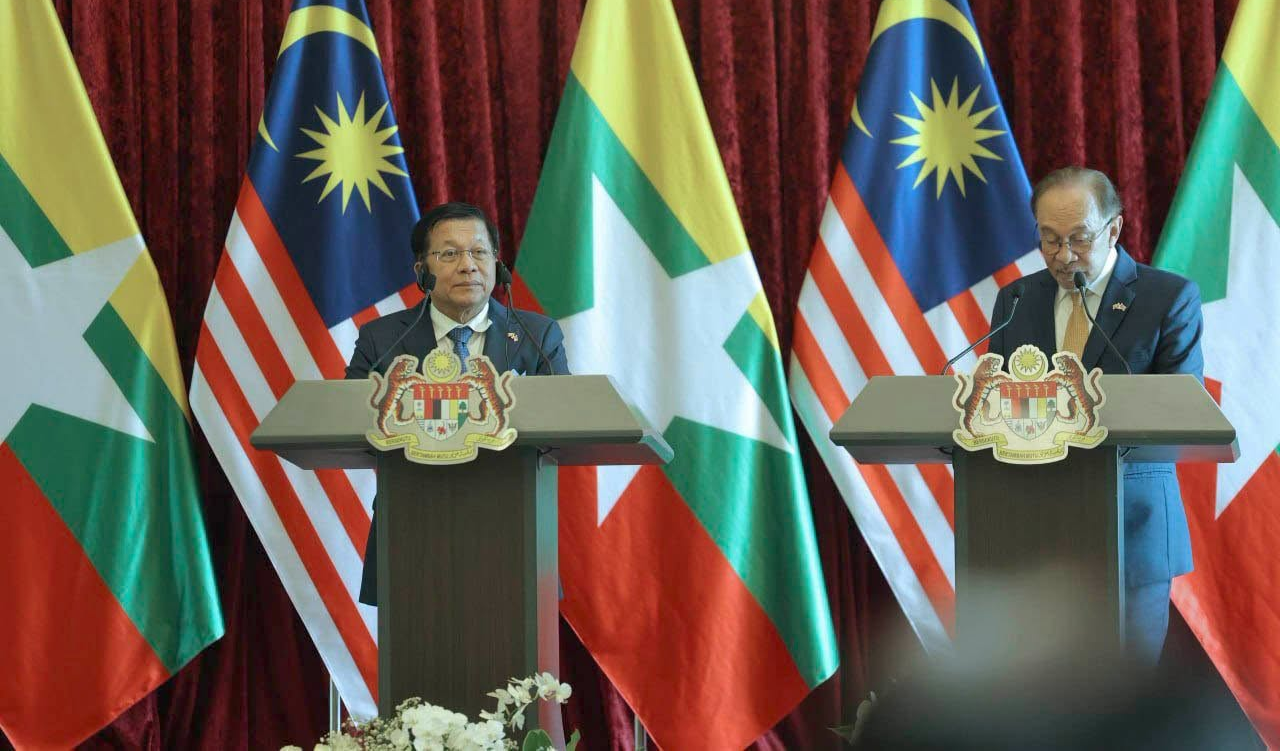
The first involved Myanmar military leader Min Aung Hlaing’s visit to Malaysia at the invitation of Malaysian Prime Minister Anwar Ibrahim. During the two-day visit on October 7 and 8, the Malaysian prime minister made remarks that appeared unusually favorable and supportive toward Myanmar’s military government, surprising many people in Myanmar.
Since the military coup in 2021, the Association of Southeast Asian Nations (ASEAN) has imposed restrictions preventing Min Aung Hlaing and other political representatives of Myanmar’s military government from personally attending ASEAN summits.
Influential ASEAN members, including Indonesia, Singapore, Malaysia, the Philippines, and Thailand, had agreed that political representatives of Myanmar’s military government should not be allowed to participate in ASEAN leaders’ meetings until the junta implemented the ASEAN Five-Point Consensus.
Although that agreement technically remains in place, influential ASEAN member states have increasingly begun inviting Myanmar’s military leader, who assumed the presidency following an election, on official bilateral visits.
Laos and Cambodia were among the first ASEAN countries to extend such invitations. They were subsequently followed by Thailand and, most recently, Malaysia. These developments suggest that ASEAN’s broader approach toward Myanmar’s military leadership may also be moving toward a change.
Malaysia had been among the three or four ASEAN countries that consistently exerted diplomatic pressure on Myanmar’s military government over the past five years. However, the statements made by Malaysian officials during the military leader’s latest official visit differed markedly from their positions during the five years following the coup.
Before and even after the elections held toward the end of last year, Malaysia had maintained that elections were not the central issue in resolving Myanmar’s political crisis. Instead, it emphasized the need to address violence and armed conflict.
However, after the military-backed Union Solidarity and Development Party (USDP)-dominated parliament selected and confirmed a president and cabinet in April, establishing what was presented as an elected government, Myanmar’s military leader began receiving official invitations from neighboring countries.
India and China extended invitations first, followed by a succession of ASEAN member states.
Thailand’s official reception of Myanmar’s military leader in early August was particularly significant. Unlike his earlier visit to Laos, the visit to Thailand appeared to have broader implications for other ASEAN members.
Following the Thailand visit, Min Aung Hlaing traveled to Vietnam, Cambodia, and other countries. Then, in early October, Malaysia—previously one of the most outspoken critics of Myanmar’s military government—extended an official invitation.
Malaysia not only received Min Aung Hlaing as an official guest but also made striking statements at a press conference near the end of his visit.
The Malaysian prime minister expressed recognition of the efforts made by Min Aung Hlaing’s government and stated that Malaysia would work toward restoring Myanmar’s full engagement with ASEAN.
These remarks came as a surprise to those advocating for democracy in Myanmar.
During discussions with Myanmar’s military leader, the Malaysian prime minister placed the repatriation of Myanmar nationals residing illegally in Malaysia at the top of the agenda.
Cooperation on transnational crime and economic relations also featured in the discussions, but these matters appeared to be of secondary importance compared with the repatriation issue.
For the Malaysian prime minister, resolving the issue of Myanmar refugees and undocumented migrants in Malaysia also carries domestic political significance. By demonstrating that he can address a problem facing his country, he may hope to gain greater public support.
From Malaysia’s perspective, undocumented migration presents genuine challenges. Some Myanmar nationals enter Malaysia illegally, while others initially enter legally but remain after their visas expire. There are also cases involving criminal offenses committed by some Myanmar nationals.
These issues are understandably regarded as problems and burdens by Malaysian authorities.
Moreover, refusing to engage with Myanmar’s military government because of questions surrounding its legitimacy would leave Malaysia responsible for tens of thousands of detainees in immigration detention facilities.
Even if the authorities do not provide adequate food, healthcare, or other services, maintaining such detention facilities still represents a substantial financial and administrative burden.
The Malaysian prime minister appears to have recognized the practical reality that resolving these problems requires direct communication with the military government led by Min Aung Hlaing, despite its lack of broad public support in Myanmar.
That government continues to conduct airstrikes during the civil war and has been accused of forcibly recruiting returning nationals into military service.
Nevertheless, Malaysia appears to have concluded that engagement with the authorities exercising power in Myanmar is necessary to address the migration issue.
Although the Rohingya refugee issue has not been directly addressed, Malaysia had already begun engaging with Myanmar’s military authorities before this visit to seek solutions concerning non-Rohingya Myanmar nationals.
As part of these discussions, Malaysia secured a commitment from Myanmar to accept the return of 5,000 nationals.
In recent weeks, Myanmar naval vessels transported 1,476 Myanmar nationals back from Malaysia. The Malaysian prime minister praised the repatriation operation, describing it positively as an example of a country taking responsibility for bringing its nationals home.
According to official figures, more than 160,000 Myanmar nationals are registered in Malaysia. However, the number of undocumented Myanmar migrants entering across the border from Thailand remains unknown.
In summary, Malaysia may continue its contacts with the National Unity Government (NUG) and other ethnic armed organizations involved in Myanmar’s resistance movement.
Nevertheless, the latest developments suggest that Malaysia has effectively begun treating Min Aung Hlaing’s administration as Myanmar’s de facto government.
While news of this significant shift in relations between Malaysia and Myanmar’s military government emerged on October 8, another surprising report appeared.
Reuters reported that a senior official from U.S. President Donald Trump’s administration had visited Naypyidaw the previous month and met with Myanmar military authorities.
The visit marked the first reported engagement of this kind between a senior U.S. government official and Myanmar’s military leadership in more than five years since the 2021 coup.
On September 15, a small U.S. government aircraft arrived at Naypyidaw Airport from Bangkok and departed the following evening.
The aircraft was of a type commonly used by American diplomats and senior government officials.
Its arrival in Naypyidaw immediately prompted speculation about what might be taking place behind the scenes.
However, on the day the aircraft departed, news emerged that Adam Castillejo, a U.S. citizen and former president of the American Chamber of Commerce in Myanmar, had been released and deported.
Castillejo had been arrested at Yangon International Airport in June while returning to Myanmar from abroad.
His release appeared to provide an explanation for the mysterious visit by the U.S. government aircraft.
About a month later, however, Reuters published a report based on information confirmed by at least three or four anonymous sources, revealing that a U.S. assistant secretary of state had met with officials from Myanmar’s military government.
The visit was reportedly not limited to securing the release of a detained American citizen.
According to anonymous sources cited by Reuters, Michael Vance, the U.S. assistant secretary of state responsible for intelligence and research, also discussed efforts to combat online scam operations and issues relating to rare-earth mineral deposits during his visit to Naypyidaw.
These revelations suggest a possible shift in the Trump administration’s Myanmar policy, moving away from diplomatic isolation toward direct engagement with Myanmar’s military leadership.
When the Myanmar military staged its coup in 2021, Joe Biden had only recently assumed the U.S. presidency.
Throughout Biden’s four-year administration, there was no comparable high-level engagement with Myanmar’s military government.
Now, nearly two years into Trump’s presidency, such engagement has reportedly begun to emerge.
Adam Castillejo, who was arrested at Yangon Airport in June, has been described in news reports as a strong supporter of Trump’s Make America Great Again (MAGA) movement.
Reports have also identified him as an intermediary involved in efforts by Myanmar’s military government to hire lobbyists in the United States.
His connections with individuals associated with the Trump administration and the MAGA movement raise several questions.
Did the U.S. government begin engaging with Myanmar’s military leadership while attempting to secure the release of a politically connected American citizen?
How far might this diplomatic channel develop?
And what broader direction could U.S.–Myanmar relations take as a result?
These are questions that Myanmar’s pro-democracy activists are eager to understand.
For decades, Republican Senator Mitch McConnell had been one of the most prominent supporters of Myanmar’s democracy movement in the U.S. Senate.
However, as McConnell has become less politically active because of health concerns, questions have emerged about whether Washington will increasingly prioritize American national interests while paying less attention to other considerations in its Myanmar policy.
The Trump administration’s foreign policy has often been unpredictable, with dramatic reversals and changes in direction.
Against this background, there is a possibility that Washington’s approach toward Myanmar could place American strategic and economic interests above the restoration of democracy or the imposition of sanctions on those responsible for serious human rights violations.
Under such an approach, American interests could become the first, second, and third priorities in dealings with Myanmar’s military government.
The statements emerging from Myanmar’s military leader’s visit to Malaysia, together with reports of a senior U.S. official’s discussions with military authorities in Naypyidaw, have therefore generated considerable concern and debate.
For supporters of Myanmar’s Spring Revolution, the struggle against military dictatorship, and the movement for democracy, these developments may not yet amount to an earthquake that fundamentally transforms the political landscape.
Nevertheless, they represent a significant diplomatic tremor whose consequences could be far-reaching.