The Right to Speak About Our Union in Ethnic Languages (1)
Maung Yit (MoeMaKa) September 19, 2026
MoeMaKa Media has long carried the banner of “Burmese literature, Burmese culture, and Burmese arts.” Since its founding in 2003, we have operated in the Burmese language from abroad—in a country like the United States—for more than two decades. Our primary audience has always been people inside Myanmar. Since our focus has been on people in Myanmar and along its border regions, one could say that we have paid less attention to the reading and speaking habits of Burmese communities overseas.
At the same time, we have valued and published the writings and voices of Burmese writers and artists living in exile. We have also given serious attention to the words and writings of those abroad who work and campaign on issues concerning Myanmar, and we have collaborated with them. One could justify our focus by saying that Myanmar’s struggles ultimately concern what is happening inside Myanmar, and therefore concentrating on audiences there is understandable.
MoeMaKa has also occasionally presented Myanmar affairs and Burmese literature in English. But this has never been a major focus of our work. We have done it whenever circumstances and opportunities allowed. We must admit that we have not paid enough attention to younger generations of Burmese who can no longer read Burmese. Our attention has remained primarily on Myanmar and its people.
Perhaps we had simply resigned ourselves to the fact that we lacked both the resources and expertise to teach Burmese abroad or to communicate Myanmar affairs effectively in English.
MoeMaKa is also different from many other Burmese media organizations operating overseas in that it does not quite fit the conventional Western model. We simply do what we are capable of doing. We do not fall neatly into the category of media initiatives for “vulnerable minority communities” that Western institutions often support. Instead, we have survived independently through volunteers and supporters. Nor can we really be counted among Myanmar-focused media organizations that operate primarily within English-speaking and English-reading circles.
When we returned to Myanmar in 2013 and began publishing books there, we discovered that MoeMaKa already had a recognizable audience. We were also able to meet and introduce ourselves in person to journalists and writers who had contributed articles and reports to MoeMaKa while we were operating abroad.
What made us especially happy and proud was discovering that MoeMaKa’s use of Burmese—its contemporary literary language, its ways of expressing experiences, emotions and art—felt natural to readers inside Myanmar.
Although our publication was produced abroad, it did not sound awkward or foreign to readers back home, like someone unnaturally saying, “I would like to drink a glass of cold water.” That realization was a relief.
This was possible because throughout MoeMaKa’s existence we had consciously tried not to become disconnected from people inside Myanmar and along the border regions. We worked to remain connected to their feelings, ideas, ways of life and intellectual atmosphere.
Here, I must thank the editors, reporters and writers who prefer to remain unnamed and who helped sustain us. I also want once again to publicly thank my senior editor, Ko Khin Lun. Those interested in knowing more about the people to whom we owe our gratitude can find a year-by-year record of contributors on MoeMaKa’s website. I thank every one of them.
We Had Never Broadcast in an Ethnic Language
Until then, MoeMaKa had never produced content in any of Myanmar’s ethnic languages. And, to be truthful, we had never felt particularly troubled by that.
Many ethnic writers and journalists contributed to us in Burmese, so we assumed that Burmese, as a common language, could also be used to present and reflect the experiences and concerns of ethnic communities.
There was another practical reason: we ourselves did not speak any ethnic language. Producing programs in ethnic languages therefore seemed like an entirely separate undertaking—a responsibility beyond our abilities.
But eventually, a day came when we had the opportunity to work in media using ethnic languages.
That opportunity came with the emergence of the Spring Revolution following the February 2021 military coup.
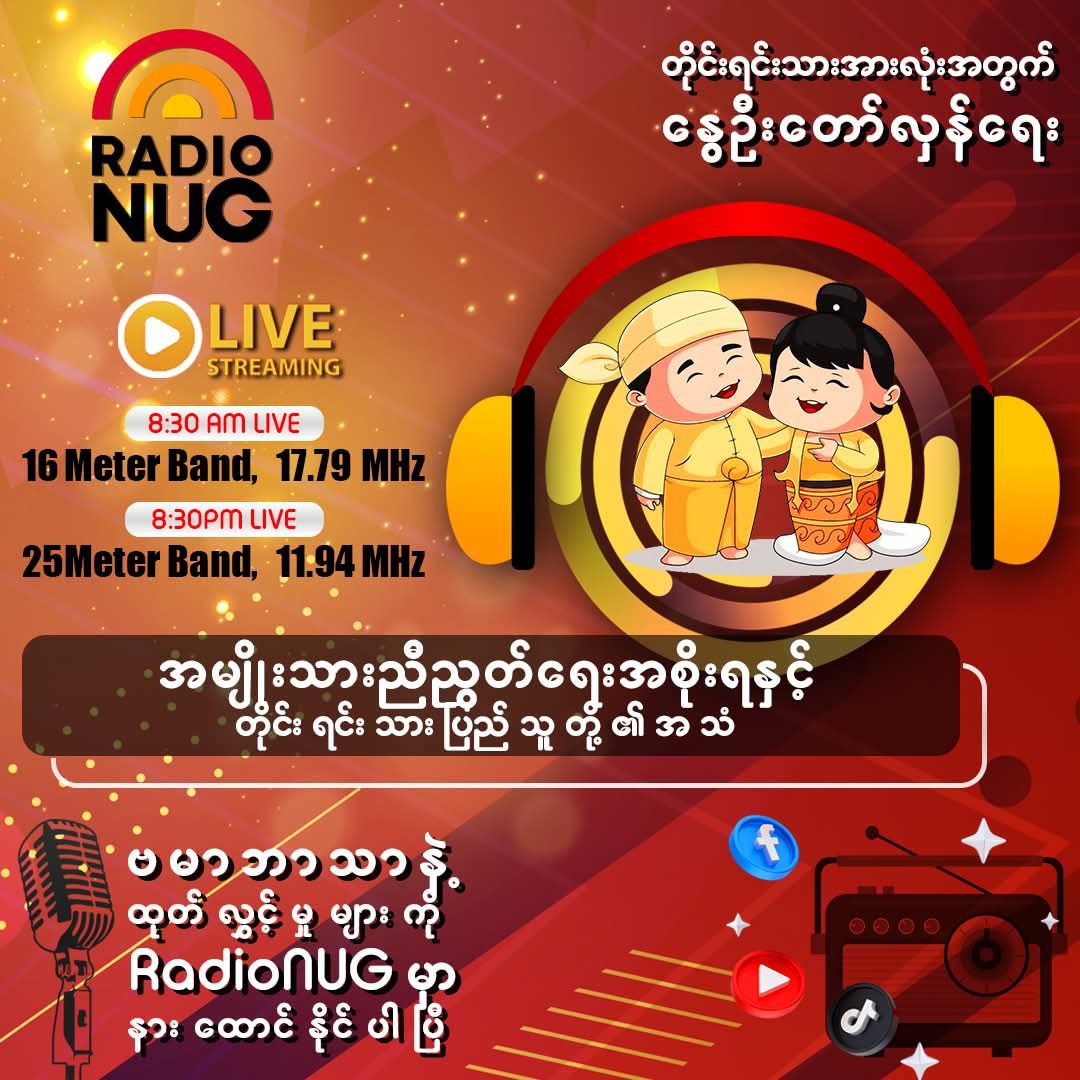
After the CRPH and NUG emerged as leading institutions of the Spring Revolution, an experimental broadcasting service called Radio NUG was established in August 2021 as one of their information and revolutionary communication platforms.
We became involved in that effort.
Our original background was in literature and journalism, whereas Radio NUG was an audiovisual broadcasting operation. We were hardly experts in that field.
There, however, we had the opportunity to work alongside members of Generation Z as well as CDM colleagues who had worked at Myanmar’s state broadcasting institutions.
Our role was to collect and prepare news and current-affairs material, while the CDM media professionals produced the broadcast programs.
Many experienced information and broadcasting personnel who had joined the Civil Disobedience Movement came together under what was then the Ministry of Communications, Information and Technology (MoCIT), which has since been dissolved. Through Radio NUG, they produced not only radio broadcasts but also video programming, maintaining broadcasts day after day.
A Revolution Across the Entire Union
We gradually came to understand that the Spring Revolution was not merely a revolution of central Myanmar. It was a revolution involving the entire Union.
Once people agreed that armed resistance against the military was necessary, the revolution increasingly took shape as a collective struggle spanning villages, forests, plains and ethnic regions throughout the country.
Burmese-speaking and Burmese-reading revolutionaries from central Myanmar established bases in ethnic regions, received training there, acquired weapons and joined the resistance.
Across those regions, various ethnic armed organizations welcomed people from many different backgrounds, working alongside them and providing support.
It therefore became increasingly obvious that platforms such as PVTV and Radio NUG—widely perceived by the public as the media arms of the CRPH and NUG—needed to broadcast news in ethnic languages as well.
It was important for information about the revolution and events on the ground to reach ethnic communities without linguistic barriers and to build mutual understanding.
We also realized that satellite television and shortwave radio could reach people living in forests, mountains, valleys and plains, overcoming many technological and communications barriers.
The CDM staff at Radio NUG poured their knowledge and professional experience into making this possible.
Radio NUG was also able to rebroadcast programs produced independently by local ethnic organizations in resistance-controlled areas. Weekly news programs produced by independent Cho Chin, Zomi Chin and Matupi Chin groups were rebroadcast throughout Radio NUG’s existence.
What “State Media” Meant to CDM Staff
The term “state media” was commonly used by CDM employees who had come from the former Ministry of Information.
They placed considerable importance on the concept of “government.” They were proud of having served as government employees.
For independent media workers like us, this was an unusual and illuminating encounter.
Those of us who identified ourselves as independent journalists and writers encountered CDM civil servants who felt loyalty toward a country—and, if you prefer, a government—that they believed should serve the people. That was an extraordinarily valuable experience.
This was particularly striking because many had served under the NLD government led by Daw Aung San Suu Kyi and then made a decisive choice to join the Civil Disobedience Movement during the Spring Revolution.
What we witnessed was their loyalty, courage, sacrifice, willingness to take risks and steadfast commitment.
When Radio NUG was broadcasting, people listened carefully on shortwave. They also supported the internet broadcasts.
In remote rural areas, villagers, farmers and members of ethnic communities listened on small radios.
In Chin State, for example, we broadcast in several Chin languages, including Cho Chin varieties, Zomi and Matupi. Some Chin listeners made considerable efforts to tune in. They listened both to programs in Chin languages and to the Burmese-language broadcasts.
We once heard of people recording a radio broadcast and then carrying a loudspeaker around their village to replay it for everyone.
In Karen State, we heard that young PDF members in areas without reliable internet or mobile-phone service listened to Radio NUG through shortwave radios.
We frequently received stories like these.
Those of us who were “outsiders” might not have become overwhelmingly emotional about them. But the CDM staff were deeply encouraged and delighted whenever they heard such stories.
Why?
Because they were public servants.
They took pride in serving the public and regarded that service as something meaningful.
Working From Inside Myanmar and the Borderlands
One point I want to emphasize is that the CDM colleagues working with us were not simply people who had left Myanmar and settled abroad.
They remained inside Myanmar and in border areas, holding on under difficult circumstances while continuing their information work.
Because many were living in hiding or constantly moving, they were scattered across cities, villages, forests and mountains. Some had crossed borders, but even there they lived quietly, discreetly and often secretly.
The ethnic CDM staff who produced broadcasts in their own languages consistently took responsibility for ethnic-language news programs. That was something that brought us tremendous satisfaction.
Among our CDM colleagues, we were able to broadcast in three Karen languages as well as Kachin, Rakhine and Karenni.
They worked with remarkable discipline. Week after week, they produced their programs without interruption.
There was very little drama among the people doing this media work.
They dealt with their exhaustion and anxieties by joking and laughing with one another.
Sometimes they had to record inside bathrooms. Sometimes they read scripts underneath blankets. During news recordings, you could hear roosters crowing behind them, along with cows and pigs.
At other times, fighter jets roared overhead while CDM workers continued trying to complete their assignments.
We wanted to add programs in Wa, Kokang and Palaung languages, so people began searching among their networks for speakers.
Eventually, we found a CDM colleague who could read the news in Wa.
What Government and Public Service Can Mean
Through these experiences, I came to understand something else about the meaning of government.
Sometimes a government must undertake work that may not necessarily be popular with the majority but is nevertheless necessary for the country as a whole. Such work sometimes has to be deliberately created, sustained and institutionalized through the authority of government.
Likewise, civil servants sometimes have to carry out work that may not be popular but can benefit the public.
Ethnic-language broadcasting was one such area.
Call it propaganda if you wish. Criticize it as indoctrination if you wish. But paying attention to ethnic communities and promoting the development of their regions must occupy a central place in national policy.
Government institutions possess the financial resources, personnel and authority needed to turn such policies into reality.
Civil servants, meanwhile, can devote themselves to serving the public with commitment and conviction.
Healthcare workers and educators are obvious examples. They travel even to remote areas to serve communities.
But beyond health and education, we came to understand more deeply the foundational role played by public servants across many different fields.
When these employees joined the CDM, both the country and its governing institutions suffered an enormous loss of professional capacity.
The fact that CDM participants have nevertheless continued serving the revolution represents an extraordinary sacrifice. I very much want readers to understand and appreciate the value of what they have given.
How the Wa-Language Program Began
Returning to the story: Who ordered the creation of a Wa-language information program?
We were told that it came from the encouragement of a former military officer who had become a member of parliament.
Apparently, the information authorities had been instructed to produce programs in the ethnic languages spoken in areas where the military had established ceasefires.
That was how a Wa-language program came into existence.
Wa ethnic staff were recruited.
And later, some of those employees became CDM participants.
What I want to say is that ethnic peoples share the same human feelings and aspirations as we Burmese do—the same capacity for empathy, the same desire for freedom and justice.
Whether they are powerful ethnic leaders with armed forces or Myanmar military rulers, those who possess power, influence and weapons will always be tempted to use language and culture to shape and control people in pursuit of their own interests.
That is precisely why we, too, must recognize the importance of communicating truth not only in Burmese, but through the languages of Myanmar’s ethnic peoples themselves.
And so Radio NUG, like everything else, had its sunrise.
Eventually, its sunset came as well.
(To be continued)