
Myanmar Spring Chronicle – Scenes from September 22
(MoeMaKa), September 22, 2026
Misguided Economic Policies During Civil War and the Growing Burden on Myanmar’s People
Myanmar, where the flames of civil war have never been fully extinguished for more than 70 years, has since 2021 descended from a simmering conflict into a full-scale civil war engulfing nearly the entire country. Amid this conflict, the military that seized power has pursued misguided economic policies that have driven the country’s economy even further downward.
In recent months, developments reported in the news have pointed to conditions not seen in Myanmar for the past two or three decades. Many of these are economic policy failures so obvious that even ordinary citizens can recognize them.
Given that the country is at war, it may be understandable that military expenditure takes priority over other spending. However, the military leadership has imposed policies of self-sufficiency and austerity that are poorly suited to current conditions, largely on the ideas and decisions of a single military leader. As a result, prices have become increasingly disconnected from people’s incomes, and growing numbers of citizens are struggling simply to put food on the table.
Across Myanmar, people are facing extraordinary hardship. The situation could arguably be described as among the worst the country has experienced since independence. Moreover, the consequences of these policy failures are not confined to areas under the control of the military authorities. They are also affecting territories controlled by armed resistance forces, where people likewise face severe economic hardship.
Rakhine State provides a striking example. Although roughly 90 percent of the state has been under the administration of the ULA/AA for more than two years, the economic consequences of the broader conflict have crossed territorial boundaries and continue to affect these areas.
Since fighting resumed between the ULA/AA and the military authorities in November 2023, food, medicines, fuel and consumer goods have been allowed into Rakhine only in limited quantities and with authorization for three military-controlled townships. Residents of the remaining 14 townships have consequently been forced to pay exorbitant prices because of these restrictions.
At the same time, agricultural produce and other goods produced in Rakhine cannot be exported to central Myanmar and must largely be traded within the state. This has sharply reduced incomes and employment opportunities, leaving residents to cope with extreme poverty and hardship.
In many Rakhine townships, the number of people begging for food has reportedly risen to unprecedented levels. For the ULA/AA, which exercises military and administrative control over 14 townships, the only significant route for external trade is across the Indian border through Mizoram State. Rather than serving primarily as a market for Rakhine’s exports, however, this route is mainly used to obtain essential goods needed inside Rakhine.
While simultaneously engaged in armed conflict, the ULA/AA has little capacity to make Rakhine’s economy self-sufficient or prosperous. The population remains exposed to the effects of the military authorities’ economic policies, inflation and trade restrictions. Under such circumstances, residents have been unable to experience meaningful economic benefits from living outside the military’s direct control.
Although conditions elsewhere have not become as severe as in Rakhine State, territories controlled by other armed resistance groups are also suffering from soaring prices, inflation and shortages of essential goods.
Regions such as Sagaing and Magway, as well as Kachin State, northern Shan State and Mandalay Region, have limited access to convenient cross-border trade. People there are therefore enduring high prices and shortages alongside the direct consequences of war. Although the military authorities have not imposed the same comprehensive restrictions seen in Rakhine, they have restricted crucial commodities such as medicines and fuel from reaching some of these areas.
In areas commonly referred to as the country’s heartland—including Yangon, Mandalay, Ayeyarwady, Magway and Bago—goods imported across the borders are also being confiscated or seized, while traders are reportedly required to pay exorbitant bribes before shipments are allowed to proceed. Consequently, imported products in major cities such as Yangon, Mandalay and Naypyidaw have reached prices rarely, if ever, seen before.
For example, a washing machine that can reportedly be purchased in neighboring Thailand for the equivalent of about 500,000 to 600,000 kyats may sell in Myanmar for two to three million kyats. Similarly, refrigerators that might cost two to three million kyats in Thailand are reportedly selling for more than 10 million kyats in Myanmar.
These are not merely luxury products. They are goods needed in everyday life. When essential consumer products—and even medicines vital to survival—must be purchased at extraordinarily inflated prices while employment opportunities disappear and household incomes decline, ordinary people are being squeezed from both directions.
Beginning roughly two years ago, the authorities established a steering committee to combat illegal trade, headed by the military’s deputy commander-in-chief. The committee began seizing a wide variety of consumer products and other goods entering the country through border areas.
Following a reshuffle of senior positions earlier this year, Deputy Commander-in-Chief Soe Win became chairman of the Union Government Advisory Committee. Nevertheless, seizures of goods imported through border areas appear to have become even more aggressive.
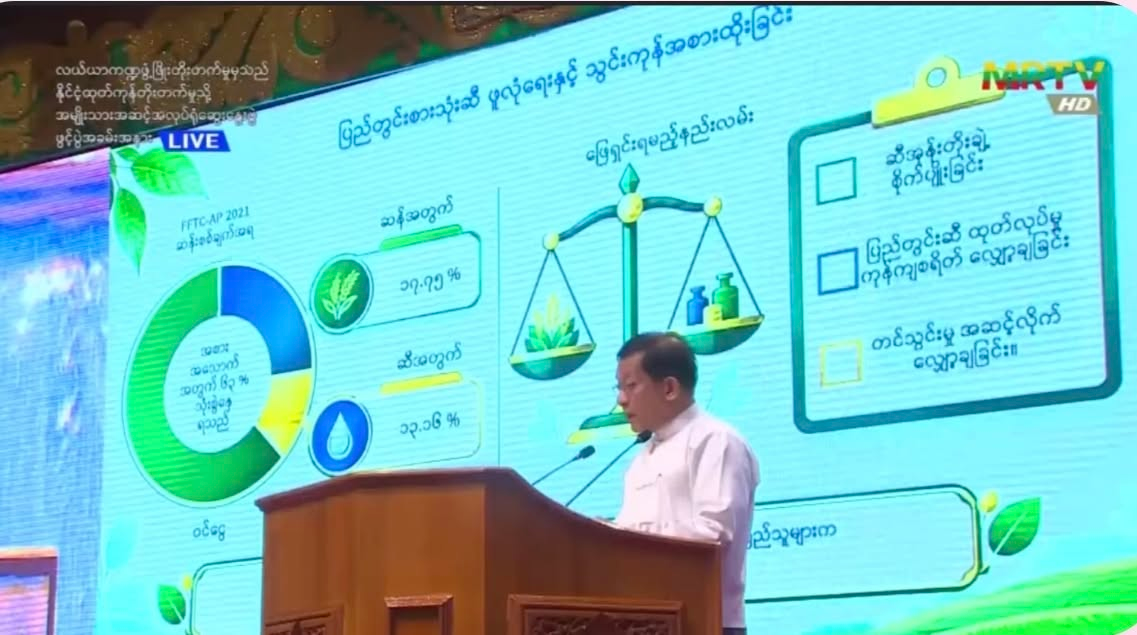
At an agricultural-sector workshop held yesterday in Naypyidaw, military leader Min Aung Hlaing delivered a speech lasting about an hour. He spoke about developing value chains, Myanmar’s abundance of natural resources and the need for the country to pursue self-sufficiency. Much of what he said, however, amounted to prescriptions that, in the author’s view, do not conform even to basic economic principles.
He also repeated familiar arguments, including the claim that Myanmar people consume too much cooking oil. According to news reports, he said that annual expenditure on fuel imports had fallen from about US$6 billion to roughly US$3 billion, presenting the decline as evidence that efforts to conserve fuel were succeeding.
In reality, however, restricting fuel consumption risks choking economic activity. Likewise, preventing the import of raw materials needed by domestic industries through border trade could further undermine production.
If such policies continue, Myanmar faces the prospect of an increasingly severe economic crisis—and potentially even widespread hunger—in the not-too-distant future.