
Myanmar Spring Chronicle – Scenes from August 31
(MoeMaKa), September 1, 2026
Fighting Between Shwegu and Bhamo, and the Transport of Monsoon Supplies and Military Equipment by River
News reports, citing a spokesperson for the Kachin Independence Army (KIA), say that KIA forces captured a military outpost near Zinbon village, a strategically important location close to Shwegu in Kachin State, in recent days.
After gaining control of the Mandalay–Mogok road corridor during 2025, the military that seized power has been attempting to expand its control over areas where Mandalay Region, Sagaing Region and Kachin State meet. At the same time, it has been reinforcing its troops and weapons and carrying out further attacks with the aim of prevailing in the battle for Bhamo, which has continued for more than a year and a half and is now approaching two years.
Following a ceasefire with the TNLA and the return of Mogok and Momeik to its control, the military attacked and seized positions, towns and villages held by MDY PDF forces along the Mandalay–Mogok road corridor and adjoining northern Shan areas during 2025. As a result, the military has reached a position where it may soon be able to use the Mandalay–Myitkyina highway as an uninterrupted transportation route.
At the same time, the military has been attempting to maintain control of towns along the route heading north from Mandalay along the Ayeyarwady River. It also appears to have the objective of fully regaining control of Bhamo, which lies along the Ayeyarwady River.
During the past several months, the KIA blocked some of the routes leading into Shwegu. Reports also emerged around June suggesting that an offensive to capture Shwegu might be launched. However, fighting did not break out in Shwegu itself. Instead, clashes have been taking place between Shwegu and Bhamo.
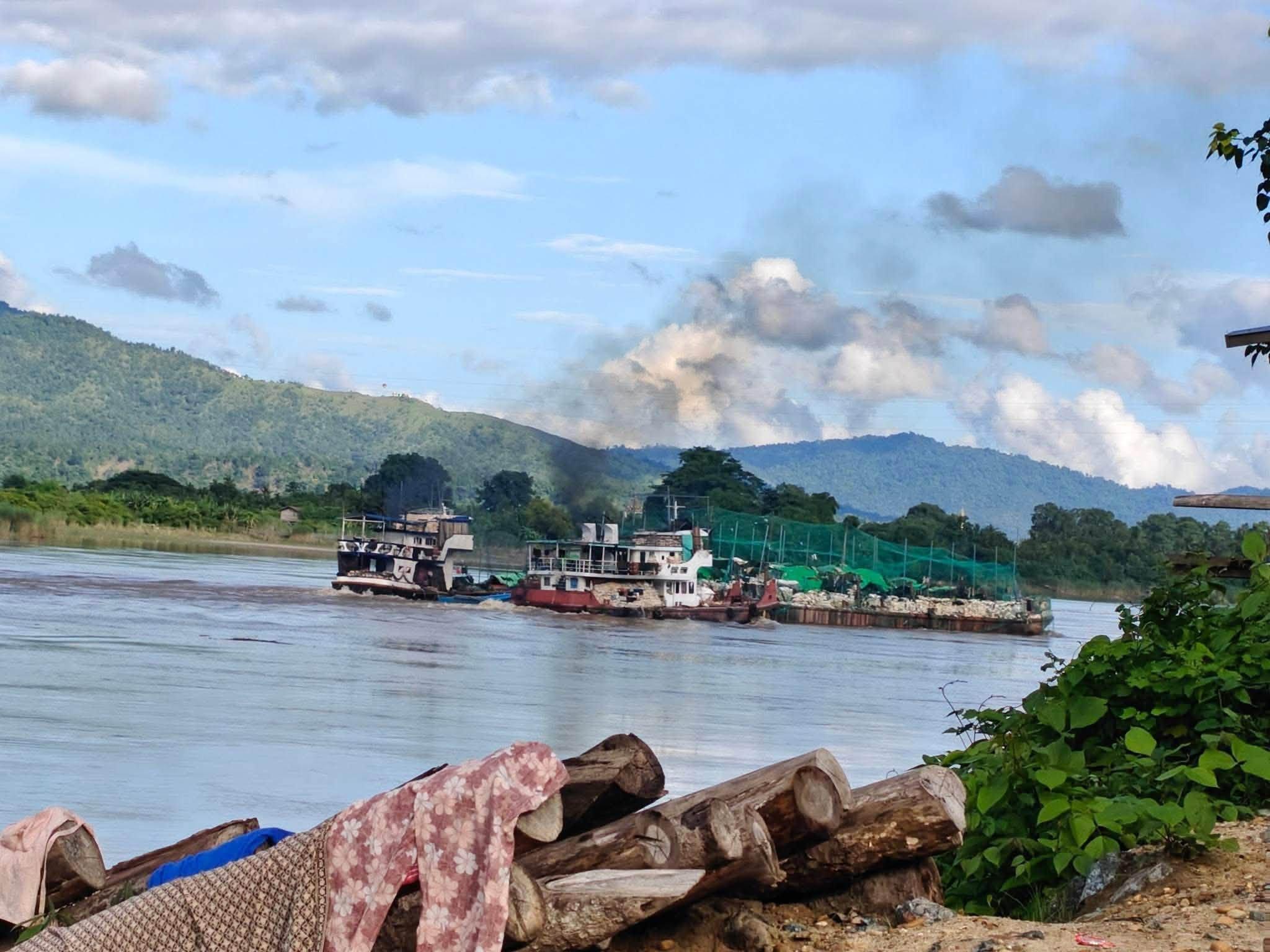
Every year during the monsoon season, when river levels are at their highest, the military typically loads weapons and supplies onto convoys consisting of dozens of vessels and sends them upriver under the protection of armed military boats. Supplies are transported from Mandalay and Monywa to areas of Sagaing Region farther north along the Chindwin River, while similar supply operations are also conducted along the Ayeyarwady River.
Last year, a convoy carrying supplies, weapons and personnel reached as far as Bhamo. This year, a similar convoy again traveled upriver. Between Shwegu and Bhamo, however, the convoy came under a joint attack by KIA and resistance forces. According to news reports, one of the vessels was damaged and could no longer continue upriver, after which it was captured by the KIA and allied forces.
Reports said First Person View (FPV) drones were used to attack the vessels. After one vessel was damaged and became unable to continue its journey, KIA and allied forces reportedly boarded and seized it.
At present, the major offensive and defensive fronts facing the military include the fighting against the Arakan Army (AA) and allied forces in Magway, Bago and Ayeyarwady regions bordering Rakhine State; the fronts against AA forces around Kyaukphyu and Sittwe inside Rakhine State; and the fighting around Myawaddy Township along the Karen State–Thailand border.
In other regions, military operations largely consist of columns numbering in the hundreds conducting offensives and efforts to continue defending territories already under military control.
When the military’s current battlefield situation is compared with that of 2024 and early 2025, there are signs that it has moved beyond one of the most difficult periods it had faced.
During 2024 and early 2025, the military was fighting across a very broad range of fronts. At the same time, the conscription law had only recently been activated, and the military had not yet been able to use conscription on a sufficient scale to replace the manpower it had lost. In this respect, it can be said that the military has now passed through what had been one of its worst periods.
There is also no longer a major active front in northern Shan State. Meanwhile, the military holds only three towns in Rakhine State and is defending territories bordering Rakhine. Against this background, it has been able to redirect its attention toward Kachin, Sagaing and the areas adjoining Kachin State and to launch renewed offensives there.
More than two years after activating the conscription law, the military has also become capable of training personnel in drone technology and deploying drones on a much wider scale. At the same time, it has increased the intensity of its air attacks compared with previous years. Under these circumstances, financial resources have increasingly become a critical requirement.
Because the military does not control border trade routes from end to end, and because it seeks to reduce foreign-currency expenditures, border trade has been placed under increasingly strict controls. Economic policies are also being forcibly adjusted in an effort to conserve foreign currency so that a larger proportion can be spent on weapons, ammunition and essential supplies for the air force, such as aviation fuel.
The military is therefore attempting to conserve as much foreign currency as possible for its war expenditures and is continuing these policies regardless of the negative consequences they may have for the domestic economy.
At the same time, armed resistance forces also have to find ways to meet the financial costs of the war. They have been seeking funding through various means, including collecting taxes on goods transported through territories under their control and raising revenue from rights related to the extraction of natural resources, among other methods, in order to finance their military expenditures.
By the second half of 2026, the areas experiencing particularly intense military activity included Kachin State; areas bordering Rakhine State; Kyaukphyu; the Myawaddy border area; and the Tamu–Kalay road corridor along the Chin State–Sagaing Region border, which connects the India–Myanmar frontier with Sagaing Region in central Myanmar.