Myanmar Spring Chronicle – Scenes from September 25
(MoeMaKa), September 26, 2026
Chinland Government Warns Against Links With Military-Run Schools
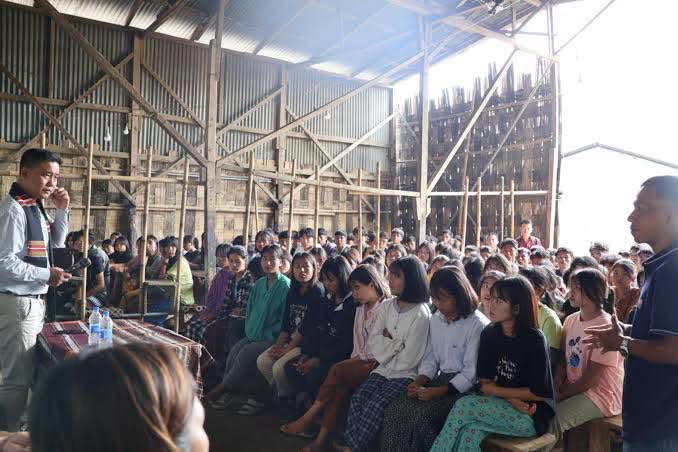
A news report says that the Ministry of Education under the Chinland Government, which was formed under the leadership of the Chin National Front (CNF), issued a statement dated September 24 warning that it would take serious action against those maintaining links with schools and offices under the military’s administration.
According to the statement issued by the Chinland Government’s Ministry of Education, schools operating in liberated areas controlled by Chin armed groups have been warned not to establish or maintain links with schools in military-controlled areas. The statement said that serious action would be taken if such contacts or cooperation were discovered.
In Chin State, the CNF has taken the lead in establishing the Chinland Government. At the same time, there is another alliance known as the Chin Brotherhood, comprising Chin revolutionary armed groups based in southern Chin State as well as some armed organizations in the north. According to an ISP-Myanmar report released in mid-2025, revolutionary armed forces under the Chinland Government controlled around 40 percent of Chin State’s territory.
What, then, is the political significance of the Chinland Government’s strict prohibition against schools in areas under its control maintaining links with schools administered by the military regime?
The Chinland Government’s statement does not clearly explain what is meant by contacts between civilian schools. For example, it is unclear whether the prohibition includes issues such as recognition of academic records. If a student attending a school in a liberated area transfers to a school in a military-controlled area, would documentation certifying the grade level the student has completed at one school be recognized by the other? The statement does not provide a clear answer.
Another question concerns how this announcement relates to directives issued by local administrative bodies in central Myanmar regarding students attending schools in military-controlled areas.
Earlier this year, around the beginning of the school year, a People’s Administration Team (Pa Ah Pha) in Sagaing Region reportedly issued a directive ordering parents whose children were attending schools in military-controlled areas to bring their children back.
As revolutionary armed organizations establish administrative systems in the territories they control, sectors such as education have increasingly come under those administrative structures. As a result, armed organizations have taken responsibility for assigning and managing tasks such as opening schools and recruiting education personnel.
When armed organizations take responsibility for civilian administration, however, there is an increasing tendency for decisions in areas such as education to be made from a political standpoint, including through orders and prohibitions. Similar to the recent announcement in Chin State, revolutionary groups in central Myanmar have also taken steps aimed at drawing a clear boundary between education systems in territories controlled by resistance forces and those controlled by the military.
There is little doubt that many members of the public support the revolutionary forces. Nevertheless, families often face circumstances in which it is simply impossible to draw a firm line between the two territories. Family circumstances, livelihoods, and other practical necessities require people to move between and maintain connections across both sides.
When it comes to education, revolutionary forces must also keep in mind that the right to education is a fundamental human right. It is equally important for them to understand the struggles of parents who are doing everything they can, with extremely limited resources, to ensure that their children receive an education amid the hardships of civil war and severe economic difficulties.
In dealing with educational matters, revolutionary forces should therefore be cautious about imposing rigid distinctions between “our side” and “the enemy’s side” in ways that are unlikely to win public support. Such measures risk placing additional burdens on the very communities that are already supporting and assisting the revolutionary movement.