
Myanmar Spring Chronicle – Scenes from September 26
(MoeMaKa), September 27, 2026
Bangkok Flooding, Capitalism, and the Global Consequences of Climate Change
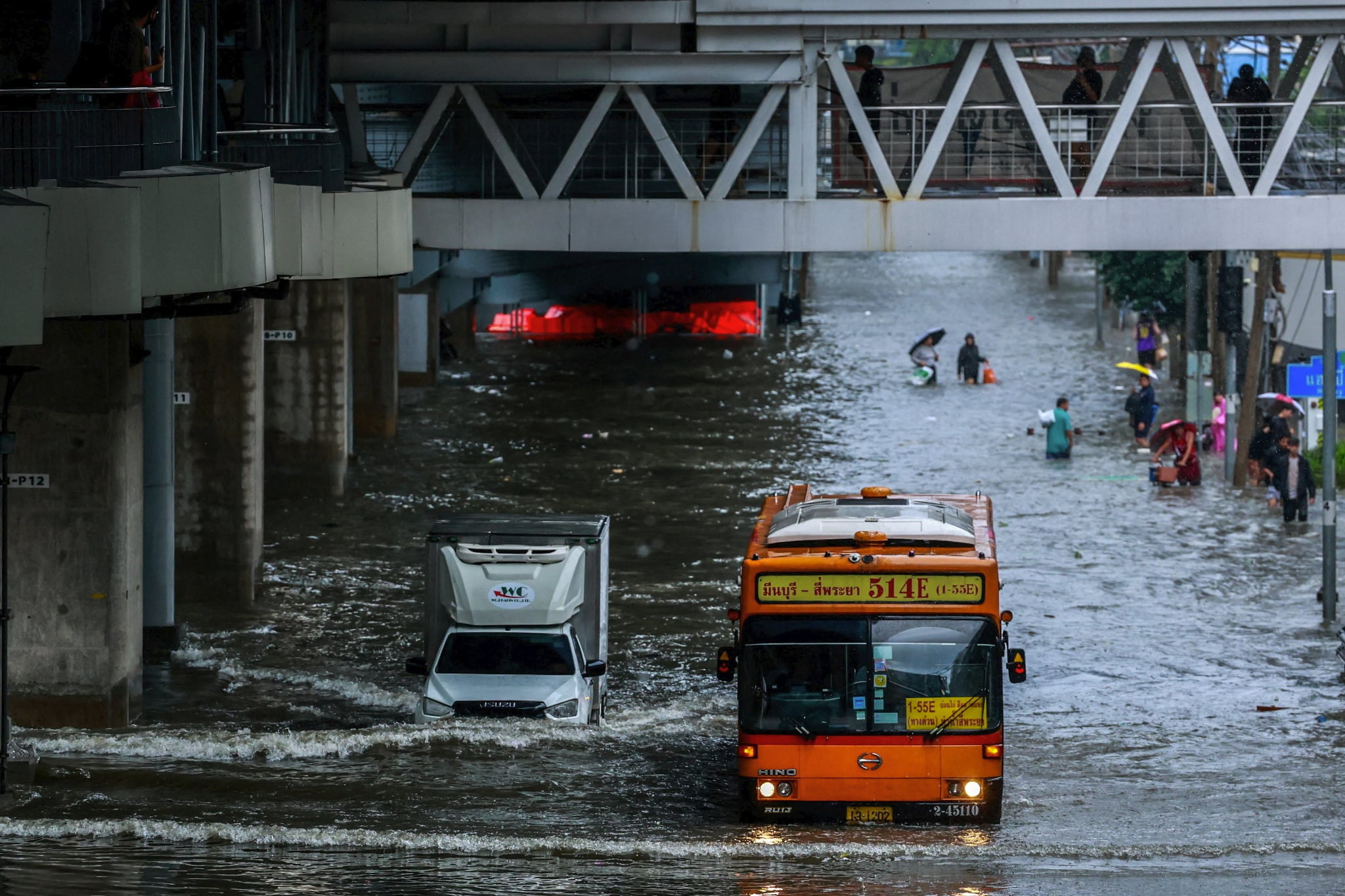
Over the past two days, Bangkok has experienced continuous heavy rainfall, flooding roads and sending water into homes and shops in low-lying areas. Public transportation, including trains and buses, has been unable to operate normally, affecting millions of people living in the Thai capital.
Bangkok lies close to the sea and is extremely low-lying. To cope with ordinary rainfall, the city has developed an extensive drainage system consisting of large drainage pipes, pumping stations, canals, and floodgates that discharge water toward the sea. As a result, even after more than an hour of heavy rain causes water to accumulate on paved roads, the flooding can often subside within roughly an hour to an hour and a half after the rain stops.
Located near the mouth of the Chao Phraya River where it flows into the Gulf of Thailand, Bangkok is a vast metropolis built largely on flat terrain, with relatively little variation in elevation.
Hundreds of thousands of Myanmar nationals have worked in Bangkok for decades. In recent years, following the military coup in Myanmar and the outbreak of civil war, even larger numbers of Myanmar people have come to Bangkok to work or to seek refuge from war and political persecution.
For this reason, flooding in Bangkok is also an issue directly relevant to Myanmar people and is a subject of considerable interest to them. Myanmar workers are present in very large numbers in factories, restaurants, markets, and numerous other service industries throughout Bangkok and its surrounding areas.
Bangkok’s flooding is therefore an event that also affects Myanmar nationals. It is of particular concern to Myanmar people living in Thailand because many experience its consequences directly.
Moreover, according to weather forecasts, the current spell of severe weather is expected to affect not only Bangkok but also southern Myanmar and Yangon, bringing heavy rainfall to those areas in the coming days.
The large mass of clouds and circulating weather system responsible for several consecutive days of heavy rain around Bangkok is moving westward. Forecasts indicate that it will cross the Thai-Myanmar border toward Mon and Karen States before moving farther north toward Yangon and Ayeyarwady Regions.
Although Mon and Karen areas do not contain metropolitan populations on the scale of Bangkok’s many millions, intense rainfall there poses serious risks of landslides, flash floods from mountainous areas, and overflowing rivers.
At the same time that reports of flooding in Bangkok have been circulating, news reports have already described heavy rainfall and landslides in some villages in Launglon Township near Dawei in Myanmar’s Tanintharyi Region. Villages in southern Launglon Township have reportedly experienced intense rainfall, flooding, and landslides.
Launglon Township, adjacent to Dawei, occupies a peninsula-like area extending toward the sea. It is also an area where People’s Defence Forces (PDFs) have been active and where armed clashes occur frequently. Residents are therefore confronting the additional danger of flooding and other natural disasters on top of the ongoing conflict.
Similar conditions exist in Mon and Karen areas along the projected path of the low-pressure weather system. Communities there are already dealing with armed conflict and displacement.
When flooding strikes Bangkok, Thailand is not simultaneously experiencing a civil war, and the Thai government has financial resources, institutions, and emergency-response systems available for disaster relief and rescue operations. Consequently, communities affected by flooding there may be in a better position to cope with the disaster than communities in Myanmar.
Myanmar, by contrast, is already experiencing civil war. When natural disasters strike on top of armed conflict, people face one hardship compounded by another. Adequate rescue and relief operations are often unavailable, leaving communities to struggle toward recovery largely through their own efforts.
Climate Change and the Global Economic System
The increasingly frequent occurrence of abnormal and extreme weather events around the world is connected to the global greenhouse effect, driven by factors including excessive fossil-fuel consumption and deforestation.
For decades, countries have prioritized economic development while consuming large quantities of fossil fuels and overlooking environmental destruction. Scientists have warned for decades, with supporting evidence, that rising greenhouse-gas concentrations are causing the planet to warm.
Yet despite those warnings and the evidence presented, major economic powers have remained concerned about falling behind their competitors. Rivalry among countries, often resembling adversarial competition, is itself a consequence of the capitalist economic system.
Even today, many major economic powers have not fully accepted or acted upon the warnings of environmental scientists. Excessive fossil-fuel consumption and other activities harmful to the environment continue.
The consequences of climate change, however, are not confined to the countries responsible for the greatest environmental damage. They are experienced across the entire planet.
Wealthier countries generally possess the resources to provide emergency relief and finance reconstruction when natural disasters occur. For poorer countries—and particularly countries trapped in political crises and armed conflicts—natural disasters compound suffering that is already severe.
In the coming days, areas of southern Myanmar may face increased risks of flooding and landslides. As described above, these are communities already enduring armed conflict. It is deeply troubling to see them confronting the consequences of war and natural disasters at the same time.