
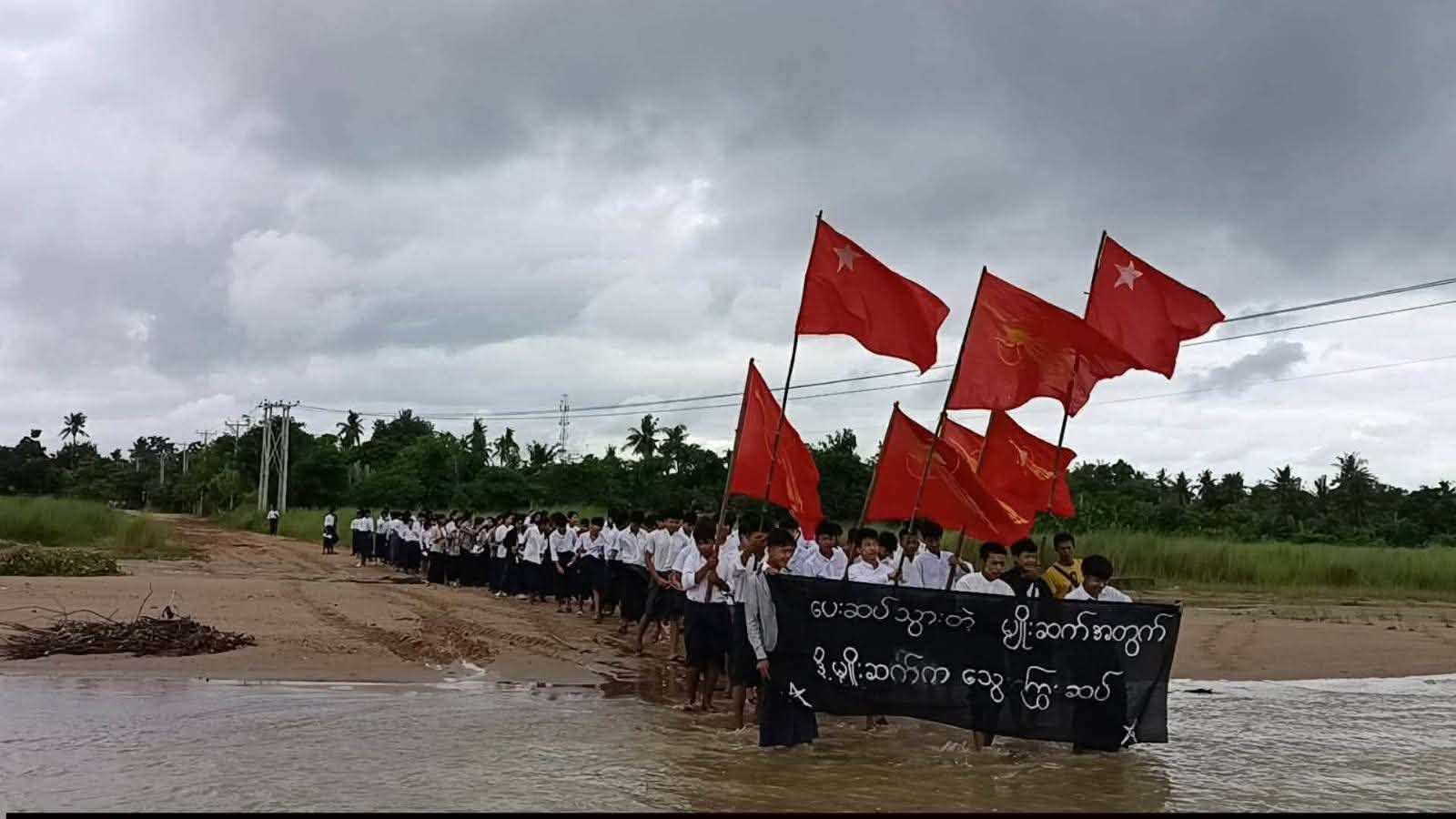
Myanmar Spring Chronicle – Scenes from August 7
(MoeMaKa), August 8, 2026
The 38th Anniversary of the 8888 Uprising and a Historical Perspective
Whether written numerically as “8888” or in words as the “Four Eights,” the term refers to August 8, 1988—a date on which the day, month, and final two digits of the year were all eight, a combination that occurs only once every ten years. It was chosen as the day for a nationwide general strike and demonstrations against the rule of General Ne Win, a military leader whose career dated back to the Burma Independence Army and who later became the country’s military dictator under the Burma Socialist Programme Party (BSPP).
Beginning in the then-capital Rangoon and spreading simultaneously to major cities such as Mandalay and Moulmein, students and ordinary citizens took to the streets in protest.
Before the 8888 Uprising erupted, Burma had endured more than two decades under the so-called “Burmese Way to Socialism.” Military officers had exchanged their uniforms for civilian roles, established party and council institutions, and governed through a highly centralized system. The country had largely isolated itself from the outside world and pursued policies of domestic production and self-sufficiency. Former military officers with little understanding of economics or economic management ran the system, while civil war continued across the country.
As a result, the population was suffering from severe economic hardship, shortages of consumer goods, and a lack of employment opportunities. Against this backdrop, the government’s demonetization of currency and the brutal suppression of student demonstrations by riot police introduced concepts such as “human rights violations” into public consciousness in an unprecedented way. The wider public consequently rallied around and joined the student-led 8888 protests.
At the time, public frustration and long-suppressed political grievances had reached such intensity that the 8888 demonstrations developed into a nationwide protest and general strike on a scale not seen since the military seized power in the early 1960s.
During the 26 years of BSPP rule, there had been numerous student and labor protests, including the July 7 student protests, the Kyun Taw affair, the U Thant crisis, the Sinmalaik Dockyard workers’ strike, the Hmaing Centenary protests, and the Shwedagon protests. Yet none became a nationwide mass uprising on the scale of 8888.
The uprising did bring about the abolition of the BSPP and its council-based political system after 26 years of rule. It did not, however, bring an end to military dictatorship.
Under the BSPP system, military officers had been transferred into civilian administrative departments and placed in senior positions within state and central government institutions. After the military seized power again, generals returned to governing openly in uniform. Martial law was declared, curfews were imposed, and the population lived under direct military rule for years.
One legacy of the 8888 Uprising was the establishment of the All Burma Students’ Democratic Front (ABSDF), commonly referred to as the “student army.” Other political and military organizations, including the Democratic Alliance of Burma (DAB) and the National Coalition Government of the Union of Burma (NCGUB), also emerged around this period. Inside the country, the National League for Democracy (NLD) and other political parties continued their activities, while organizations such as the ABSDF and its allies operated along the border and in territories controlled by ethnic armed organizations.
The emergence of above-ground political parties and underground armed organizations in the aftermath of 8888 represented an important political development. But what changes did ordinary people actually experience?
Under the newly established State Law and Order Restoration Council (SLORC), regional military commanders held the highest authority in the states and divisions. Military officers occupied administrative positions at township, district, state, and divisional levels.
Corruption and the pursuit of personal interests became even more widespread than under the BSPP. Natural resources were extracted on a much greater scale in order to generate foreign currency. Unlike during the BSPP era, when border trade had been heavily restricted, trade with China and Thailand was opened up. In this way, a market economy was combined with continued military dictatorship.
Following the collapse of the Communist Party of Burma (CPB), the military government approached newly emerged ethnic armed organizations—including the United Wa State Army, the Kokang armed forces, and NDA-Kachin—to negotiate ceasefires. The authorities sought to win them over by granting business concessions and economic opportunities.
In the years following the 1988 uprising, ethnic armed organizations that accepted ceasefires were generally allowed to retain their weapons and maintain control over their existing territories. They also gained business opportunities in other areas and access to natural-resource concessions. Armed organizations that rejected ceasefire offers, however, faced military offensives from the SLORC government.
The 8888 Uprising did not overthrow either military dictatorship as a system or the military government that seized power. Nevertheless, it gave rise to political parties and movements, the armed ABSDF, and organizations such as the DAB and NCGUB.
The failure of the 8888 Uprising to uproot military dictatorship cannot simply be attributed to the abilities or shortcomings of any single organization or individual. It can also be understood as a consequence of Burma’s political history and the legacy of earlier historical events—particularly the mistrust among political and military forces opposing the armed forces and their inability to cooperate effectively with one another.
Following the 2021 military coup, comparisons inevitably emerged between the resistance that followed and the 8888 Uprising. Since 2021, there have been debates over which movement was stronger and which generation or movement was more capable.
Comparing and analyzing these two historical events is natural. But their strengths and weaknesses can only be properly understood by closely examining their respective contexts—the conditions surrounding the events themselves, as well as the circumstances before and after the military’s seizure of power in 1988—and by approaching the comparison without preconceived biases.
The nature of history is such that, if lessons from the past are properly understood, later generations may be able to avoid repeating earlier mistakes. But when people become convinced that victory is already assured, grow overconfident, and underestimate their opponent, they may repeat precisely the mistakes of the past. This is what is often described as history coming full circle.
It is in such circumstances that people arrive at the observation that history has a tendency to repeat itself.
Claims that those participating in the 2021 Spring Revolution are inherently more capable or superior to those who participated in the 8888 Uprising and belonged to that generation lack both a theoretical foundation and a proper historical perspective.
If we fail to learn from history, we risk repeating the same mistakes when history comes full circle. That is a danger that deserves serious attention.