
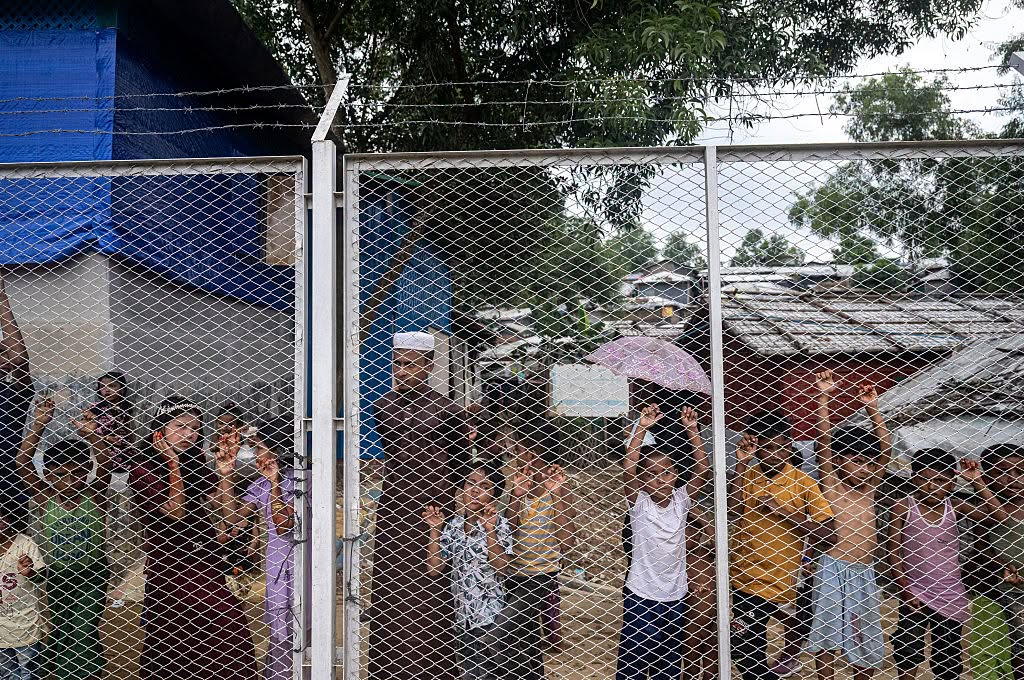
Myanmar Spring Chronicle – Scenes from August 15
(MoeMaKa), August 16, 2026
Myanmar Military Government Issues Statement on Rohingya Refugee Crisis Nearly Nine Years On
More than five years after the military coup, Myanmar’s Ministry of Foreign Affairs under the Min Aung Hlaing government has issued a statement concerning the Rohingya refugees who fled across the Myanmar-Bangladesh border during the 2017 military operations against the Arakan Rohingya Salvation Army (ARSA) in northern Rakhine State. The Min Aung Hlaing government refers to the Rohingya as “Bengalis” in its statement.
According to the statement, of a list of more than 800,000 refugees, more than half have so far been screened. Among those screened, just over 300,000 were found to have evidence that they had previously lived in Myanmar, while more than 100,000 were found to have no evidence of prior residence in the country.
The statement also rejects as inaccurate reports that more than one million people fled following the 2017 military operations. It claims that at the time there were only slightly more than 740,000 Rohingya—referred to as “Bengalis” in the original statement—living in the three northern Rakhine townships of Buthidaung, Maungdaw and Rathedaung. Since more than 200,000 remained after the exodus, the statement argues that only around 540,000 people could have fled.
On August 25, 2017, ARSA launched simultaneous attacks on police posts and border guard posts. The Myanmar military subsequently launched an operation to eliminate the armed group. Following mass killings of civilians during the operation, hundreds of thousands of Rohingya fled Rakhine State, crossing the Myanmar-Bangladesh border into the Cox’s Bazar area. News reports and figures from refugee aid organizations at the time estimated that between at least 700,000 and as many as one million people had fled.
At the time, Myanmar was governed by the National League for Democracy (NLD), while Min Aung Hlaing—now serving as president—was commander-in-chief of the armed forces. During the military operation in Maungdaw, Buthidaung and Rathedaung townships, which lasted only around two weeks, human rights monitoring organizations reported that, in addition to a relatively small number of ARSA fighters, thousands of Rohingya civilians—whom the military has consistently referred to as “Bengalis”—were killed, with some estimates putting the death toll at around 10,000.
During the operation, killings in villages reportedly included children, women and the elderly, while entire villages were burned. As a result, hundreds of thousands of Rohingya fled to neighboring Bangladesh in an effort to save their lives.
Reports by some human rights monitoring organizations stated that, during what the military described as a 2017 counterinsurgency operation against ARSA, Myanmar government forces also burned villages with the intention of preventing those who had fled from returning and resettling in their original communities. News reports and other investigations also documented the bulldozing of burned villages, making reconstruction difficult, as well as allegedly unlawful management of farmland belonging to local residents who had fled to the neighboring country.
Operations involving killings in villages and the burning of homes, similar to what occurred in 2017, had happened twice before over the preceding four or five decades: once in 1978 under the Burma Socialist Programme Party (BSPP) government and again in 1992 under the State Law and Order Restoration Council (SLORC). Unlike the current situation, however, refugees displaced during those earlier episodes did not remain in the neighboring country for many years. Most returned within one or two years.
Following the events of 2017, there was likewise an expectation that the refugees would be able to return home within a certain period. However, during the three years from 2018 through the end of 2020, the NLD government, neighboring Bangladesh and the United Nations were unable to implement an effective repatriation process.
During those same years, allegations that the mass killings of civilians in northern Rakhine State constituted genocide led The Gambia to bring a case before the International Court of Justice (ICJ), with proceedings beginning at the end of 2019.
The prospects for the return of Rohingya refugees sheltering in Bangladesh are closely connected to the question of citizenship. Criticism has increasingly focused on weaknesses and discriminatory provisions in Myanmar’s 1982 Citizenship Law. As a result, the issue of repatriating Rohingya refugees from Bangladesh has developed into a prolonged crisis far beyond what either the parties involved or the refugees themselves had originally anticipated.
Following the 2021 military coup, the military council, seeking international recognition, made statements indicating that it intended to proceed with plans to accept the return of Rohingya refugees from Bangladesh. Humanitarian and human rights organizations, however, urged that any repatriation be carried out on the basis of the refugees’ free and informed choice and in conditions that would allow them to return with dignity. Consequently, the military council was unable to implement its proposed repatriation plans.
Beginning in late 2023, offensives by the Arakan Army (AA) spread fighting across Rakhine State. By around the end of 2024, almost the entire state had come under AA control, a situation that continues to the present.
During fighting between the military council’s forces and the AA beginning in late 2023, the military council once again made use of Rohingya from northern Rakhine State, either forcibly conscripting them into militias or recruiting them through various incentives and deploying them as armed fighters against the AA. It was a striking development that the same military that had oppressed the Rohingya and been accused of committing genocide against them before the coup subsequently used Rohingya in its war against the AA.
Since 2024, the United League of Arakan/Arakan Army (ULA/AA), which controls around 90 percent of Rakhine State’s territory, has indicated that it is prepared to communicate with neighboring Bangladesh regarding the repatriation of Rohingya refugees. Bangladesh, however, has continued to deal with Myanmar’s post-coup military government on the refugee repatriation issue.
Apart from matters arising directly along the two countries’ border, such as incidents involving fishermen, there has been little indication that the Bangladeshi government has engaged with the ULA/AA on other issues.
In the nearly nine years since the 2017 Rohingya refugee exodus, Myanmar’s political and military landscape, as well as the balance of power within the country, has changed dramatically. Neighboring Bangladesh has likewise undergone major political changes. Following months of student-led protests in 2024, Prime Minister Sheikh Hasina, who had dominated the country’s politics for decades, fled to India. An interim government was subsequently formed, followed by elections last year and the establishment of a new government.
With the military government having lost control of around 90 percent of Rakhine State, it is clear that it has little practical ability to implement measures on the ground there. Therefore, the issuance of this statement on the Rohingya refugee crisis just weeks before the ninth anniversary of the 2017 exodus can be seen as little more than an expression of the military government’s political position, with little practical significance beyond that.