
Myanmar Spring Chronicle – Scenes from July 21
(MoeMaKa), July 22, 2026
What Does the PSLF/TNLA–NSPNC Agreement Indicate?
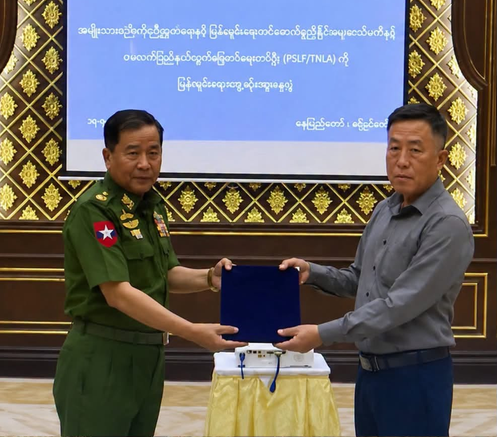
Minutes from a July 19 meeting in Naypyidaw between a delegation from the Palaung State Liberation Front / Ta’ang National Liberation Army (PSLF/TNLA)—led by its Vice Chairman (1)—and the junta’s National Solidarity and Peace Negotiation Committee (NSPNC) have circulated online.
The leaked document records the positions presented by the PSLF/TNLA alongside the NSPNC’s responses. It appears to have been drafted by the NSPNC and signed by both sides after the meeting, suggesting that the contents were reviewed and accepted by the PSLF/TNLA delegation and are therefore likely to be authentic.
The minutes show that the PSLF/TNLA presented a much broader set of proposals, while the NSPNC’s responses were comparatively brief.
The PSLF/TNLA’s main requests included official recognition of a Ta’ang State, assistance from the military government for regional development—including economic development, education, and transportation—and formal recognition of development initiatives carried out in Ta’ang-populated mountainous areas by what the TNLA referred to as the “new government.” The group also proposed that, if such recognition were granted, it would participate more actively in the junta’s peace process alongside the United Wa State Army (UWSA) and the National Democratic Alliance Army (NDAA-Mongla).
The PSLF/TNLA also stated that its long-term objective is the establishment of a Ta’ang State with constitutional authority equal to that of Myanmar’s other states while remaining within the Union rather than seeking independence.
This appears to be the group’s most significant demand. Rather than remaining a Self-Administered Zone, it is seeking full state status.
This differs from the approach taken by the Myanmar National Democratic Alliance Army (MNDAA), another member of the former Three Brotherhood Alliance. Following Operation 1027, the MNDAA returned Lashio to the military but designated the remaining territories it controlled as Special Region (1) under the framework established during the 1989 ceasefire, without publicly demanding statehood.
In response to the PSLF/TNLA’s request, the NSPNC argued that the Palaung Self-Administered Zone already exists and that granting statehood would require action through elected parliamentary representatives, in accordance with constitutional procedures.
This response can be interpreted as a general reference to the procedures under the 2008 Constitution, avoiding any firm commitment. A similar request had previously been made by the UWSA during the 30th anniversary of Wa State in April 2019, when it called for the Wa Self-Administered Division to be upgraded to state status. Neither the then-NLD government nor the military responded publicly.
Shan State currently contains five Self-Administered Areas—for the Pa-O, Wa, Palaung, Kokang, and Danu ethnic groups—while the Naga Self-Administered Zone is located outside Shan State.
As Myanmar’s largest state geographically and home to at least nine ethnic communities, Shan State presents complex political and administrative challenges. It appears unlikely that the Min Aung Hlaing military government would agree to the TNLA’s request for statehood. At the same time, given the ongoing nationwide conflict, the junta is also unlikely to seek a renewed military confrontation with the PSLF/TNLA if it can avoid one.
The two sides also discussed regional development issues, including whether schools operated by the Ta’ang Education Center should teach according to the curriculum of the military government’s Ministry of Education.
According to the meeting record, the NSPNC proposed holding the next round of talks in Namhsan, a town under TNLA control, with both sides agreeing to coordinate a future meeting date.
The developments also highlight how political narratives have shifted. During the height of Operation 1027, NUG Minister Dr. Zaw Wai Soe popularized the slogan “All Roads Lead to Naypyidaw,” widely understood as referring to an eventual military advance on the junta’s capital following battlefield successes.
More than a year later, however, the military has regained some momentum while several resistance groups have lost parts of the territory they previously captured. Against this backdrop, the fact that some resistance organizations are now traveling to Naypyidaw for peace negotiations has given the slogan an ironic new meaning in the eyes of many observers.