
Myanmar Spring Chronicle – Scenes from July 4
(MoeMaKa), July 5, 2026
Min Aung Hlaing’s Third Overseas Trip Since Assuming the Presidency
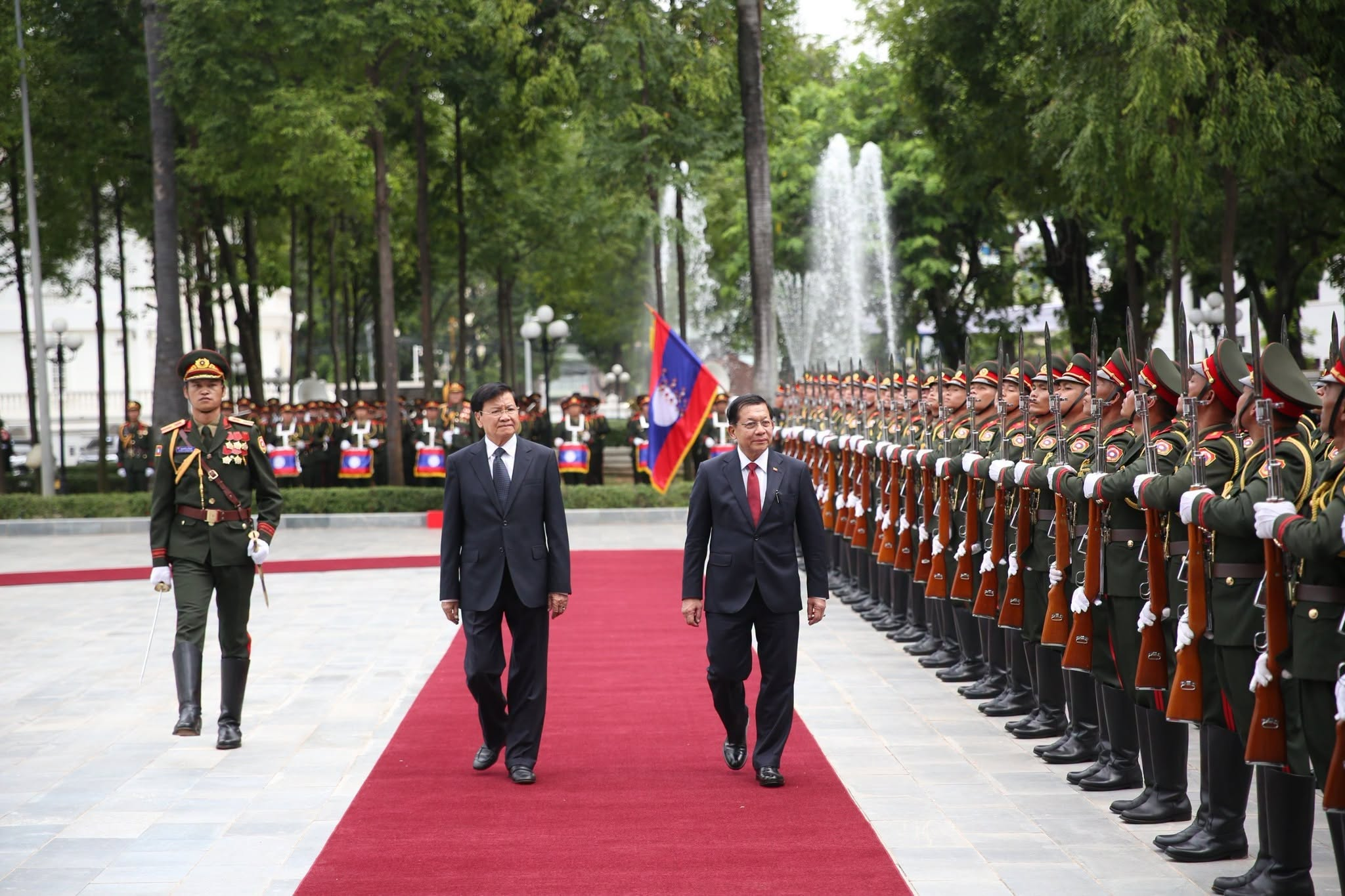
After assuming the presidency—the highest office in the government—following an election that was widely criticized both domestically and internationally as neither free nor fair, Myanmar’s military leader Min Aung Hlaing has embarked on his third foreign trip. After making five-day visits to neighboring India and China in May and June, he is now paying an official visit to another neighboring country, Laos, in July.
According to official announcements, Min Aung Hlaing’s visit to Laos from July 3 to July 5 is intended to strengthen bilateral relations and enhance strategic cooperation between the two countries.
Although Myanmar and Laos are neighboring states, they do not share an extensive border like Myanmar does with Thailand, China, or India. Instead, their border is limited to the eastern Shan State region around the so-called Golden Triangle, where Thailand, Myanmar, and Laos converge. Historically, the Golden Triangle was one of the world’s major centers for opium production and trafficking.
Tens of thousands of Myanmar citizens work in Laos after crossing the border from eastern Shan State. However, compared with the number of Myanmar migrant workers in Thailand, this figure is significantly smaller.
Laos is a one-party state where only the Communist Party is legally permitted to govern. It is also a landlocked country with a population of just over seven million, approaching eight million people. Culturally, Laos shares closer ties with Thailand, while economically it maintains particularly close relations with China.
In recent years, China and Laos jointly completed the China-Laos high-speed railway project, financed roughly 70 percent through Chinese loans and built with Chinese technology. The railway forms part of China’s Belt and Road Initiative (BRI), linking Kunming in China’s southwestern Yunnan Province with the Lao capital, Vientiane. Costing approximately US$6 billion, the project has made Laos the first Southeast Asian country to operate a high-speed rail line.
Among Laos’ major sources of foreign income are electricity exports generated by Chinese-built hydropower projects, tourism, and agriculture.
Although Laos is not one of ASEAN’s most influential members like Indonesia, Malaysia, Singapore, or Thailand, it could play an important role when ASEAN deliberates on Myanmar-related issues. Laos may be expected to support a softer approach toward Min Aung Hlaing’s government, which has transformed itself from a military junta into what it presents as an elected civilian administration.
Min Aung Hlaing’s successive visits to neighboring countries clearly suggest a diplomatic campaign to build regional support. Likewise, while neighboring countries refrained from openly endorsing Myanmar’s military regime following the 2021 coup, they now appear increasingly willing to engage diplomatically with the government after it conducted elections and rebranded itself as an elected civilian administration. Even if they stop short of offering public praise, their willingness to maintain official diplomatic relations indicates a degree of recognition.
China’s explicit support for Min Aung Hlaing’s government may also have encouraged some neighboring countries to establish more formal relations with his administration.
During the Laos visit, the two sides reportedly signed an agreement to jointly study the feasibility of a hydropower project on the Mekong River with a capacity of nearly 2,800 megawatts.
Unlike the visits to India and China, which produced a number of agreements, the Laos trip appears to have been aimed primarily at reinforcing strategic diplomatic ties rather than achieving major economic or political deals.
The itinerary for the three-day visit includes observing small and medium-sized enterprises such as silk weaving and handicraft industries, as well as religious visits to Buddhist temples.
Overall, the principal objective of Min Aung Hlaing’s visit appears to be demonstrating that, following the election, governments led by former military generals are now being officially received and recognized by neighboring countries.
At present, however, it still appears unlikely that all ASEAN member states will reach consensus on inviting Myanmar’s government leaders back to ASEAN summits and foreign ministers’ meetings.
Meanwhile, figures such as USDP parliamentarian Bu Hla Swe—known for making provocative remarks—have spoken about discussing Myanmar’s withdrawal from ASEAN in parliament, while simultaneously pursuing political tactics aimed at pressuring the regional bloc. At the same time, Min Aung Hlaing’s government is visibly conducting diplomatic outreach to ASEAN member states that have shown relatively accommodating attitudes toward his administration.