
Myanmar Spring Chronicle – Scenes from July 3
(MoeMaKa), July 4, 2026
A New Administrative Step Emerging in Ethnic Armed Group-Controlled Territories
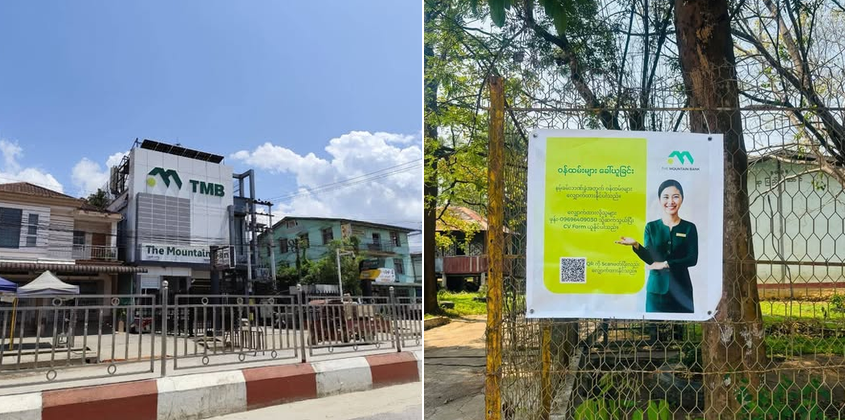
According to several media reports, in March 2026, a recruitment announcement was published for employees to staff a new branch of The Mountain Bank (TMB) in Namkham, a town administered by the Ta’ang National Liberation Army (TNLA).
TMB, or The Mountain Bank, is also reportedly preparing to open branches in Namhsan and Namtu, both under TNLA control. Some reports, citing local sources, indicate that TMB already operates money transfer services in Panghsang, the capital of the Wa Self-Administered Region.
It remains unclear whether TMB is fundamentally a bank headquartered in the Wa region that is now expanding into Ta’ang territory, or whether it is a new banking institution established within TNLA- and Ta’ang State Council-administered areas that also operates branches in the Wa region.
The information currently available suggests that TMB intends to conduct transactions primarily in Chinese yuan and focus mainly on money transfer services. Given Namkham’s active cross-border trade with China, there is considerable demand for remittance services, which may explain the decision to establish TMB branches there. Some observers also speculate that the bank may eventually provide services related to digital currencies such as cryptocurrencies.
Approximately three to four months after reports emerged about banking services in Ta’ang territory, similar reports began circulating that the Arakan Army (AA) was preparing to establish its own bank in areas under its control in Rakhine State. The bank is expected to begin operations toward the end of this year, and recruitment announcements for staff have already appeared, indicating that the AA/United League of Arakan (ULA) is moving toward establishing its own banking system.
Following the launch of Operation 1027, ethnic armed organizations captured significant territory and gradually established administrative systems in their newly controlled areas. These administrations introduced vehicle registration and licensing systems, collected taxes, required permits for opening schools, and established policies regarding the language of instruction. However, until recently, they had made few visible efforts to develop independent financial systems. The emergence of these new banks marks the first significant step in that direction.
Even in Rakhine State, where the military now retains control over only Kyaukphyu, Manaung, and Sittwe, residents throughout AA-controlled areas have continued using the Myanmar kyat along with payment systems such as KBZPay (KPay) and Wave Pay. Because these mobile payment platforms are registered using users’ phone numbers and national identity information, the military authorities have been able to monitor transactions and periodically freeze accounts belonging to political opponents or individuals linked to resistance organizations. This has created strong incentives for ethnic armed organizations to develop alternative payment systems beyond the military government’s reach.
In territories bordering China, Chinese yuan is already widely used in many border communities, while other areas continue relying primarily on the Myanmar kyat.
The establishment of independent banks can therefore be viewed as an effort to break away from the military junta’s control over financial circulation, even in areas where territorial control has already shifted away from the central government.
Creating an independent financial system offers several potential advantages but also presents important challenges. Banks established by ethnic armed organizations are unlikely to have direct connections with banks operating under the military government’s regulatory framework. As a result, questions remain about how people will transfer funds between the two systems. Trade between ethnic-controlled territories and junta-controlled areas continues, making it difficult to completely avoid using banks regulated by the military government for commercial transactions.
It is also important to distinguish the situation in the Wa region from that of other ethnic-controlled territories. The Wa region conducts relatively little trade with the rest of Myanmar and is economically oriented primarily toward China, using the Chinese yuan extensively. In contrast, territories controlled by organizations such as the TNLA and AA are only beginning—or have just begun—to expand economic ties with neighboring countries including China, Bangladesh, and India. Consequently, they remain unable to immediately abandon Myanmar’s domestic banking and monetary systems.
Nearly two and a half years after the launch of Operation 1027, some ethnic armed organizations have begun developing banking and financial systems designed to operate independently of Myanmar’s military government. How these emerging financial institutions will influence the country’s political and military landscape remains an important question that warrants close observation.