
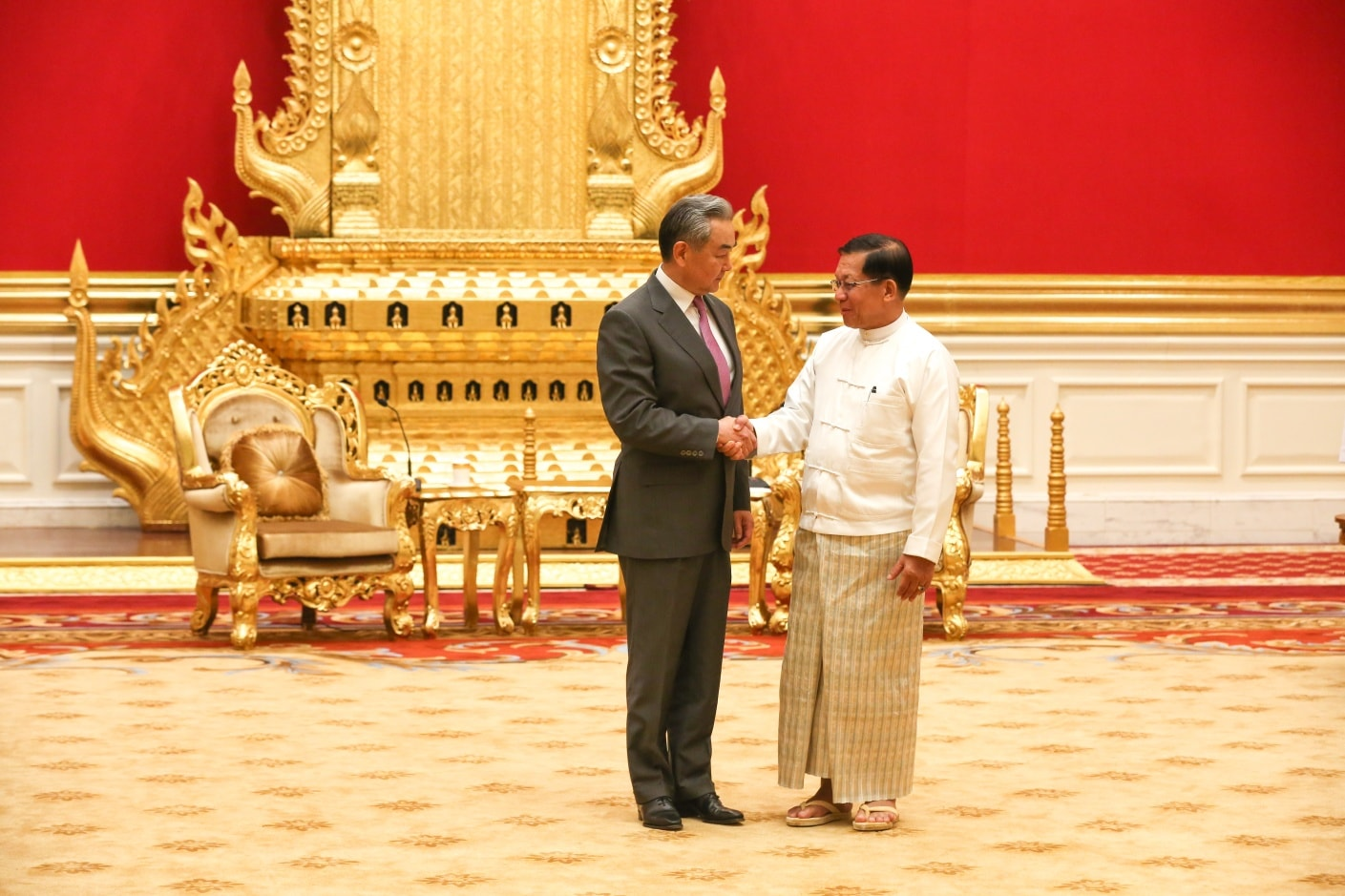
Myanmar Spring Chronicle – Scenes from April 25
(MoeMaKa), April 26, 2026
Chinese Foreign Minister’s Visit to Naypyidaw and Myanmar’s Future
Chinese Foreign Minister Wang Yi, who has been on an official tour of three Mekong-region countries, arrived in Naypyidaw, Myanmar on April 25—the final stop of his trip.
The six-day visit covered Cambodia, Thailand, and Myanmar—three countries that can all be considered to have close ties with China. Cambodia, governed in an authoritarian style under Hun Sen and now his successor and son Hun Manet, maintains strong economic and diplomatic relations with China. Thailand, which previously had closer ties with the United States, has in recent decades also developed increasingly close relations with China, whose economic and political influence has grown both regionally and globally. China’s role in Thailand’s economy has steadily become more significant.
Among these three countries, Myanmar stands out as it shares a border with China and is deeply intertwined with China in terms of internal affairs such as armed conflict and the economy. Many of the weapons and ammunition used in Myanmar’s ongoing civil war are manufactured in China. Cross-border trade, as well as Myanmar’s cooperation in cracking down on online scam operations targeting China, are also major aspects of the deep involvement between the two countries.
In addition, unlike Cambodia and Thailand, Myanmar holds unique geopolitical importance for China as a potential outlet to the Indian Ocean. One of the world’s key maritime trade chokepoints today is the Strait of Malacca. For China, being able to transport oil and other goods from Kyaukphyu on Myanmar’s western coast to Yunnan Province—without passing through the Malacca Strait—offers major strategic advantages in terms of time, cost, and security.
This geopolitical importance is not new. Oil and natural gas pipelines from Kyaukphyu to Yunnan have already been constructed and are operational. If railway links along the same route are developed, they could further facilitate trade and logistics. This gives China a strong interest in seeing an end to Myanmar’s internal conflicts.
Although the Myanmar military had kept some distance from China over the past decade, China’s support became increasingly indispensable after the escalation of military operations that began on October 27, 2023, near the China-Myanmar border. China, which has influence over northern alliance armed groups and has its own strategic interests, has become a power the Myanmar military cannot ignore—even if it is not entirely comfortable doing so.
A key turning point in China’s policy shift toward supporting the Myanmar military came after the MNDAA-led capture of Lashio and the Northeastern Regional Military Command. China decided to support the military rather than allow a situation where multiple armed groups independently control separate territories within Myanmar.
To help the Myanmar military recover from setbacks—including the loss of major cities and regional commands in the northeast and the surrender of thousands of troops—China provided assistance within its capacity, in exchange for certain political commitments. It pressured the United Wa State Army to restrict the flow of weapons and funds to ethnic armed groups in the northeast, and also applied pressure on Kokang and Ta’ang areas by restricting border trade.
Although China’s influence over Myanmar has limits, both the Myanmar military and ethnic armed groups recognize that it is impossible to completely operate independently of China.
The recent election also followed a trajectory preferred by China. After Min Aung Hlaing assumed the presidency as planned, the Chinese government quickly sent a congratulatory message. Soon after, this visit by the foreign minister took place.
This trip is likely to serve as a reaffirmation of China’s recognition and support for Myanmar’s military leader Min Aung Hlaing. At a time when global attention is focused on issues such as the Middle East and the war in Ukraine, China’s diplomatic backing suggests that Myanmar is being guided along a path aligned with China’s strategic interests in East Asia.