
Myanmar Spring Chronicle — November 13 Perspective
(MoeMaKa), November 14, 2026
What Did Thailand’s Foreign Minister Discuss with Min Aung Hlaing’s Government?
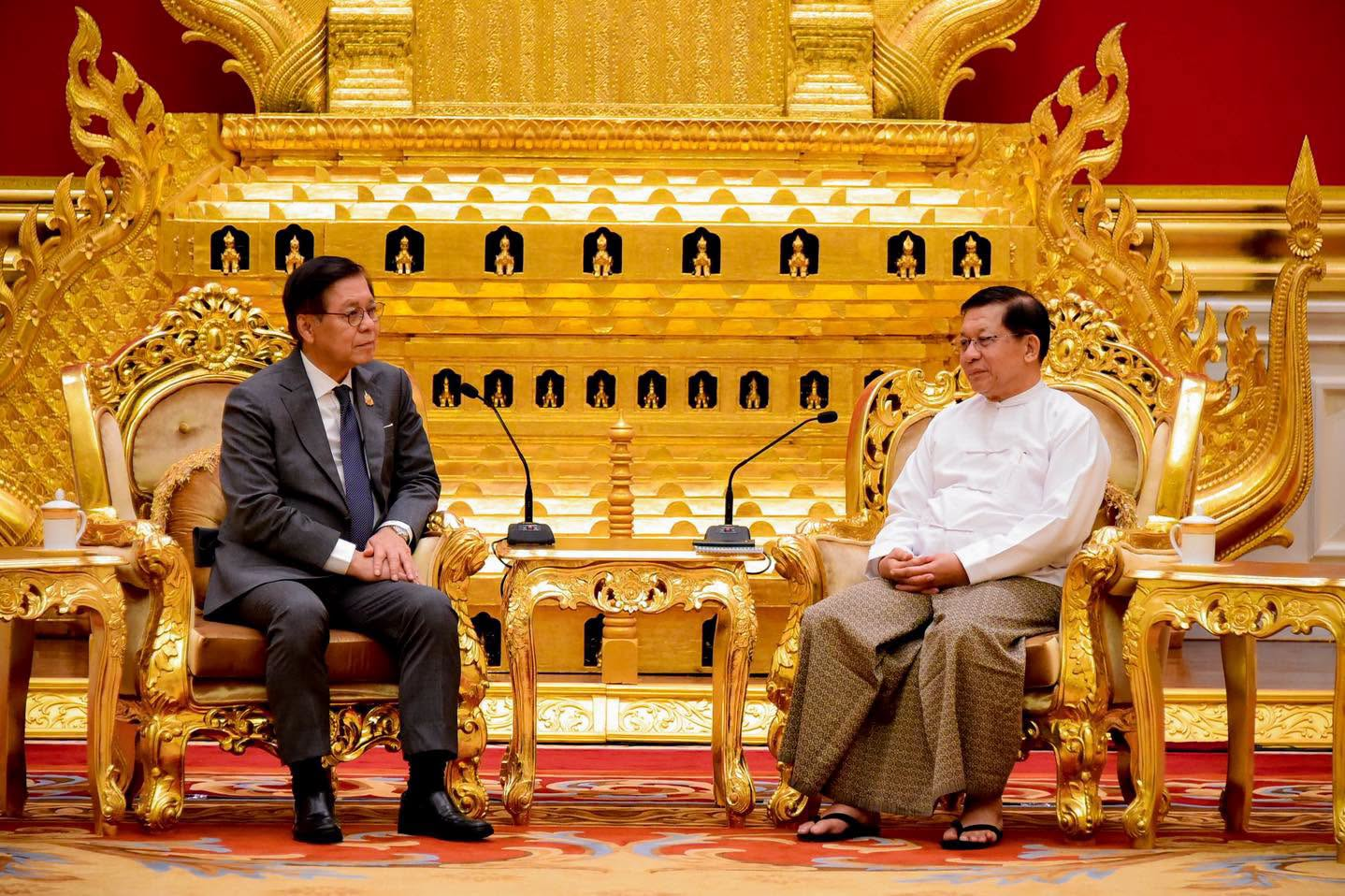
Both Myanmar’s military government and Thailand’s Ministry of Foreign Affairs have issued statements about the discussions between Thai Foreign Minister Sihasak Phuangketkeow and military leader Min Aung Hlaing during the Thai minister’s one-day visit to Naypyidaw on November 12.
There are numerous issues requiring discussion between Thailand and Myanmar. Four major areas were highlighted: border security, river and air pollution, cross-border trade, and Thailand’s offer to help bring an end to armed conflict and violence inside Myanmar.
Border Security and the Impact of Fighting
In recent days and weeks, Myanmar military offensives along the Thai-Myanmar border, particularly in areas adjoining Karen State, have raised serious concerns in Thailand. Artillery shells have landed on Thai territory, causing injuries, while airstrikes have created fears of further damage and the possibility of Myanmar fighter jets crossing the international border.
The Thai government is also facing domestic political pressure to demand that Myanmar’s authorities ensure the safety of Thai citizens.
Over the past several months, artillery shells fired during fighting on the Myanmar side have crossed into Thailand on at least two occasions, injuring Thai nationals and damaging homes.
These incidents could prompt criticism that the current Thai government has failed to issue sufficiently strong warnings or protests to Myanmar’s military authorities. Consequently, it was necessary for the Thai foreign minister to raise the issue during his visit and seek assurances that artillery shells from fighting near the border would not land on Thai territory again.
According to one news report, during the visit, Myanmar’s military leader promised to prevent further incidents and discussed providing a certain amount of compensation for injuries and property damage sustained on the Thai side of the border.
Cross-Border River Pollution and Mining Operations
Regarding the pollution of rivers flowing across the border, news reports indicate that relevant government departments and administrative officials from Myanmar and Thailand are expected to hold a joint meeting soon.
The contamination of these rivers has been linked to gold mining and rare-earth extraction operations in eastern Shan State, including areas controlled by ethnic armed organizations and territories under the military government’s administration.
From a diplomatic standpoint, it is difficult for the Thai government to engage directly with ethnic armed organizations controlling these mining areas. As a result, Thailand has had to address the issue through Myanmar’s military government.
Min Aung Hlaing’s government may therefore need to hold further discussions with ethnic armed organizations operating in these areas to find solutions.
Although the military government may be able to regulate mining operations around Tachileik, resolving pollution problems in territories controlled by certain ethnic armed organizations in eastern Shan State will be considerably more difficult.
Thai PBS reported that mining activities on the Myanmar side of the Sai River, which separates Tachileik in Myanmar from Mae Sai in Thailand, had caused water turbidity levels to reach as high as 14,000 Nephelometric Turbidity Units (NTU).
In Kachin State, rare-earth mining operations are primarily run by Chinese-owned companies. Similarly, mining activities in eastern and northern Shan State are frequently undertaken by Chinese-owned businesses operating under contractual arrangements.
These environmental concerns represent important issues that Thailand needs to discuss with Myanmar’s military authorities.
Border Trade and Economic Relations
Another major topic discussed between Thailand and Myanmar’s military government was the state of cross-border trade.
Although Myanmar’s military government reopened the Asian Highway between Thingannyinaung and Kawkareik in April 2026, border trade has not increased to the extent Thailand had anticipated.
The military government’s strict import licensing requirements have continued to restrict commercial activity despite the reopening of the highway.
According to news reports, the Thai foreign minister raised this issue with Myanmar’s military leader, explaining that Thai-Myanmar border trade had failed to recover as expected.
Another economic issue discussed during the visit concerned agreements with Thai companies involved in Myanmar’s offshore natural gas production.
Thailand has entered into agreements with Myanmar’s authorities to extract natural gas from offshore fields along the Tanintharyi coast and in other areas. These supplies are used for electricity generation and other industrial purposes.
Natural gas imported from Myanmar remains an important source of energy for Thailand, making cooperation in this sector a significant component of Thailand’s energy security.
Thailand Offers to Facilitate Peace Talks with Ethnic Armed Organizations
Beyond economic issues, another major topic was Thailand’s offer to help facilitate peace negotiations between Myanmar’s military government and ethnic armed organizations.
The proposal focused not on ethnic armed groups based along the Chinese border or in eastern Shan State, but on organizations operating along the Thai-Myanmar border.
These include the Karenni National Progressive Party (KNPP), based in Karenni (Kayah) State, and the Karen National Union/Karen National Liberation Army (KNU/KNLA), based in Karen State.
During his visit to Naypyidaw, the Thai foreign minister reportedly offered to host negotiations between these ethnic armed organizations and Myanmar’s military government.
According to news reports, Lieutenant General Yar Pyae, the current defense minister and head of the National Solidarity and Peace-making Negotiation Committee (NSPNC), agreed to the proposal in principle.
Thailand’s offer can be understood as an attempt to reduce continued fighting along the shared border, minimize damage and casualties resulting from the conflict, and prevent further movements of refugees across the border into Thai territory.
Ethnic armed organizations depend to varying degrees on access to Thailand for food, medicine, supplies, and cross-border movement.
Because of these practical connections, it may be difficult for such organizations to reject outright a Thai government proposal to facilitate talks between the two sides involved in the armed conflict.
Myanmar’s Possible Return to Full ASEAN Participation
Another important issue discussed during the Thai foreign minister’s visit was Myanmar’s possible return to full participation in meetings of the Association of Southeast Asian Nations (ASEAN).
Thailand appears to favor allowing Myanmar to resume participation at a relatively senior level, potentially beginning with attendance by its foreign minister.
At the same time, Thailand has encouraged Myanmar’s military government to undertake additional constructive measures.
Thailand appears to regard several recent developments as positive steps.
These include allowing detained former State Counsellor Aung San Suu Kyi to communicate with her son, permitting her to meet a representative of the International Committee of the Red Cross (ICRC) in August, and allowing her to receive a book and a letter from Britain’s King Charles III.
In media interviews, the Thai foreign minister appeared to suggest that these developments were encouraging, while emphasizing the need for further constructive actions by Myanmar’s military authorities.
His remarks also indicated Thailand’s interest in seeing Myanmar gradually restored to participation in ASEAN meetings.
Thailand’s approach therefore appears to combine diplomatic engagement with encouragement for Myanmar’s military government to take further positive steps.
What Comes Next?
The ASEAN summit scheduled to take place in the Philippines in the coming days is also expected to include discussions on the situation in Myanmar.
The outcome of those discussions, including how ASEAN member states respond to Thailand’s diplomatic initiatives and Myanmar’s possible return to higher-level participation, remains to be seen.
For now, the November 12 visit illustrates the range of issues shaping relations between Thailand and Myanmar’s military government—from immediate border security concerns and environmental pollution to trade, energy cooperation, peace negotiations, and Myanmar’s future role within ASEAN.