
Myanmar Spring Chronicle — November 6 Perspective
(MoeMaKa), November 7, 2026
The Lives of Civilians Suffering from Intensifying Fighting and Rising Crime Along the Sagaing–Kachin Border
Fighting between Myanmar’s military junta and combined forces of the People’s Defense Force (PDF), operating under the National Unity Government (NUG), and its ally, the Kachin Independence Army (KIA), has intensified in recent days around Indaw and Mawlu, near the border between Sagaing Region and Kachin State, according to news reports.
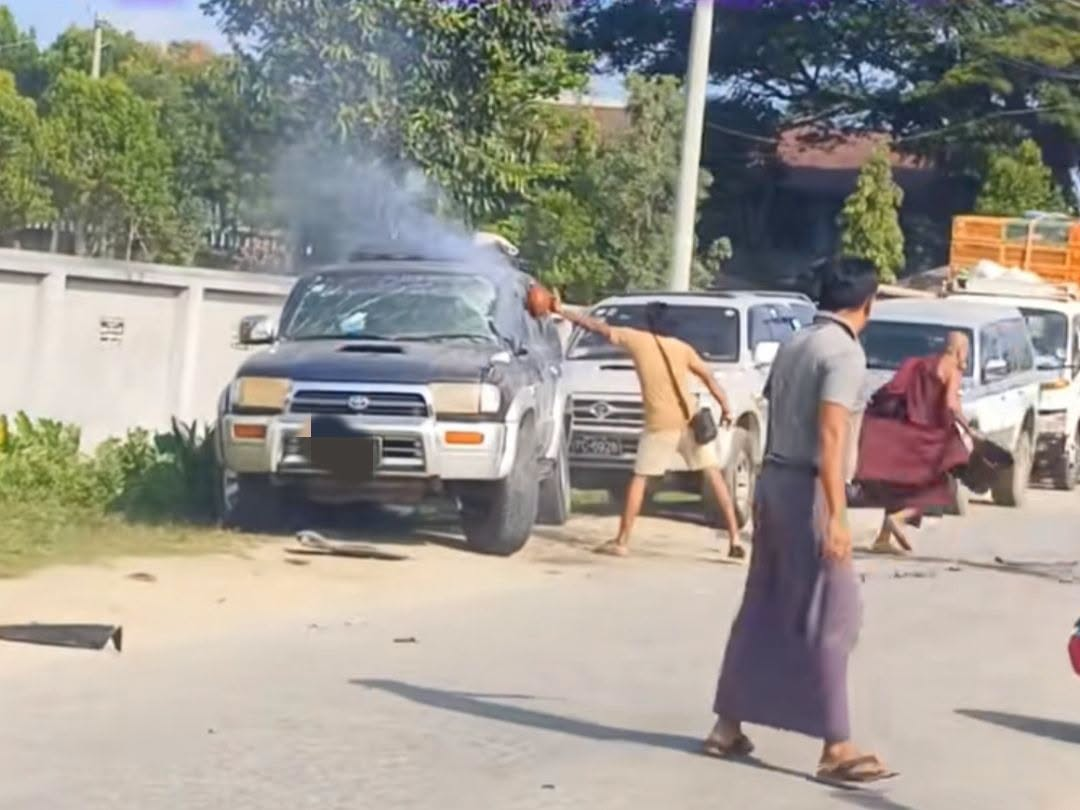
About two days ago, a video circulated on social media showing a drone bomb striking a convoy of vehicles stranded in Mawlu due to road closures caused by the fighting. The vehicles were reportedly traveling toward Myitkyina. One vehicle caught fire, killing a civilian and injuring several others. The convoy, which had departed from Mandalay and Sagaing toward Myitkyina, reportedly consisted of more than 100 vehicles.
Over the past two or three years, areas of Sagaing Region bordering Kachin State, including Kawlin, Indaw, Wuntho, and Kanbalu, have experienced repeated fighting. Revolutionary armed groups have captured towns, only for junta forces to launch counteroffensives and retake them.
Last year, intense fighting also occurred in Banmauk, southwest of Mawlu, where clashes are currently escalating. Those battles involved the Shanni National Army (SNA) and Myanmar’s military on one side, and the NUG-affiliated PDF and KIA forces on the other.
Townships in upper Sagaing Region bordering Kachin State, including Katha, Indaw, Shwegu, and Banmauk, are strategically important to the KIA.
These areas form a corridor connecting the northeastern region, including Bhamo and Mansi, where fighting has continued for nearly two years, with Sagaing Region and the Chindwin River basin farther west. From there, the corridor extends toward northern Chin State and northern Sagaing Region.
The area is also strategically significant because it lies along the Mandalay–Myitkyina highway, a major transportation route into Kachin State.
From a military perspective, the resistance forces appear to be fighting either to maintain control of this territory or to prevent the junta from establishing complete control over it. Such control would allow the military to use vital supply routes connecting northern Sagaing Region and Kachin State without significant obstruction.
On a map of Myanmar, Bhamo, Shwegu, Katha, and Indaw are situated roughly along an east-to-west corridor, while Kawlin and Wuntho lie slightly farther south.
Several armed organizations operate in this region, including PDF battalions under the NUG Ministry of Defense, some battalions of the All Burma Students’ Democratic Front (ABSDF), KIA forces, and groups commonly referred to as KIA-PDF units, which operate with KIA assistance and support.
Following the reduction in fighting in northern Shan State, the junta appears to have shifted its attention toward gaining full control of the Sagaing–Kachin border region.
For the KIA, fighting in these areas also serves as a form of forward defense. By engaging junta forces beyond its core territories, the organization seeks to protect the areas it currently controls in Kachin State.
Another consideration is the protection of revenue-generating natural resources, including jade, rare earth minerals, and timber. An expansion of fighting deeper into Kachin State could disrupt the extraction and trade of these resources, which provide important sources of funding.
Consequently, the KIA’s military operations in the border areas can also be understood as an effort to establish an outer defensive perimeter around its territories and economic interests.
Armed Robberies and Killings Raise Concerns About Worsening Lawlessness
Another major development concerns the increasing number of armed robberies and fatal shootings taking place in broad daylight in towns and crowded public areas across Myanmar.
According to news reports, three people were killed during a robbery at a mobile phone shop in Yankin Taung village, Patheingyi Township, Mandalay Region.
The incident began when an armed robber entered the phone shop and attempted to steal from it. When the shop owners resisted and called for help, the robber opened fire, killing one of the owners.
The perpetrator then fled on a motorcycle and reportedly fired at people who pursued him in a vehicle, resulting in two additional deaths.
Reports indicate that the male shop owner’s uncle and another individual pursued the robber by car. During the chase, the motorcycle was struck by the vehicle, causing the robber to fall.
The robber reportedly abandoned his motorcycle, threw a hand grenade into the pursuing vehicle, and shot the two occupants. Both sustained serious injuries and later died in hospital.
Conflicting accounts have emerged regarding the perpetrator’s identity.
One news outlet that regularly publishes pro-junta content claimed that the robber entered the phone shop shouting, “I am Pyu Saw Htee!”
Another pro-military news outlet alleged that the perpetrator was a member of the PDF.
Neither claim has been independently verified, and it remains unclear which account, if either, is accurate.
According to one of the pro-military news outlets, investigators used the abandoned motorcycle and other evidence to locate the suspect’s residence.
The outlet claimed that authorities recovered a pistol holster, a walkie-talkie, a PDF cap, and camouflage clothing from the house.
These details remain allegations reported by a pro-military source rather than independently established facts.
A Series of Armed Robberies in Mandalay
The fatal robbery in Patheingyi Township reportedly followed two similar incidents in Mandalay the previous day.
In the first incident, an armed individual entered a shop selling solar equipment and LED lighting in Chanayethazan Township, fired a handgun, and demanded money.
Later that evening, an armed robber targeted Lwin Mobile Phone Shop.
The perpetrator reportedly fired shots to threaten those inside, smashed the shop’s glass display counter, and escaped with four mobile phones.
News reports have suggested that the same individual was responsible for all three incidents: the armed robbery at the solar and LED lighting shop, the robbery at Lwin Mobile Phone Shop, and the fatal robbery in Patheingyi Township.
If these accounts are accurate, a single perpetrator carried out a series of armed robberies and shootings over two consecutive days.
The incidents illustrate how increasingly frequent armed robberies have become and how easily individuals with access to firearms can threaten public safety.
Armed Conflict and the Breakdown of Law and Order
Myanmar’s ongoing armed conflicts, the prioritization of maintaining political power over enforcing the rule of law, and the widespread availability of weapons such as firearms and hand grenades have created conditions in which robberies and killings can be committed with alarming ease.
Another contributing factor is the fragmentation of territorial control.
After committing armed robberies, murders, or other serious crimes, perpetrators may be able to escape from one area to another under a different administrative authority.
The absence of effective law enforcement, combined with the difficulty of pursuing suspects across territories controlled by different armed organizations, creates conditions that enable further criminal activity.
Armed robberies targeting mobile phone shops and gold shops in major cities frequently receive media coverage. However, in smaller towns and rural communities affected by armed conflict, robberies, killings, and other serious crimes have become so commonplace that they are increasingly treated as ordinary occurrences.
Incidents in major cities such as Yangon, Mandalay, and Naypyidaw tend to attract greater public attention. In some cases, authorities may investigate, arrest suspects, and take legal action following such incidents.
The situation is considerably different in rural areas and smaller towns.
Reports and accounts from these communities indicate that many perpetrators of robberies, murders, kidnappings, and other serious crimes escape punishment.
In many cases, victims and their families are left without justice, while those responsible remain at large.
The broader picture is one in which civilians face threats not only from ongoing armed conflict but also from the growing breakdown of law and order.
As fighting continues and administrative authority remains fragmented, ordinary people are increasingly exposed to violence, insecurity, and criminal activity, with limited prospects for effective protection or accountability.