
Myanmar. Spring Chronicle November 19
The ICJ Ruling: Gains and Losses
The ICJ Ruling: Gains and Losses
MoeMaKa – November 20, 2026
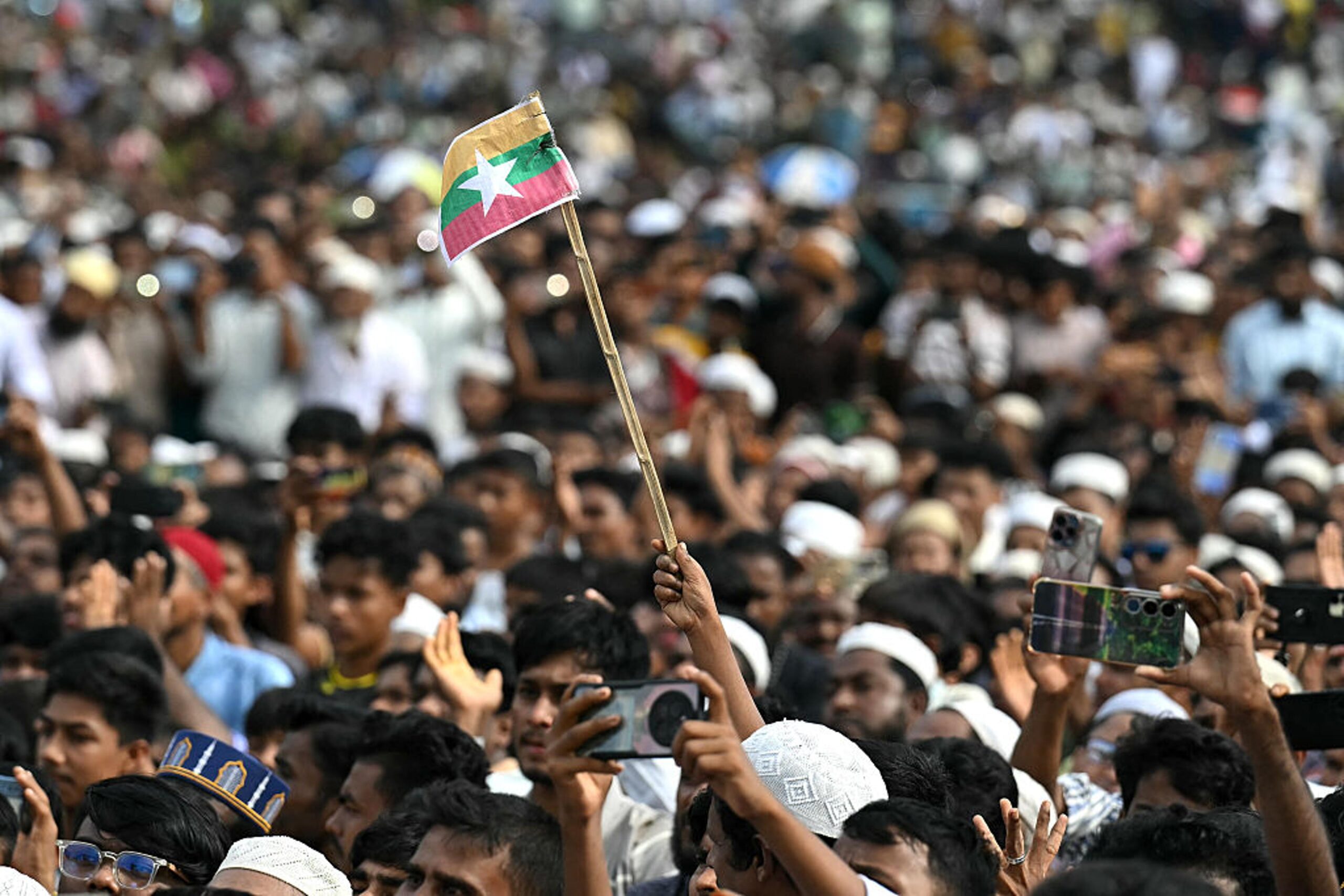
On November 19, the International Court of Justice (ICJ), the principal judicial organ of the United Nations, ruled that Myanmar had committed genocide against the Rohingya minority.
The ruling was delivered by a panel of 15 judges, with nine voting in favor of the finding that Myanmar had committed genocide and six voting against it. Along with its finding of genocide, the ICJ also ordered Myanmar to provide reparations to the victims.
The court was established in 1945, following the end of World War II, and began its work in 1946. According to the article, Myanmar has now become the first country to be found responsible for committing genocide by the ICJ since the court began operating.
Over the past approximately 80 years, the world has witnessed numerous wars, massacres, war crimes, and incidents in which governments and non-state armed groups have killed tens of thousands, hundreds of thousands, and even millions of civilians. Nevertheless, for various reasons, many of these incidents either never reached the ICJ or did not result in a judicial determination of state responsibility.
The ICJ’s ruling against Myanmar has prompted a wide range of reactions among the country’s military, government, armed organizations, human rights activists, international nongovernmental organizations (INGOs), civil society organizations, and ordinary citizens.
Because it was known that the ICJ would announce its decision at 10 a.m. Netherlands time on November 19, many Myanmar citizens, both inside the country and abroad, reportedly waited with great interest to follow the ruling through social media.
While some people clearly understand the distinction between the ICJ and the International Criminal Court (ICC), many others do not fully understand the differences between the two institutions. Many were following the November 19 decision with the expectation that an international court might now be able to take action against military leader Min Aung Hlaing and the military government.
For Rohingya living in Rakhine State and in refugee camps in neighboring Bangladesh, the ICJ ruling carried a different set of hopes.
They hoped that the decision would help prevent a recurrence of the killings committed during the military operations in 2017, which were officially described as operations to clear out the Arakan Rohingya Salvation Army (ARSA), as well as the human rights abuses that preceded those operations.
These abuses included restrictions on freedom of movement and other violations of fundamental rights, despite the Rohingya having been born and raised in Myanmar.
More than one million Rohingya refugees living in neighboring Bangladesh were also hoping that the ruling might eventually create conditions that would allow them to return to their homeland in safety and with human dignity.
When the genocide case was first brought before the ICJ, many people who supported the National League for Democracy (NLD) and Aung San Suu Kyi opposed the genocide allegations against Myanmar.
However, following the 2021 military coup, many of these same people reversed their earlier positions and began supporting The Gambia’s case before the ICJ.
They came to view the proceedings as a means of holding the military accountable for its actions and as a potential blow against the military government that had seized power.
Historical records show that communal conflicts between the Rohingya and ethnic Rakhine communities in northern Rakhine State date back to World War II and have continued in various forms through successive political eras.
In 1942, during World War II, communal killings occurred at a time when weapons were readily available, public order had broken down, and administrative authority had collapsed.
During the Burma Socialist Programme Party era and the subsequent periods of the State Law and Order Restoration Council (SLORC) and State Peace and Development Council (SPDC), the military conducted operations under the pretext of clearing out illegal immigrants.
Some of these operations led to crises that required intervention by the United Nations.
In 1978 and 1991, the military, together with immigration authorities, reportedly conducted operations involving identity-document inspections and the burning and destruction of certain villages.
At the time, the capacity to document such military operations was limited. As a result, it was difficult to establish how many civilians were killed or how many homes and villages were destroyed.
Unlike today, comprehensive evidence could not easily be collected and presented to the international community.
The communal conflicts that erupted in Maungdaw Township in 2012, along with broader tensions between ethnic Rakhine and Rohingya communities, became sparks that contributed to the military operations that would eventually take place in August 2017.
According to the article’s analysis, influential officials within the government and military, including individuals with ultranationalist views, deliberately exploited the Rohingya issue.
Rather than confining the issue to Rakhine State, they allegedly encouraged ethnic and religious tensions across the country and orchestrated communal violence while avoiding the creation of evidence that could expose their involvement.
Ethnic and religious riots occurred in towns in western Bago Region, as well as in Taungup, Thandwe, and Kyaukphyu in Rakhine State. Similar violence also broke out in Meiktila in central Myanmar.
The article argues that these incidents were deliberately encouraged to obstruct Myanmar’s democratic transition, prevent the military’s political influence from diminishing, and complicate what had previously been a relatively clear political struggle between democracy and military dictatorship.
Although the November 19 ruling, which found that Myanmar had committed genocide and failed to prevent it, was based on evidence examined in relation to the military operations of August and September 2017, discrimination in Myanmar has a much longer history.
For decades, Rohingya and other Muslim communities, along with people belonging to different ethnic and religious groups, have experienced various forms of discrimination.
A close examination of Myanmar’s history also suggests, according to the article, that successive military governments have repeatedly and covertly encouraged communal violence during periods of political crisis and rising public dissatisfaction.
Looking back at this historical background makes it possible to understand how the events of 2017 were connected to developments spanning several decades, including more recent incidents.
Turning from the past to the present and future, the central question is what consequences the ICJ’s November 19, 2026 ruling against Myanmar might produce.
Could the decision weaken the military government, which continues to deploy every resource available to sustain its civil war campaigns?
The military government has been using fighter jets, naval vessels, weapons and ammunition, financial resources, and troops recruited through forced conscription in its ongoing military operations.
Could the ruling meaningfully constrain its ability to continue these campaigns?
Another important question concerns the Rohingya, who have endured generations of repression, discrimination, and restrictions.
Despite having been born and raised on Myanmar’s land for generations, many have never been recognized as citizens.
Could this ruling represent the beginning of a path toward justice for them?
Under the ICJ decision described in the article, Myanmar has been ordered to provide compensation and other remedies to victims and to submit a report explaining how these measures will be implemented.
However, questions remain about how the military government led by Min Aung Hlaing will respond.
There is also a significant practical obstacle.
Even if the Myanmar government announces that it intends to implement remedial measures for the Rohingya, many of the areas where those measures would need to be carried out have been under the control of the Arakan Army (AA) since the middle and latter part of 2024.
Before any repatriation process can begin, could the struggle for territorial control between the AA and Min Aung Hlaing’s military government lead to further fighting in these areas?
Alternatively, what role will the AA, which currently controls much of the territory concerned, play in the process?
Although the AA bears no direct responsibility under the ICJ ruling itself, it occupies a crucial position in any effort to implement measures arising from that decision.
Its policies toward the repatriation of more than one million Rohingya refugees currently sheltering in Bangladesh, as well as its treatment of Rohingya communities still living in Rakhine State, will be particularly important.
The day after the ICJ delivered its November 19 ruling, some news organizations asked the AA for its response.
AA spokesperson U Khaing Thukha reportedly stated:
“We are monitoring the situation and will take whatever action is necessary in the interests of Arakan.”
For the foreseeable future, including the coming months and possibly years, the AA appears likely to retain control over significant parts of Rakhine State.
This creates another possibility: the Myanmar military government could argue that it is unable to implement the ICJ’s ordered remedies for Rohingya victims because it does not control the territories where those measures would need to be carried out.
Some observers describe the ICJ ruling as the beginning of a path toward justice.
However, substantial obstacles remain before justice can be achieved in practice.
The road ahead is still filled with difficulties, potential deception, attempts to divert the process, and policies that prioritize political and strategic interests over truth and accountability.