
Myanmar Spring Chronicle — November 10 Perspective
(MoeMaKa), November 11, 2026
Myanmar Military Government Summons German Embassy Chief Over Remarks on President U Win Myint
Myanmar’s military government announced today that its Ministry of Foreign Affairs had summoned and warned Matthias Leis, the head of the German Embassy in Myanmar, over a video posted on the embassy’s social media account on November 8, the birthday of President U Win Myint.
In the short video, filmed outside U Win Myint’s former residence in Yangon, the German diplomat stated that the former president was not truly free despite having been released from military detention under an amnesty in April.
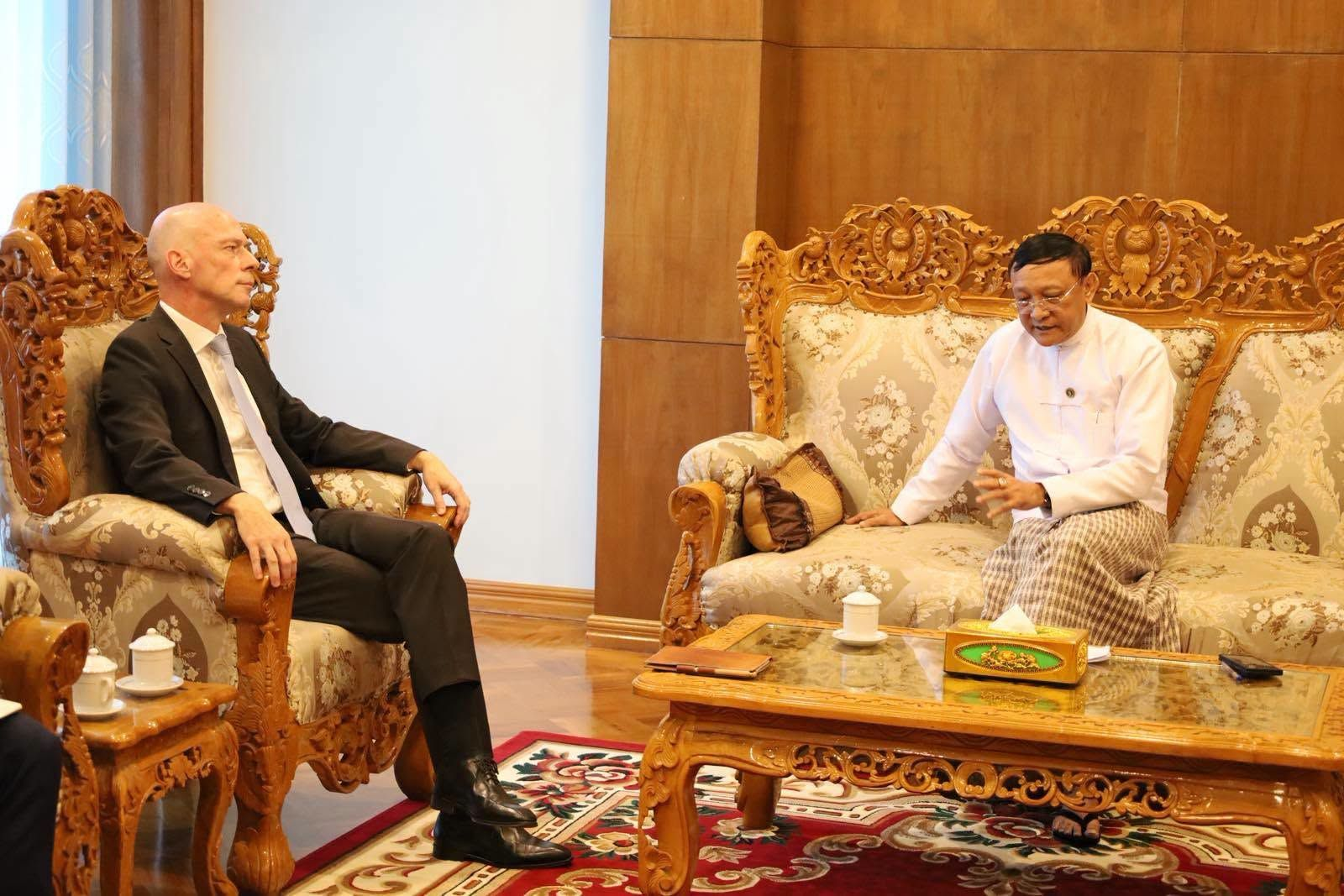
According to the military government’s announcement, Leis was summoned to Naypyidaw, where he received a formal warning from the deputy foreign minister.
On November 8, standing outside the apartment building in Yangon’s Kyaukmyaung neighborhood where U Win Myint had previously lived, Leis stated that although the former president had been released from prison, he was still not permitted to receive visitors freely or communicate with others without restrictions.
The video also stated that the United Nations continued to recognize U Win Myint as Myanmar’s president. The German Embassy further called for the unconditional release of all those unjustly detained, including Daw Aung San Suu Kyi.
Two days after the video was published on the embassy’s social media platforms, Myanmar’s military-controlled Ministry of Foreign Affairs announced that its deputy minister had summoned the German diplomat, issued a warning, and delivered a formal diplomatic note of protest.
Following the 2021 military coup, many Western embassies in Myanmar reduced their diplomatic representation from ambassadorial level to chargé d’affaires.
This arrangement was intended to avoid presenting letters of credence to military leader Min Aung Hlaing, a diplomatic procedure that could be interpreted as formally recognizing him as the country’s head of state.
Instead, these countries have maintained diplomatic relations with the military authorities through chargés d’affaires, who serve as heads of mission without holding ambassadorial rank.
Although elections were held at the end of last year, followed by the convening of parliament in April and the selection of Min Aung Hlaing as president, Western embassies have continued to avoid formally presenting ambassadorial credentials. They have instead maintained their representation at the chargé d’affaires level.
Germany appears to be among these countries.
Traditionally, Germany has coordinated its positions and statements concerning Myanmar’s military government with other European Union member states.
However, it remains unclear whether Matthias Leis, Germany’s chargé d’affaires, recorded and published the November 8 video on his own initiative or whether he had informed Germany’s Federal Foreign Office and obtained prior authorization.
The language used by the military government’s deputy foreign minister in addressing the German diplomat was notably severe.
According to the military government’s statement, the deputy minister told Leis that if he regarded U Win Myint as Myanmar’s president and was unwilling to cooperate with the current government, and therefore no longer wished to continue serving in Myanmar, the authorities would not prevent him from leaving.
The deputy minister also demanded an official explanation as to whether the video had been published with the authorization of Germany’s Federal Foreign Office or solely on Leis’s personal initiative.
He strongly warned the German diplomat against repeating such actions and stated that, should similar incidents occur, Myanmar, as the host country, would take appropriate measures in accordance with international law and established diplomatic practices.
These remarks can be interpreted as a warning approaching the final stage before the possible expulsion of a diplomat from the country.
Myanmar’s military government has previously taken similar diplomatic measures against Timor-Leste.
Recently, the military authorities objected to Timor-Leste’s ASEAN membership over its official meetings with representatives of Myanmar’s National Unity Government (NUG), including officials at the foreign ministerial level, as well as proceedings initiated in Timor-Leste’s courts concerning alleged human rights violations by Myanmar’s military following a complaint by the Chin Human Rights Organization.
The military government also ordered Timor-Leste’s diplomats to leave Myanmar within one week.
Photographs accompanying the Myanmar military government’s Foreign Ministry statement show the German chargé d’affaires looking toward the deputy foreign minister as he delivers his remarks.
The diplomat’s facial expression appears to convey frustration or displeasure, possibly reflecting his reaction to the unusually strong diplomatic warnings.
Germany and Myanmar have a long history of diplomatic relations, including periods of close cooperation under previous military-led governments.
Following General Ne Win’s takeover in 1962, Germany maintained friendly relations with Myanmar during the Burma Socialist Programme Party (BSPP) era. Similar relations continued under the State Law and Order Restoration Council (SLORC) and the State Peace and Development Council (SPDC) after 1988.
Throughout the BSPP period, the German company Fritz Werner supplied the design, manufacturing technology, and machinery used in the production of G3 assault rifles for Myanmar’s armed forces.
Following 1988, the military government also maintained favorable relations with the West German government.
Between 2011 and 2021, Germany provided development assistance to Myanmar in several sectors through the German development agency GIZ.
This assistance included agricultural technology, improvements in agricultural production, market access for agricultural products, construction and improvement of rural roads, and other development initiatives.
These historical developments demonstrate that Germany maintained relatively positive relations with successive Myanmar governments over several decades.
However, the relationship changed significantly following the military coup in 2021, marking a departure from the patterns of cooperation that had existed in earlier periods.
The latest diplomatic confrontation raises several questions about Germany’s official position.
It remains uncertain whether the German chargé d’affaires acted in accordance with established policies and instructions from Germany’s Federal Foreign Office or whether he made the decision independently within the scope of his diplomatic authority.
It also remains to be seen how Germany’s Foreign Office will assess the incident, what decisions it may take, and how it will respond to the Myanmar military government’s unusually forceful diplomatic warning.
The German government’s response will therefore be an important development to watch in the coming days.