
Myanmar Spring Chronicle — November 18 Perspective
(MoeMaKa), November 19, 2026
Min Aung Hlaing’s More Than Two-Hour Speech to Parliament
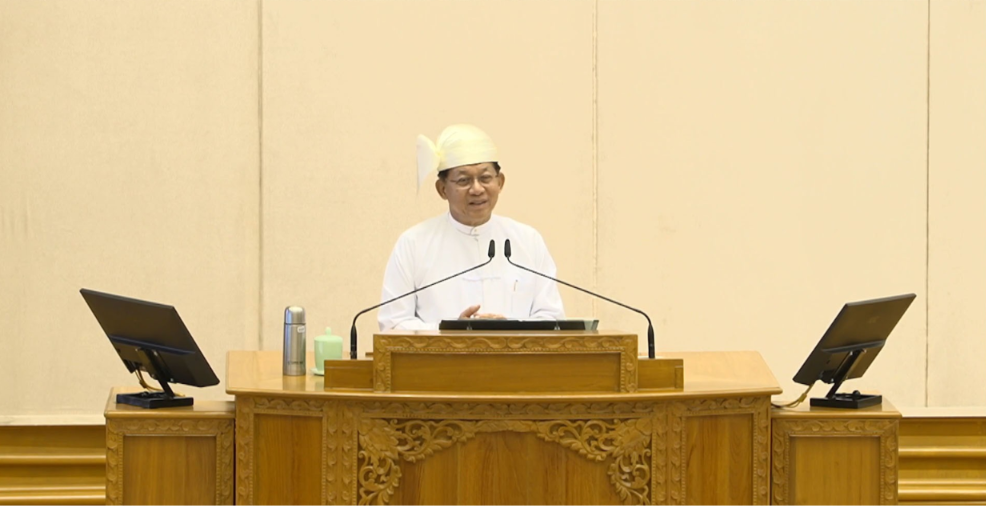
Min Aung Hlaing, the former military chief who served as Commander-in-Chief for 15 years before becoming president in April 2026, delivered a speech lasting more than two hours on the final day of the third parliamentary session.
His presidency followed the elections held in late 2025 and January 2026, which could be described as the second elections conducted during a civil war in Myanmar’s modern history.
Although the military government’s official statement described the address as a speech “on state policies and the overall situation of the country,” this particular speech differed from his previous addresses. It could be interpreted as an occasion when the president temporarily set aside diplomatic protocols and openly expressed his feelings about current economic conditions, ongoing wars, international relations, and ASEAN’s measures against Myanmar.
Rather than using diplomatic and carefully chosen language, he frequently spoke in a more informal and conversational manner.
Before the 2010 elections, military dictator Than Shwe appointed Min Aung Hlaing as Commander-in-Chief of the armed forces. From that point onward, Min Aung Hlaing gradually consolidated his power. Fifteen years later, he has become an elected president—although some countries do not recognize his presidency—and has reached a position where he can deliver a state-of-the-nation address before Parliament.
After the Union Parliament elected and confirmed Min Aung Hlaing as president in early April, he had already addressed Parliament. Therefore, this was not his first parliamentary speech. According to news reports, it was his third address to the Union Parliament.
Judging from the speech, which lasted more than two hours, there is little doubt that the topics and supporting information had been prepared in advance. However, rather than simply reading from a prepared script, he appeared to be speaking in his own words and expressions, drawing on information collected beforehand.
Some remarks also gave the impression that they may not have been intended for inclusion in the prepared speech but emerged spontaneously as he became emotionally engaged with the subjects he was discussing.
Examples included his comments about Operation 1027, launched simultaneously by the Myanmar National Democratic Alliance Army (MNDAA) and two other members of the Three Brotherhood Alliance, as well as his remarks concerning ASEAN’s restrictions on Myanmar.
In discussing these matters, his tone of voice and manner suggested a degree of emotional involvement. Although he avoided explicitly naming certain organizations or countries, his remarks were unusually direct rather than diplomatically restrained.
Remarks on Operation 1027 and Allegations of Outside Assistance
Referring to the northern Shan State military offensive involving the MNDAA and the other two members of the Three Brotherhood Alliance, the speech mentioned November 27, 2023.
Min Aung Hlaing suggested that the operation had involved assistance from parties beyond the three armed organizations themselves.
He stated:
“We have refrained from saying certain things because they are difficult to talk about. There was assistance involved.”
It is difficult to determine precisely whom he was referring to when he mentioned such assistance.
Was he referring to an armed organization such as the United Wa State Army (UWSA), which has maintained a ceasefire agreement with the Myanmar military? Or was he referring to neighboring China?
If his remarks were directed at the UWSA, they could damage relations between the two sides, given their existing ceasefire arrangement.
Alternatively, if he intended to suggest that China had provided weapons, ammunition, or technological assistance, such allegations could anger Beijing, which has continued to support Myanmar’s military government diplomatically, economically, and politically.
During the months immediately following the launch of Operation 1027, military council spokespersons had made similar remarks at press conferences. They suggested that additional assistance had been involved and claimed that Kokang armed forces had traveled through Namtit, an area controlled by the Wa organization.
The involvement of the UWSA/UWSP in Operation 1027, including its interests in the operation and allegations that it provided financial support, weapons, and ammunition, has become something of an open secret in Myanmar.
According to reports, some portions of Min Aung Hlaing’s remarks about Operation 1027 were omitted from the versions of his speech published in military government-owned newspapers.
Another subject reportedly omitted from those newspapers concerned ASEAN.
His Remarks on ASEAN and Growing Frustration
Min Aung Hlaing’s comments about ASEAN also revealed a noticeably emotional tone and manner of delivery.
Referring to a statement ASEAN had issued in recent days, he said:
“Three or four individuals in positions of authority opposed and discussed the matter according to their personal wishes.”
This particular passage was reportedly omitted from the newspaper versions of his speech.
Although his comments about ASEAN came during the final minutes of the address, they became the main headlines in subsequent news coverage.
Since the 2021 military coup, ASEAN has sought to pressure Myanmar’s military authorities through its Five-Point Consensus, which includes demands for an end to violence and unhindered humanitarian assistance.
ASEAN has also downgraded Myanmar’s representation at certain high-level meetings.
Min Aung Hlaing’s latest remarks suggest that Myanmar’s military government may now be preparing to take a tougher position in its dealings with ASEAN.
He indicated that Myanmar was considering reviewing its relationship with the regional organization.
He also questioned why ASEAN had placed pressure on Myanmar following the 2021 military takeover when military coups had occurred in other ASEAN member states without similar pressure being imposed.
These were among the objections Min Aung Hlaing raised in his speech.
ASEAN’s Historical Background and Myanmar’s Position
ASEAN was established in 1967, during an intense period of the Cold War, when the Vietnam War was affecting the three countries of Indochina, including through extensive bombing campaigns.
At its founding, ASEAN was largely conceived as a grouping of anti-communist countries.
Over the following three or four decades, however, the organization gradually shifted its emphasis away from anti-communism toward economic cooperation among countries in the region.
Thailand and Indonesia were among ASEAN’s founding members. Both countries experienced military rule and military coups in their histories.
It appears that Min Aung Hlaing was referring to these historical experiences when questioning ASEAN’s treatment of Myanmar.
His speech was delivered at a time when both Myanmar’s population and international diplomats were closely observing developments.
Nevertheless, he used language that was unusually undiplomatic and, at times, confrontational.
His remarks suggested that he harbors considerable resentment over ASEAN’s measures against his government.
Some observers interpreted his statements as a challenge to ASEAN.
Another possibility is that Myanmar’s military authorities may be considering withdrawing from ASEAN if the ongoing ASEAN summit decides to maintain the existing restrictions on their participation.
The military government might also decide that it would be preferable to maintain good bilateral relations with individual ASEAN member states that are friendly toward it, rather than continue participating in the organization under the current restrictions.
These remain possible interpretations rather than confirmed government decisions.
Economic Issues: Explanations Without Clear Solutions
Although Min Aung Hlaing devoted a substantial portion of his November 18 speech to Myanmar’s economy, he offered few concrete plans for economic growth or a convincing outlook for recovery.
Instead, much of his discussion focused on explaining the reasons behind existing economic difficulties.
Regarding restrictions on border trade, he argued that goods transported through territories controlled by ethnic armed organizations had to be seized or blocked to cut off revenue sources for those groups.
He also repeatedly cited armed conflict and instability as major reasons for the country’s economic problems.
However, he did not meaningfully address several pressing issues currently affecting the population.
These include accelerating inflation, excessively high commodity prices, and crime rates that have reportedly risen to unprecedented levels.
Despite the severity of these problems, they were largely absent from his remarks.
Conclusion
In summary, Min Aung Hlaing’s speech, delivered approximately seven months after assuming the presidency, lasted more than two hours but offered little in the way of concrete solutions to Myanmar’s pressing problems.
Instead, much of the address was devoted to expressing dissatisfaction with other organizations and countries, assigning blame for the country’s difficulties, and defending the military government’s position.
The overall impression was of a president using a major parliamentary address less to present a clear national policy direction than to voice grievances and frustrations over the challenges confronting his administration.