
Myanmar Spring Chronicle — November 12 Perspective
(MoeMaKa), November 13, 2026
Military-Backed USDP-Dominated Parliament Forms Committee to Review Amendments to the 2008 Constitution
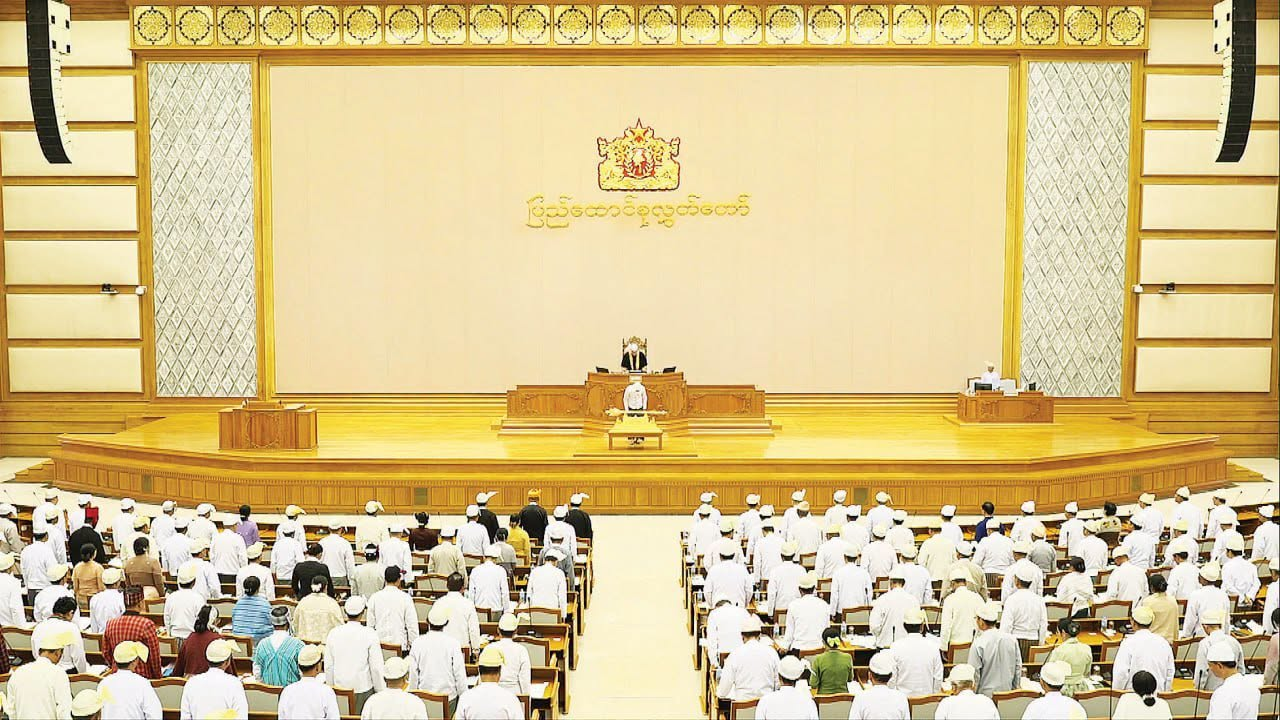
More than five years after the 2021 military coup, Myanmar’s parliament, which was convened in March 2026 and is dominated by the military-backed Union Solidarity and Development Party (USDP), established a joint committee on November 12 to review and draft legislation concerning 43 proposed amendments to the 2008 Constitution, according to news reports.
The newly formed Joint Committee for Constitutional Review and Drafting has been tasked with examining these 43 proposed changes. But what exactly do these proposals contain, and when were they originally discussed?
According to available information, the 43 proposals were developed from discussions held between 2022 and 2025, following the military coup. During that period, the military held 28 rounds of talks with certain ethnic armed organizations and another 14 rounds with representatives of political parties.
The contents of the proposals became known to political circles only after military leader Min Aung Hlaing, who assumed the presidency this year, submitted them to the USDP-dominated parliament in July.
Broad assessments of the 43 proposed amendments suggest that they are primarily intended to strengthen executive authority. One notable criticism is the absence of any proposal to amend Section 261 of the Constitution, which concerns the appointment of state and regional chief ministers.
During the administration of the National League for Democracy (NLD), there had been proposals to amend Section 261 to allow state and regional legislatures to elect their respective chief ministers. At the time, the military supported such an amendment. However, the provision is conspicuously absent from the current list of 43 proposed changes.
Following the 2021 military coup, anti-military dictatorship forces have maintained that the 2008 Constitution should be abolished or that it had already become invalid as a consequence of the coup. For these groups, the question is no longer how to amend the Constitution but whether it should continue to exist at all.
For the National Unity Government (NUG), locally organized People’s Defense Forces (PDFs), and certain ethnic armed organizations that adopted armed resistance following the coup, constitutional amendments are no longer a matter of significant interest.
Their priorities instead center on defeating the military through armed struggle or defending territories under their control. For organizations that no longer recognize the legitimacy of the 2008 Constitution, whether it is amended has become largely irrelevant.
This raises another question: Why have certain ethnic armed organizations continued to participate in peace negotiations with the military’s National Solidarity and Peace Negotiation Committee (NSPNC) in recent years, presenting their political demands through these discussions?
What do organizations such as the United Wa State Army (UWSA), National Democratic Alliance Army (NDAA), Shan State Progress Party/Shan State Army (SSPP/SSA), Restoration Council of Shan State (RCSS), New Mon State Party (NMSP), Karen National Union/Karen National Liberation Army Peace Council (KNU/KNLA-PC), and Shanni Nationalities Army (SNA) expect to gain from the 2008 Constitution? The same question applies to the Myanmar National Democratic Alliance Army (MNDAA) and Ta’ang National Liberation Army (TNLA), which have also engaged in discussions in recent years.
For most ethnic armed organizations, amending the Constitution is not their primary concern. Some participate in political dialogue mainly to ensure that neither the military nor other armed groups interfere with the territories they currently control.
During negotiations, these organizations have sought recognition of their territorial control from the military government. However, the military’s response has reportedly remained consistent: such matters must be addressed in accordance with the 2008 Constitution and through parliamentary procedures.
Other ethnic armed organizations have participated in military-sponsored peace talks because their current circumstances do not permit direct confrontation with the military. Their participation can therefore be understood as a pragmatic effort to maintain a delicate balance, avoiding open conflict while preserving their existing positions.
Political parties operating under the Political Parties Registration Law, which was revised after the 2021 coup, also lack the broad public support necessary to pursue substantial constitutional reform.
The USDP, widely regarded as a political organization backed by the military and closely aligned with its interests, is almost certain to follow the military’s positions and priorities in any constitutional amendment process.
Among the political parties operating since 2021, only the People’s Party appears to have maintained a degree of political activity, apart from certain ethnic political parties.
In an interview with a news outlet in early 2025, People’s Party leader U Ko Ko Gyi stated that if the 43 proposed constitutional amendments agreed upon at the time were later rejected, he would not remain silent.
Nearly two years later, however, U Ko Ko Gyi has been appointed as a member of the Union Consultative Council. As a result, he no longer appears to be in a position to speak as openly about such matters as he once did.
In reality, the government led by Min Aung Hlaing, which came to power through elections held more than five years after the military coup under carefully designed restrictions and arrangements, appears intent on conducting a largely symbolic constitutional amendment process.
It can reasonably be anticipated that the government will seek to amend only a handful of relatively insignificant provisions drawn from recommendations made by ethnic armed organizations that are not currently engaged in fighting against the military.
The broader objective appears to be demonstrating to the public that the 2008 Constitution is a document that can be amended and has, in fact, undergone amendments.
Rather than pursuing meaningful constitutional reform or fundamentally changing the distribution of political power, the process seems designed primarily to create the appearance of constitutional flexibility while preserving the military’s dominant position within Myanmar’s political system.