Myanmar Spring Chronicle — November 8 Perspective
(MoeMaKa), November 9, 2026
Genocide Allegations Against Myanmar: ICJ Expected to Deliver Judgment in the Coming Days
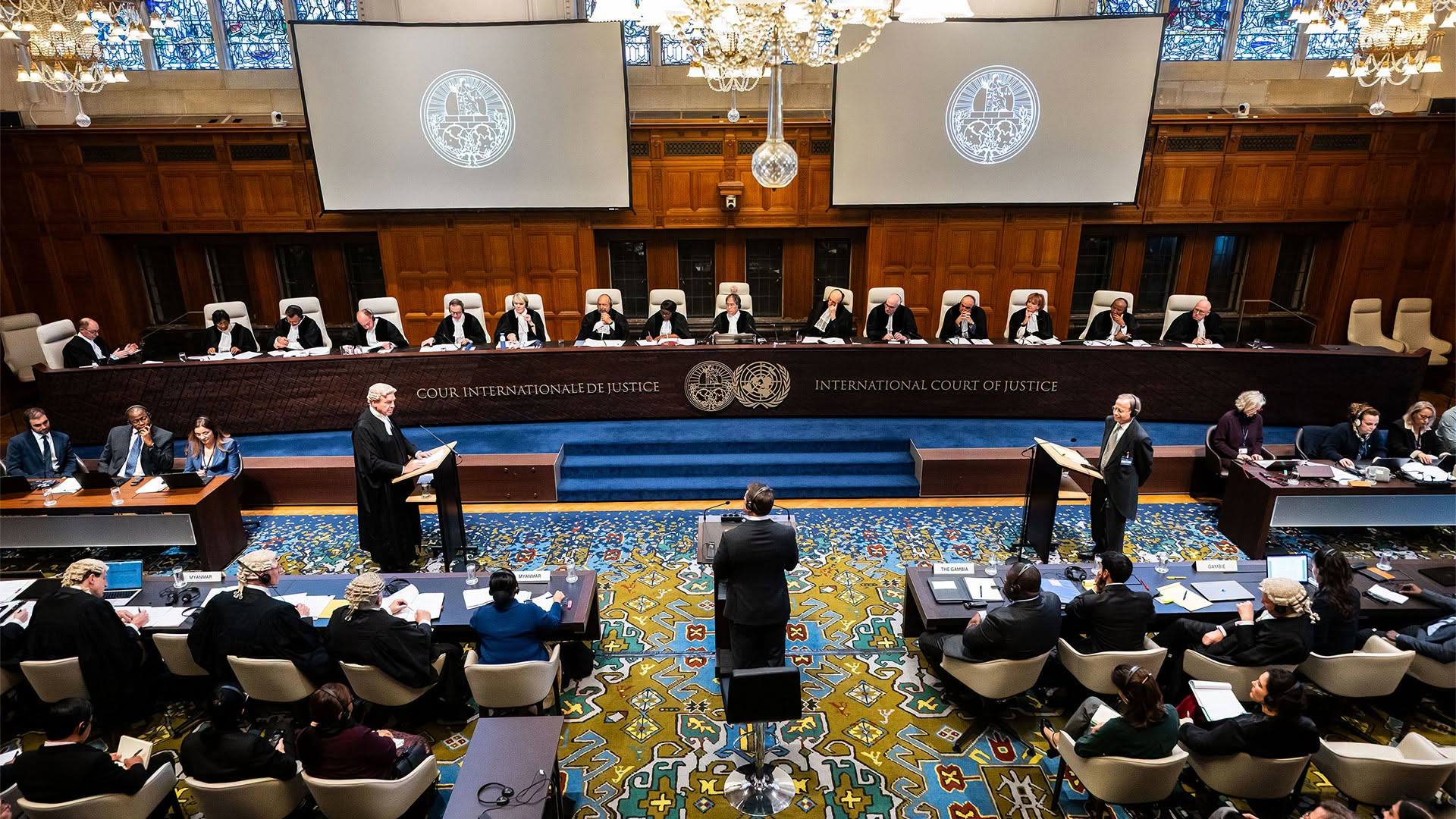
The International Court of Justice (ICJ) has announced that it will deliver its judgment on November 19 in the genocide case filed by The Gambia against Myanmar in 2019, nearly seven years after the proceedings began.
The case concerns allegations of genocide against the Rohingya population in northern Rakhine State during August and September 2017. Three successive Myanmar governments have denied the existence of the Rohingya as a distinct ethnic group.
On the morning of August 25, 2017, the Arakan Rohingya Salvation Army (ARSA) launched coordinated attacks on more than 30 police posts and border guard outposts in northern Rakhine State. The Myanmar military subsequently launched clearance operations across the region, during which civilians, including children, women, and elderly people, were killed in villages.
These military operations also reached villages such as Inn Din, where relations between Rohingya and ethnic Rakhine communities had remained relatively peaceful even during earlier episodes of communal violence, including the unrest in Maungdaw in 2012, the second wave of violence that October in Mrauk-U, Kyaukphyu, and Pauktaw, and the violence in Thandwe Township in southern Rakhine State in 2013.
The attacks initiated by ARSA in 2017 became the spark for what developed into the Myanmar military’s most intense clearance operations since June 2012. Based on available news reports and documented accounts, estimates suggest that at least 6,000 and possibly as many as 10,000 Rohingya civilians were killed.
ARSA was also responsible for the killings of hundreds of civilians. However, the scale of killings attributed to ARSA was vastly different from the number of deaths resulting from operations conducted by the military of a sovereign state.
In the months following these events, accounts provided by some members of the Myanmar military and police security forces who had participated in the operations offered a basis for estimating the approximate number of people killed.
Nevertheless, officials in the then-ruling National League for Democracy (NLD) government appeared unwilling to regard these events as war crimes, let alone genocide.
The Gambia’s Case Against Myanmar
Bangladesh, which had received and accommodated approximately 700,000 to nearly one million Rohingya refugees as a consequence of the violence, did not bring a case before an international court concerning the killings in northern Rakhine State.
Instead, in 2019, The Gambia filed an application with the International Court of Justice, accusing Myanmar of committing genocide during the 2017 operations.
Later that year, Aung San Suu Kyi, who was serving as State Counsellor and Minister of Foreign Affairs and was effectively the head of Myanmar’s civilian government, led a delegation to the ICJ in the Netherlands to respond to the allegations.
At the time, public opinion in Myanmar was deeply divided over the Rohingya genocide allegations.
A majority of the population opposed the genocide case brought against Myanmar before the ICJ. Many were also largely unaware of the full extent of the alleged genocide or war crimes committed by the Myanmar military.
Importantly, the genocide case filed against Myanmar in 2019 was not directed against individual perpetrators or those who had issued orders. Rather, it was a case against the state of Myanmar itself.
This distinction means that even if the country’s president, prime minister, military commander-in-chief, or other leaders change, the legal proceedings continue against the state. Successive governments therefore inherit responsibility for responding to the case.
The ICJ Proceedings Following the 2021 Military Coup
After the February 2021 military coup, the newly established National Unity Government (NUG) requested permission from the ICJ to represent Myanmar in the proceedings.
However, the ICJ continued to deal with representatives of the military authorities based in Naypyidaw.
The NUG also announced that it was withdrawing the preliminary objections submitted under Aung San Suu Kyi’s leadership in 2019, which had challenged the admissibility of the case against Myanmar.
Nevertheless, the ICJ did not appear to take that announcement into consideration.
During the nearly six years since the military coup, representatives of Myanmar’s military authorities have traveled to the Netherlands twice to present arguments before the court.
Now, more than seven years after the case was originally filed, the ICJ is reportedly preparing to deliver its final judgment on the genocide allegations against Myanmar.
International Political Pressures Surrounding the Courts
The anticipated judgment comes at a time of considerable tension in international politics.
The United States and Israel have challenged the authority of the International Criminal Court (ICC), including through sanctions and other measures.
Meanwhile, the ICJ has also faced diplomatic criticism questioning its credibility, including criticism involving Navi Pillay, a female judge described in the original account as a recent Nobel Peace Prize laureate.
Separately, proceedings concerning the 2017 killings of Rohingya civilians have also been pursued through international criminal justice mechanisms.
Although Myanmar is not a party to the ICC’s founding treaty, efforts have been made to obtain arrest warrants against individuals allegedly responsible for the atrocities, including Min Aung Hlaing, who was Myanmar’s military commander-in-chief at the time.
The original account states that Argentina sought arrest warrants through the ICC and that no final decision had yet been issued.
What Would an ICJ Genocide Judgment Mean for Myanmar?
If the International Court of Justice determines on November 19 that Myanmar was responsible for genocide against the Rohingya, the decision would represent a historic development in international law.
Since the ICJ was established, it has not found a sovereign state directly responsible for committing genocide.
The court has previously determined that genocide occurred in specific circumstances, but it has not held a government or state directly responsible for perpetrating genocide.
One important precedent concerns the massacre of thousands of Bosnian Muslim civilians in Srebrenica during the conflicts that followed the breakup of the former Yugoslavia in the 1990s.
The ICJ determined that the Srebrenica massacre constituted genocide. However, it ruled that Serbia was not directly responsible for committing the killings, although the court separately found that Serbia had failed to prevent genocide and punish those responsible.
Therefore, if the ICJ rules that Myanmar bears direct state responsibility for committing genocide against Rohingya civilians in northern Rakhine State in 2017, Myanmar would become the first country to receive such a judgment from the court.
The decision expected in approximately ten days at the ICJ in The Hague, Netherlands, could consequently become a landmark moment not only for Myanmar but also for the development of international law concerning genocide and state responsibility.
Editorial note: This is a translation of the supplied Burmese commentary, not an independently verified news report. Several claims warrant fact-checking before publication, particularly the reported November 19 judgment date, the description of Navi Pillay as an ICJ judge and Nobel laureate, and the account linking Argentina to ICC arrest-warrant proceedings. The ICJ and ICC are separate institutions, and Argentina’s universal-jurisdiction proceedings should not be conflated with ICC proceedings.