
Myanmar Spring Chronicle — October 27 Perspective
(MoeMaKa), October 28, 2026
Tensions Between Ethnic Organizations and Communities Taking on the Character of Ethnic Conflict
On October 23, the Shan State Joint Action Committee (SSJAC) issued a statement titled “Strong Opposition to Coercive Threats and Domination Over the Fundamental Rights and Cultures of Ethnic Communities in Northern Shan State.”
The statement primarily expressed strong opposition to policies and practices being implemented by the Myanmar National Democratic Alliance Army (MNDAA) in northern Shan State. These included issues concerning language use, land ownership, foreign influence, historical and cultural identity, and violations of freedom of expression.
Before examining the statement in detail, it is useful to understand what the SSJAC is and which organizations are involved.
The SSJAC was established in 1996 as a political alliance between the Shan Nationalities League for Democracy (SNLD) and the Shan State Peace Council (SSPC). The organization marked its 30th anniversary in June this year.
Following the 2021 military coup, the SNLD declined to register under the amended political party registration laws introduced by the reconstituted Union Election Commission. The party did not accept those legal changes and therefore did not seek renewed registration.
At present, rather than engaging in conventional political party activities, the SNLD appears to be concentrating on issuing statements concerning Shan State and Shan national affairs.
The Shan State Peace Council (SSPC), meanwhile, reportedly included the Shan State Army (SSA) and the Shan State National Army (SSNA).
The SSJAC’s stated objectives include eliminating dictatorship, ensuring civilian supremacy, establishing a federal democratic union, and bringing about a civilian government.
The central concerns raised in the SSJAC’s latest statement relate to Shan communities living in MNDAA-controlled areas of northern Shan State, particularly places such as Hsenwi and Kutkai.
According to the statement, signs written in the Shan language have been replaced with signs incorporating Chinese, while Hsenwi has been renamed Mupang.
The SSJAC also objects to land and administrative laws introduced by the MNDAA, alleging that they create opportunities for foreigners to enter the region without restrictions and acquire land ownership through direct or indirect means.
Another major concern is the alleged compulsory use of a language unfamiliar to local communities—apparently referring to Chinese—as an official language in government offices and public spaces.
The SSJAC strongly opposes these developments.
The Kokang armed organization, the MNDAA, operates in areas bordering China. Its communities have extensive cultural, linguistic, educational, and commercial connections with China.
In this respect, the Kokang population differs from several other ethnic communities in northern Shan State, including the Shan, Palaung, Kachin, Pa-O, and Lisu. Its cultural and linguistic connections with China are, in certain respects, comparable to those of the Wa communities.
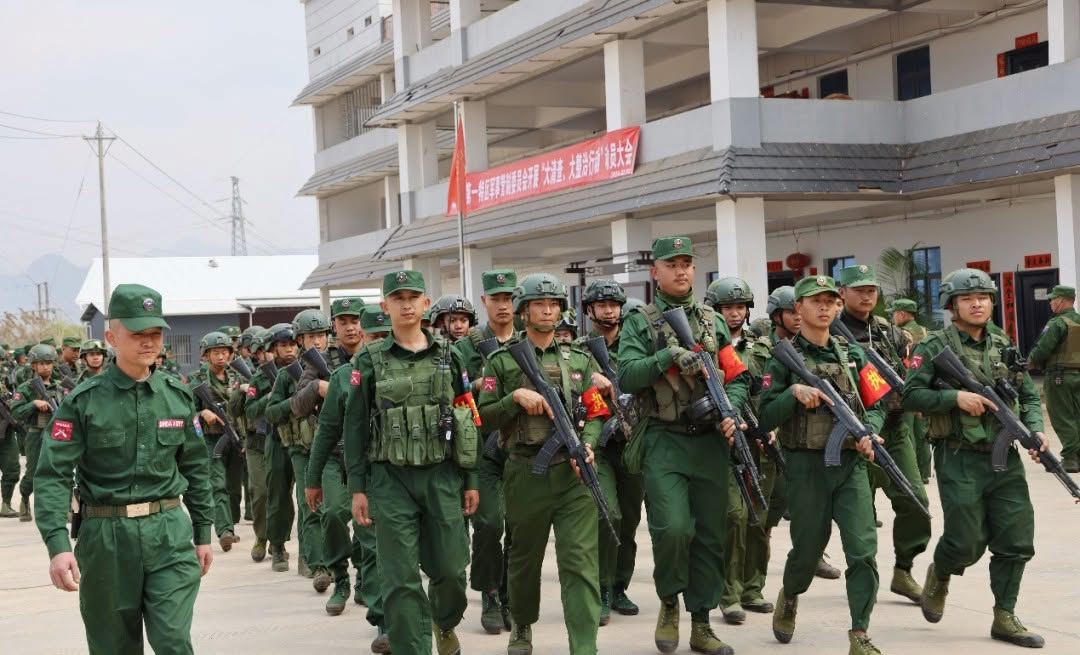
The problems now emerging in northern Shan State are also connected to the administrative, economic, and other policies the MNDAA has introduced in territories captured following Operation 1027, which marks its third anniversary on October 27.
Exactly three years ago, the Three Brotherhood Alliance—comprising the MNDAA, Ta’ang National Liberation Army (TNLA), and Arakan Army (AA)—launched Operation 1027 against military junta positions, bases, and towns.
Within several months, the alliance captured numerous towns, military bases, territories, and battalion headquarters. Approximately ten months into the offensive, it also captured Lashio and the military’s Northeastern Regional Military Command, taking thousands of prisoners of war.
In 2025, however, the MNDAA returned Lashio to the military authorities while continuing to control and administer other territories.
During 2026, the MNDAA also launched an offensive against Kutkai, which had been largely controlled by the TNLA, and subsequently took control of the town and established its administration.
Following their military victories, some ethnic armed organizations have changed town entrance signs to reflect their own ethnic languages, introduced their languages into school curricula, and restricted or closed schools teaching in other languages.
There is nothing inherently wrong with ethnic armed organizations pursuing their original objectives of national liberation and the preservation of their languages and cultures.
However, rapidly replacing the languages and signs of other ethnic communities, or imposing compulsory language instruction in schools, has generated grievances of the kind now reflected in the SSJAC’s statement.
The issuance of a protest statement by the SSJAC does not necessarily mean that armed clashes will occur in territories bordering Kokang-controlled areas.
Nevertheless, these developments could deepen grievances between ethnic communities living in northern Shan State and increase tensions between the MNDAA and other ethnic armed organizations operating in the region.
Many ethnic armed organizations were originally established to defend their peoples’ identities, languages, cultures, and territories.
Consequently, attempts to impose a particular language or culture on communities that have lived in a territory for generations could potentially lead to confrontation, including armed conflict, between ethnic organizations.
On October 27, the MNDAA responded to the SSJAC’s statement by issuing an open letter addressed to the committee.
In its response, the MNDAA argued that the SSJAC’s allegations were entirely disconnected from conditions on the ground.
The MNDAA stated that schools in Special Region 1 teach Burmese as the primary language of instruction, while Chinese is offered as an optional subject. It also maintained that schools permit the teaching of relevant ethnic languages.
To support these claims, the MNDAA cited several basic education high schools in Kutkai and Hsenwi districts, including areas associated with Lashio.
Regarding land ownership and foreign influence, the MNDAA denied that foreigners are permitted to own land.
It stated that land ownership is restricted to individuals holding national citizenship scrutiny cards or locally issued citizenship identification documents.
Concerning the alleged renaming of towns and villages, the MNDAA maintained that original place names remain in use.
It explained that certain areas administered by local Kokang communities use additional Kokang-language names alongside existing names solely to facilitate administrative operations.
The MNDAA further claimed that conditions in northern Shan State’s Special Region 1 remain peaceful and stable, with substantial efforts underway to improve the economy, education, and healthcare.
It also stated that its administration is implementing policies to ensure equality among all ethnic communities and guarantee freedom of religious belief and worship.
In Section 7 of its open letter, which contained a counterwarning in response to what it characterized as threats from the SSJAC, the MNDAA firmly rejected the committee’s accusations.
It warned that it would respond firmly, in accordance with the law, to any political or social activities or interference intended to undermine regional peace and stability or provoke ethnic conflict.
The strong language used by both the SSJAC and the MNDAA in their publicly released statements and open letters suggests the potential for instability in parts of northern Shan State under MNDAA control.
This is particularly relevant to towns and villages with substantial Shan populations and areas bordering territories where Shan armed organizations operate.
The MNDAA reached a ceasefire agreement with the military authorities in early January 2025 and handed Lashio back to them in April.
It subsequently announced that towns captured by its forces and allied organizations during Operation 1027 would be incorporated into Special Region 1.
These developments created distrust and dissatisfaction among certain ethnic armed organizations and groups opposed to military rule.
Meanwhile, anti-Chinese-government sentiment has recently become more visible.
Public exchanges between Zhao Jing, a woman described as a pro-China lobbyist, and a Myanmar news organization have also contributed to an atmosphere in which criticism of the Chinese government is increasingly being extended to ethnic armed organizations perceived as maintaining close relationships with Beijing.
Although the MNDAA may be aware of these developments to some extent, its open letter responding to the SSJAC did not directly address these broader concerns.
China’s involvement in northern Shan State’s armed conflicts and its influence over the balance of power among armed organizations have also contributed to a situation in which some supporters of the military and some supporters of democracy share opposition to the Chinese government’s role.
This is a political reality that the MNDAA needs to approach with considerable caution.