
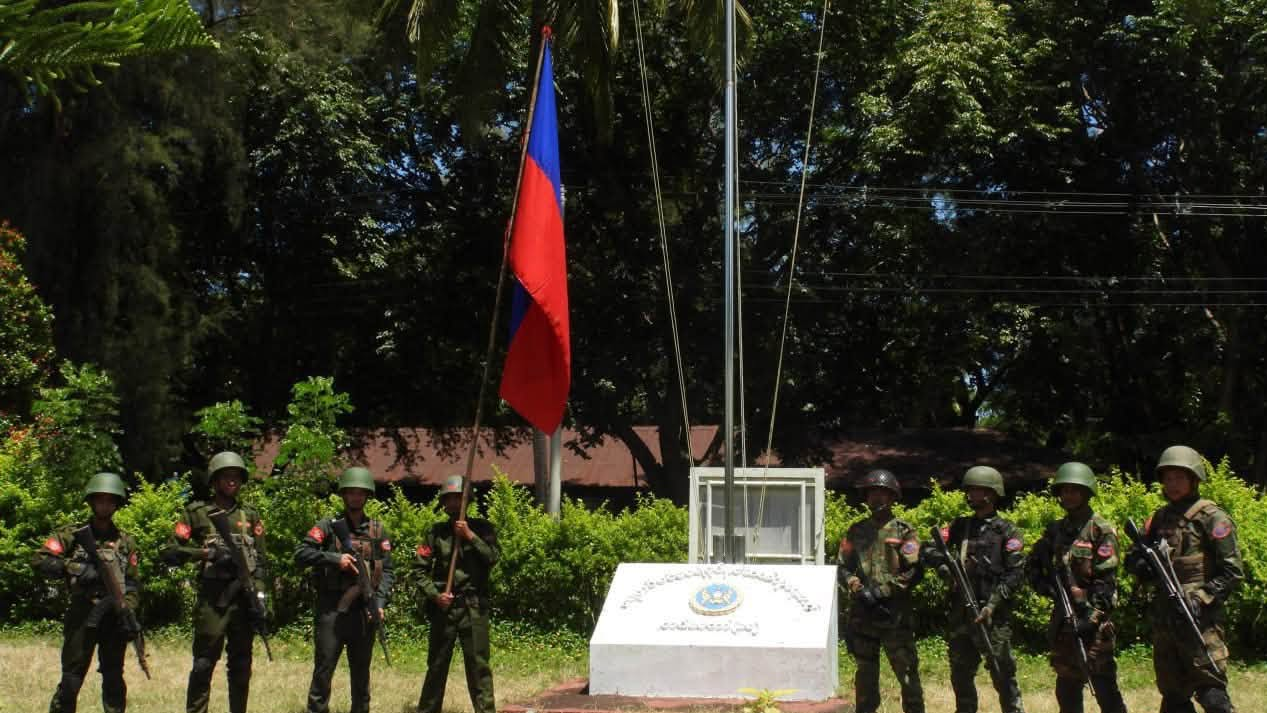
Myanmar Spring Chronicle – Scenes from October 17
(MoeMaKa), October 18, 2026
Signs That Sittwe May Be Slipping Away: The Military Situation in and Around Rakhine State’s Capital
The Arakan Army (AA) has been gradually advancing toward Sittwe, the capital of Rakhine State. After capturing and establishing control over approximately 90 percent of Rakhine State’s towns and territory during its military offensives beginning in late 2023 and continuing into 2024, the AA left Sittwe as one of the few remaining areas under Myanmar military control. In recent days, however, there have been increasingly visible signs that the state capital itself may soon come under AA control.
For Myanmar’s military, retaining control of Sittwe is more important than holding many of the other towns in Rakhine State.
Despite losing approximately 90 percent of the state’s territory and towns, the military has continued to maintain a Rakhine State administrative government in Sittwe. By retaining the state capital, the military can still claim that it has not completely lost control of Rakhine State.
In reality, however, the administration based in Sittwe exercises authority over only a handful of areas, including Sittwe, Kyaukphyu, and Manaung. It has virtually no ability to administer public services, economic activities, healthcare, or other essential functions for the population living in the roughly 90 percent of Rakhine State controlled by the AA. Instead, the military has imposed its “four cuts” strategy on these territories, restricting the movement of goods, resources, and essential supplies.
Following elections held in late 2025 and 2026, Min Aung Hlaing assumed the presidency and appointed his trusted associate Ye Win Oo as the new commander-in-chief of the armed forces.
Under Ye Win Oo’s command, the military began preparing several offensives aimed at regaining territory in Rakhine State. These included plans to advance into northern Rakhine from the Matupi area of southern Chin State, launch operations along the Minbu–Ann road, and open another offensive from Gwa, near the border with Ayeyarwady Region.
The military also attempted to advance toward Ponnagyun, near Sittwe, and conducted operations in recent weeks aimed at capturing Ngapyi Island in Pauktaw Township.
However, while military columns advancing toward Ponnagyun were forced to retreat toward Sittwe, attempts to land troops on Ngapyi Island involved intensive naval and aerial attacks. At the same time, AA forces were advancing in the opposite direction, toward Sittwe itself.
According to reports emerging on October 17, AA troops captured Military Engineering Battalion 908 and advanced to within approximately four miles of the Sittwe Regional Operations Command headquarters.
These developments suggest that the AA may be approaching a position from which it could capture Sittwe.
The military, however, is expected to make every effort to retain the city, particularly because maintaining control of the state capital allows it to claim that a functioning Rakhine State administration still exists.
The military’s position in Sittwe is further complicated by the fact that the AA controls all major roads leading out of the city. If Sittwe falls, military personnel and officials would have little choice but to withdraw by air or sea.
For those serving within the military-controlled administrative apparatus in Sittwe, the current situation is likely to be regarded as one of the most dangerous they have faced.
Under the command of the new military chief, Ye Win Oo, the military adopted a strategy of opening multiple fronts both inside and outside Rakhine State in an effort to stretch and weaken AA forces.
Nevertheless, the AA has not only maintained strong defensive positions against these offensives but has also begun exploiting weaknesses in the military’s defensive lines and launching counteroffensives.
Despite its military successes, the United League of Arakan/Arakan Army (ULA/AA) continues to face significant challenges.
Recruiting new soldiers remains difficult, while the organization has yet to develop sufficiently effective weapons and strategies to defend against aerial attacks. Consequently, AA forces and civilians in areas under their control must continue taking measures to avoid airstrikes.
Economic conditions are equally challenging. Much of the territory controlled by the AA remains subjected to the military’s four cuts blockade, severely restricting trade, transportation, food supplies, and economic activity.
Livelihood opportunities have steadily diminished, and the people of Rakhine State are struggling to survive under conditions that may be even more difficult than those experienced in other conflict-affected regions of Myanmar.
The ULA/AA has been remarkably successful in mobilizing support among the Rakhine population through appeals to national identity and aspirations for self-determination.
Its control over approximately 90 percent of Rakhine State, together with its considerable military strength, has become a source of admiration among other ethnic armed organizations and People’s Defense Forces (PDFs) operating elsewhere in Myanmar.
Nevertheless, there are clear indications that the military is determined to recapture at least part of the territory currently controlled by the AA.
The military appears prepared to redeploy troops and weapons from other regions of Myanmar to launch renewed offensives in Rakhine State.
Another indication of this determination emerged during the recent ceremony in Naypyidaw marking the 11th anniversary of the Nationwide Ceasefire Agreement (NCA).
At the ceremony, military leader Min Aung Hlaing renewed his invitation to three armed organizations—the Karen National Union (KNU), the All Burma Students’ Democratic Front (ABSDF), and the Chin National Front (CNF)—to participate in peace talks.
Notably, however, the Arakan Army was not included in the invitation.
The military administration has also invited the Kachin Independence Army (KIA) to participate in negotiations, although the two sides have reportedly been unable to agree on a venue for the proposed meeting.
The ongoing military offensives, the absence of an invitation to the AA for political dialogue, and Rakhine State’s strategic importance as a location for major Chinese and Indian economic projects all suggest that the military is determined to prevent the complete loss of the state.
Rakhine State occupies a particularly important position because of the economic and strategic interests of China and India, two powerful neighboring countries.
As fighting intensifies and the military seeks to regain territory it has lost, an important question remains: What roles might China and India play in the next phase of the conflict in Rakhine State?
Their potential involvement, whether through diplomatic pressure, economic interests, or other forms of engagement, will be an important factor to watch as the struggle for control of Rakhine State continues.