
Myanmar Spring Chronicle – Scenes from October 19
(MoeMaKa), October 20, 2026
Myanmar’s Armed Conflict and Excessive Gold Mining
Colonel Naw Bu, spokesperson for the Kachin Independence Army (KIA), told BBC Burmese that anyone with objections or concerns about gold mining activities in Chipwi Township, Kachin State, could file complaints with the KIA.
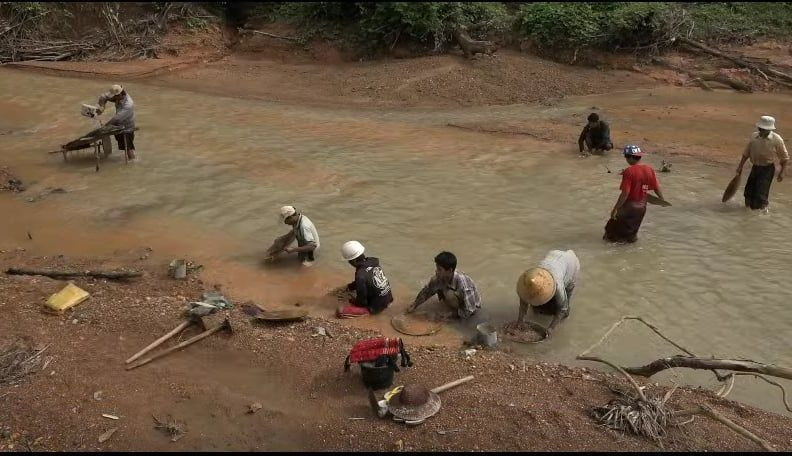
Chipwi is located along the Mali Hka River, one of the two rivers that eventually join to form the Ayeyarwady River. According to the BBC report, heavy machinery arrived near the confluence of Chipwi Creek and the Mali Hka River last month. Local residents believe preparations are underway for gold mining operations, raising concerns about the potential consequences.
Gold mining can cause extensive environmental damage, including the destruction of rivers and streams, water contamination, deforestation, and the release of mercury and other toxic chemicals into waterways. These pollutants can poison aquatic life and pose serious health risks to local communities through the consumption of contaminated fish and the use of polluted water.
Mining activities can also destroy agricultural land, making farming impossible in affected areas. Furthermore, sediment accumulation in rivers and streams can increase the risk of flooding during the rainy season. These are among the many harmful consequences associated with uncontrolled gold mining.
Environmental destruction and toxic pollution caused by gold mining were not entirely absent before Myanmar’s military coup in 2021. Such problems already existed in certain parts of the country. However, since the coup, gold mining operations have expanded significantly, as environmental regulations and restrictions have increasingly been disregarded.
In many areas, decisions about where mining can take place now depend almost entirely on the armed organization controlling the territory. As a result, gold mining has proliferated across the country.
Taxes collected from mining operations, payments made to armed organizations in exchange for mining rights, and contributions in cash or gold are determined independently by the authorities controlling each area. With little or no enforcement of environmental standards, various forms of gold extraction have emerged throughout Myanmar.
In places such as Thabeikkyin in Mandalay Region, gold is extracted through excavation and pit mining. However, alluvial gold mining using water, particularly through floating mining platforms and dredging operations, has become one of the most widespread methods.
These operations are now found not only along major rivers such as the Ayeyarwady and Chindwin but also along their tributaries and smaller waterways. Gold mining has even expanded into reservoir areas, including the Thaphanseik Dam.
One particularly serious incident involving disputes between mining operators and local residents occurred in northern Shan State.
Villagers protested when heavy machinery was brought to a stream that served as their community’s primary source of drinking and household water. During the confrontation, members of the Myanmar National Democratic Alliance Army (MNDAA) reportedly opened fire, killing six villagers.
Disputes over gold mining operations, allegations of financial misconduct, and controversies surrounding mining concessions have frequently appeared in news reports from Sagaing Region, Kachin State, and northern Shan State.
In recent months, reports have also emerged concerning alleged corruption involving gold-mining permits along the Chindwin River in Mingin Township.
According to these reports, Myanmar’s National Unity Government (NUG) has been investigating allegations that two officials—the head of the Mingin Township People’s Administration Team and the head of the local People’s Defense Team—misappropriated approximately 15 billion kyats.
The allegations themselves illustrate the potentially enormous revenues generated by gold-mining operations.
Some reports indicate that a single floating gold-mining operation may be required to pay between 70 million and 80 million kyats in taxes or fees. Given the large number of mining operations, the total revenue collected from this industry could be extraordinarily high.
At the same time, the greater the number of floating mining platforms, the more extensive the environmental damage to rivers, waterways, and surrounding ecosystems.
Another location recently highlighted in reports about environmental damage from gold mining is the Thaphanseik Dam.
During the recent mid-monsoon flooding in the Mu River basin, some observers identified gold mining inside the Thaphanseik reservoir as one of the contributing factors.
According to these accounts, extensive mining activities using floating platforms over the past several years have caused sediment to accumulate in the reservoir. This has allegedly reduced its water-storage capacity, increasing the risk of downstream flooding during periods of heavy rainfall.
In northern Mandalay Region, the Mandalay People’s Defense Force (MDY PDF) controlled areas including Thabeikkyin and Tagaung for a certain period. During that time, revenues collected from gold mines were reportedly substantial.
The importance of these revenues became apparent when a member of the MDY PDF’s political leadership committee and another senior leader were detained. The stated reason for their detention was their alleged failure to hand over 16 viss of gold collected from mining taxes.
The sharp rise in global gold prices over recent years has provided another powerful incentive for expanding gold mining operations.
Previously, gold traded at approximately $2,000 per ounce. However, as wars and geopolitical conflicts intensified around the world, investors increasingly turned toward gold as a store of value rather than conventional investments.
As a result, global gold prices climbed steadily, eventually exceeding $4,000 per ounce.
This surge has further encouraged gold exploration and extraction in Myanmar, particularly through mechanized mining and floating dredging operations.
Following Myanmar’s 2021 military coup and the subsequent escalation of armed conflict, the need to finance military operations has created strong incentives for armed organizations to exploit natural resources.
The extraction and sale of natural resources, along with the collection of taxes and fees from mining businesses, have become important sources of funding for armed groups.
During the ongoing conflict, environmental safeguards and regulations governing gold extraction have largely been ignored. Meanwhile, local communities, who must bear the immediate and long-term consequences of environmental destruction, have little ability to prevent mining operations backed by armed organizations.
Another area suffering severe environmental damage from gold extraction is the confluence of the Ayeyarwady River, known as Myitsone, north of Myitkyina in Kachin State, as well as sections of the Ayeyarwady River itself.
In recent months and years, photographs circulating on social media have shown extensive environmental destruction caused by mechanized gold mining around the Myitsone area.
It has not always been clear which armed organization exercises effective control over these locations. Nevertheless, the images have highlighted the scale of destruction associated with floating gold-mining operations.
The expansion of environmentally destructive gold mining during Myanmar’s civil war is not limited to areas controlled by the military junta, an institution widely criticized for its lack of accountability to the public.
Revolutionary armed organizations have also become dependent on taxes and revenues generated by gold mining.
This financial connection is also one reason the military junta has repeatedly carried out airstrikes against gold-mining platforms and operations in areas such as Kanbalu and Mingin in Sagaing Region.
Although revolutionary organizations may find it difficult to ignore or completely abandon the revenues generated by gold mining, they must also consider the serious environmental consequences of these activities.
The destruction of rivers, contamination of water resources, degradation of agricultural land, and broader ecological damage will have profound effects on local communities, both immediately and for generations to come.
Ultimately, the need to finance an ongoing armed struggle must be weighed against the long-term environmental costs and the well-being of the communities whose lives and livelihoods depend on these natural resources.