
Myanmar Spring Chronicle — October 25 Perspective
(MoeMaKa), October 26, 2026
Does Ethnic Unity Now Require More Than Military Alliances?
Looking at Myanmar’s current political situation and armed conflict, it is becoming increasingly clear that forming military alliances and building political unity are not the same thing. Different forces may cooperate militarily to confront a common enemy, but that does not necessarily mean they share the same vision of how a future state should be structured, how power should be distributed, or how the right to self-determination of ethnic nationalities should be guaranteed.
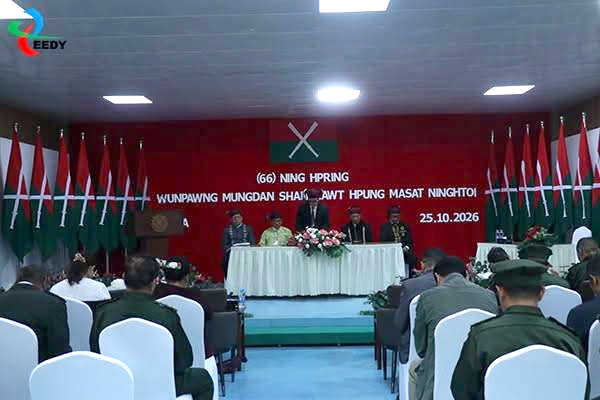
On October 25, marking the 66th anniversary of the founding of the Kachin Independence Organization (KIO), its chairman, General N’Ban La, urged ethnic nationalities to respond collectively to attempts to divide and rule them. He accused the military authorities of deliberately creating conflicts among ethnic groups and exploiting those divisions to maintain control. In particular, he pointed to armed conflicts involving the Shanni Nationalities Army (SNA).
Meanwhile, the Committee Representing Pyidaungsu Hluttaw (CRPH) and the National Unity Government (NUG) sent congratulatory messages commemorating the KIO’s anniversary. Such gestures reflect mutual political recognition. However, how far these expressions of solidarity, public statements, and alliance relationships have progressed toward concrete political agreements remains a separate question that deserves closer examination.
Military Alliances and Political Alliances
Since the 2021 military coup, Myanmar’s armed resistance has undergone significant changes. Ethnic armed organizations that have fought for decades for self-determination and territorial autonomy have increasingly cooperated with newly emerging resistance forces, including young Bamar people and others from different parts of the country. Military training, assistance with weapons and technical expertise, and coordinated operations have become prominent features of these relationships.
However, successful military cooperation does not necessarily mean that political objectives have become identical. Each ethnic armed organization has its own history, territory, ethnic interests, and political aspirations. Some prioritize autonomy within a federal union, while others seek broader forms of self-determination. Transforming these differing aspirations into a common political agreement is a far more complicated undertaking than establishing a military alliance.
Having a Common Enemy Does Not Yet Mean Having a Common Future
Myanmar’s political history offers numerous examples of groups uniting against a common enemy, only to develop disagreements once the circumstances surrounding that struggle changed. Before independence, various political forces cooperated in opposing colonial rule. Yet after independence, they failed to establish lasting political agreements on how state power should be shared and how ethnic rights should be guaranteed. These unresolved issues became contributing factors to the armed conflicts that continued for decades.
The same question arises in today’s Spring Revolution. Although ending military dictatorship is a shared objective, how much agreement exists over the political system that should follow?
Many organizations have embraced the concept of a federal democratic union. Nevertheless, substantial agreement is still needed on the practical details of federalism, including the distribution of political authority, management of natural resources, allocation of taxation and public revenue, security arrangements, and judicial powers.
The term ethnic unity has been used in Myanmar’s political discourse for many decades. However, its meaning differs significantly between a centralized political system and a federal one. Under federalism, unity means that different ethnic communities, regions, and political organizations can preserve their respective rights while living together under mutually agreed arrangements. It does not mean suppressing different voices. Rather, it requires building a political system that recognizes diversity and allows decisions to be made collectively.
Political Responsibilities Beyond Military Victories
Myanmar’s current conflict involves not only fighting between the military authorities and resistance forces but also disagreements among armed organizations over territorial control, administrative authority, and interests related to natural resources. In some areas, these disagreements have escalated into armed confrontations.
Explaining such conflicts solely as the result of the military’s divide-and-rule tactics risks overlooking other underlying causes. While the military may exploit divisions among organizations, ethnic armed groups themselves may have longstanding territorial disputes and political disagreements rooted in history. Responding to attempts at division therefore requires more than opposing those responsible for exploiting differences. It also requires addressing the mistrust that exists among the organizations themselves.
In an armed revolution, capturing territory represents a military achievement. Establishing a fair and accountable system of governance in that territory, however, represents a political achievement.
Controlling an area does not automatically mean obtaining the political consent of everyone living there. The rights of smaller ethnic communities, religious minorities, and people holding different political views must also be protected.
Federalism is not simply a matter of transferring authority from a central government to regional authorities. It also requires accountability, legal constraints on the exercise of power, and public participation in decision-making. If resistance to centralized authority merely produces new forms of centralized control at the regional level, the outcome could contradict the fundamental objectives of federalism.
Should Political Negotiations Wait Until the War Ends?
One frequently expressed position in Myanmar politics is that military dictatorship must first be brought to an end, and only afterward should discussions begin about the country’s future political system.
It is certainly difficult to resolve every political question simultaneously while intense military pressure continues. Nevertheless, postponing fundamental political agreements until the war ends also carries risks.
During the conflict, different organizations have gained territorial control and established their own administrative structures. Over time, these institutions may become increasingly entrenched, developing organizational interests of their own. Integrating these different administrative systems into a future federal union could therefore become more difficult.
For this reason, political dialogue needs to proceed alongside military cooperation. At a minimum, efforts should be made to reach basic agreements on the distribution of power, territorial administration, resource sharing, minority rights, and the structure of future security institutions.
Preparing Today for a Postwar Federal Union
The call for ethnic unity made during the KIO’s 66th anniversary is relevant not only to the current military situation but also to Myanmar’s political future.
Myanmar is confronting two challenges simultaneously: an armed struggle against military dictatorship and the longstanding unresolved question of how to build a functioning federal union. Although these two challenges are closely connected, resolving one will not automatically resolve the other.
As resistance organizations achieve military successes, they must consider the risks of allowing those with superior military strength to determine the future political system. At the same time, political organizations advocating federal democracy must translate those principles into practical arrangements for power sharing and enforceable guarantees of rights.
Myanmar’s future cannot be determined by military victories alone. Ending military dictatorship and establishing a sustainable federal union are two distinct challenges.
Whether the forces that have united to confront a common enemy can also agree on building a common future remains one of the most important political questions facing Myanmar’s Spring Revolution.