
Myanmar Spring Chronicle – Scenes from October 16
(MoeMaKa), October 17, 2026
A Thai Political Scholar’s Assessment of Myanmar’s Revolution
Thitinan Pongsudhirak, a professor of international relations at the Faculty of Political Science at Chulalongkorn University in Thailand, has written an opinion article arguing that Myanmar’s revolution has not yet been defeated militarily but is losing ground politically and diplomatically. His article was published in the Bangkok Post and The Irrawaddy.
The article, titled “Myanmar Resistance Loses Ground,” argues that although the allied forces resisting Myanmar’s military regime have not suffered a decisive military defeat, they are losing the political and diplomatic struggle.
Professor Thitinan attributes these setbacks not primarily to the strength of the military regime but to what he calls an “insurgency-industrial complex,” which he believes has become increasingly widespread among Myanmar’s opposition forces.
The term draws a parallel with the “military-industrial complex,” commonly used in the United States and other capitalist countries to describe the network of arms manufacturers, defense contractors, security companies, and related businesses that profit from military spending and warfare.
The military-industrial complex benefits economically when wars continue or when governments prepare for potential conflicts by purchasing weapons, expanding military capabilities, and increasing defense expenditures.
Professor Thitinan applies a similar concept to Myanmar’s resistance movement. He describes an “insurgency-industrial complex” consisting of Myanmar opposition communities living abroad, political dissidents, displaced people, politicians, donor organizations, human rights groups, and Western governments that provide financial and political support to the resistance.
He argues that this network is centered around the National Unity Government (NUG).
According to his assessment, the network has become structured more around sustaining resistance against the military dictatorship than around achieving a decisive victory, overthrowing the regime, and establishing an alternative government.
Reading his opinion article, one finds that his central conclusion is that Myanmar’s resistance has not yet lost the military struggle but has already suffered significant setbacks in the political and diplomatic arenas.
He points particularly to 2024, when armed resistance organizations opposing Myanmar’s military regime achieved some of their greatest battlefield successes.
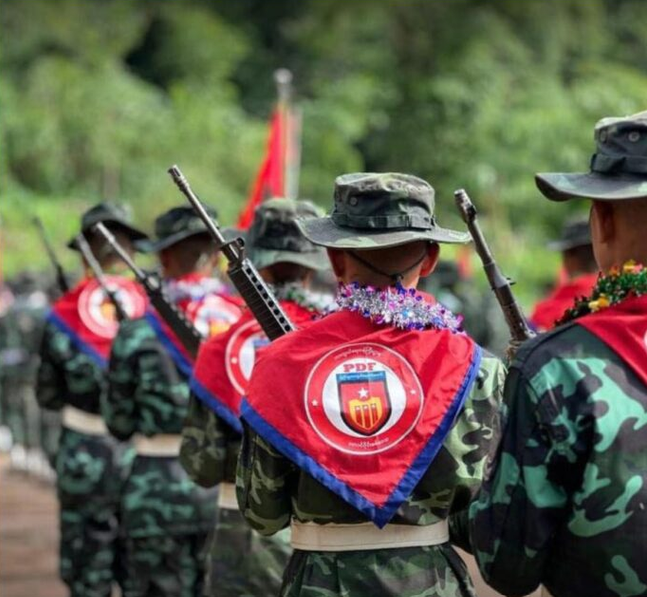
At that moment, he argues, ethnic armed organizations, People’s Defense Forces (PDFs), and NUG-aligned forces failed to coordinate sufficiently to deliver a decisive blow against the military regime and seize national political power.
Why did the revolutionary movement lose momentum at such a critical moment?
Professor Thitinan identifies weaknesses within the NUG as one factor, but he argues that the deeper problem lies in divisions within the insurgency-industrial complex.
He contends that donations and international assistance have increasingly flowed into this network, supporting overseas offices, salaries, employment opportunities, scholarships, and the livelihoods of people involved in resistance-related organizations.
His criticism goes further. He suggests that some beneficiaries may have developed an interest in prolonging the revolution because a successful conclusion could bring an end to the financial support, employment, and organizational structures on which they depend.
This is a particularly severe criticism.
It resembles the sarcastic expression sometimes heard in Myanmar political circles: “Long live the revolution,” used ironically to suggest that certain individuals may benefit more from an indefinitely continuing revolutionary struggle than from its successful conclusion.
Myanmar’s Spring Revolution has two interconnected dimensions: military resistance and political leadership.
From the early stages of the revolution, it was possible to observe that some of those providing political leadership approached the movement with attitudes and practices influenced by capitalist thinking.
Rather than building a revolutionary movement rooted in shared sacrifice, ideological commitment, and strong grassroots organization, political leadership often appeared to rely on administrative structures and institutional arrangements associated with conventional political and economic systems.
One of the principal weaknesses of the Spring Revolution has been the physical separation between political leaders and the people directly bearing the costs of the struggle.
Across Myanmar, resistance fighters have joined armed organizations and risked their lives on the battlefield. Ordinary citizens have sacrificed their homes, villages, and towns, sometimes accepting the destruction of their communities in the hope of ending military dictatorship.
Yet many of those claiming political leadership have remained outside the country, holding meetings and issuing instructions online rather than sharing the daily hardships of those fighting and surviving inside Myanmar.
This separation between political leadership and the realities on the ground has been an important contributing factor to the weakening of the Spring Revolution.
Another issue concerns the organizational structure of the National Unity Government.
Instead of establishing a compact revolutionary administration suited to wartime conditions, the NUG developed a structure resembling a conventional government, with numerous ministries and administrative positions.
These included permanent secretaries, directors-general, deputy directors-general, and other bureaucratic positions similar to those found in an established state administration.
With these positions came defined responsibilities, authority, and institutional benefits.
As additional supporting organizations emerged, the overall administrative structure expanded beyond what was necessarily required for a revolutionary government.
In other words, although the movement was called the Spring Revolution, the NUG was organized and operated in many respects like a regular government rather than a provisional revolutionary administration.
Even when calls for NUG reform grew louder and some ministries were merged or abolished, the organization continued to resemble a government in exile more than a revolutionary government operating in close connection with the struggle inside Myanmar.
Ethnic armed organizations, however, operate under somewhat different political circumstances.
Unlike the NUG, many ethnic armed groups possess a strong unifying force rooted in nationalism and the aspirations of their respective ethnic communities.
Their military objectives are not necessarily directed toward capturing Naypyidaw or taking control of the central government.
Instead, they generally pursue more geographically defined and achievable objectives.
For many ethnic armed organizations, gaining effective control over territories predominantly inhabited by their own ethnic communities would represent the achievement of a central political and military goal.
Questions concerning democracy and the future political system may then become matters to be resolved after territorial control and self-administration have been secured.
Returning to Professor Thitinan’s article, he argues that Myanmar’s revolution can succeed only if commanders and resistance fighters who are directly involved in the struggle inside the country assume leadership over political figures based abroad.
These are the people who have committed their lives to the revolution and experienced its sacrifices firsthand.
He identifies the Arakan Army (AA) as an example of an armed organization demonstrating effective leadership capacity.
He also calls for the revolutionary movement to move away from its dependence on the NUG-centered structure and reorganize around those who are genuinely engaged in fighting the military dictatorship on the ground.
His argument suggests that a more effective revolutionary leadership must emerge from within Myanmar itself rather than continue to rely predominantly on political organizations operating from abroad.
The question, however, is whether the transformation envisioned by Professor Thitinan is realistically possible.
Can Myanmar’s revolutionary movement dismantle or overcome what he describes as the insurgency-industrial complex?
Can it establish a more practical and effective leadership structure, reorganize itself as a genuine revolutionary government, and restore the momentum of the Spring Revolution?
These remain open questions.
Whether such changes can take place—and whether they can revive Myanmar’s struggle against military dictatorship—will have to be determined by future developments.