
Myanmar Spring Chronicle – Scenes from September 13
(MoeMaKa), September 13, 2026
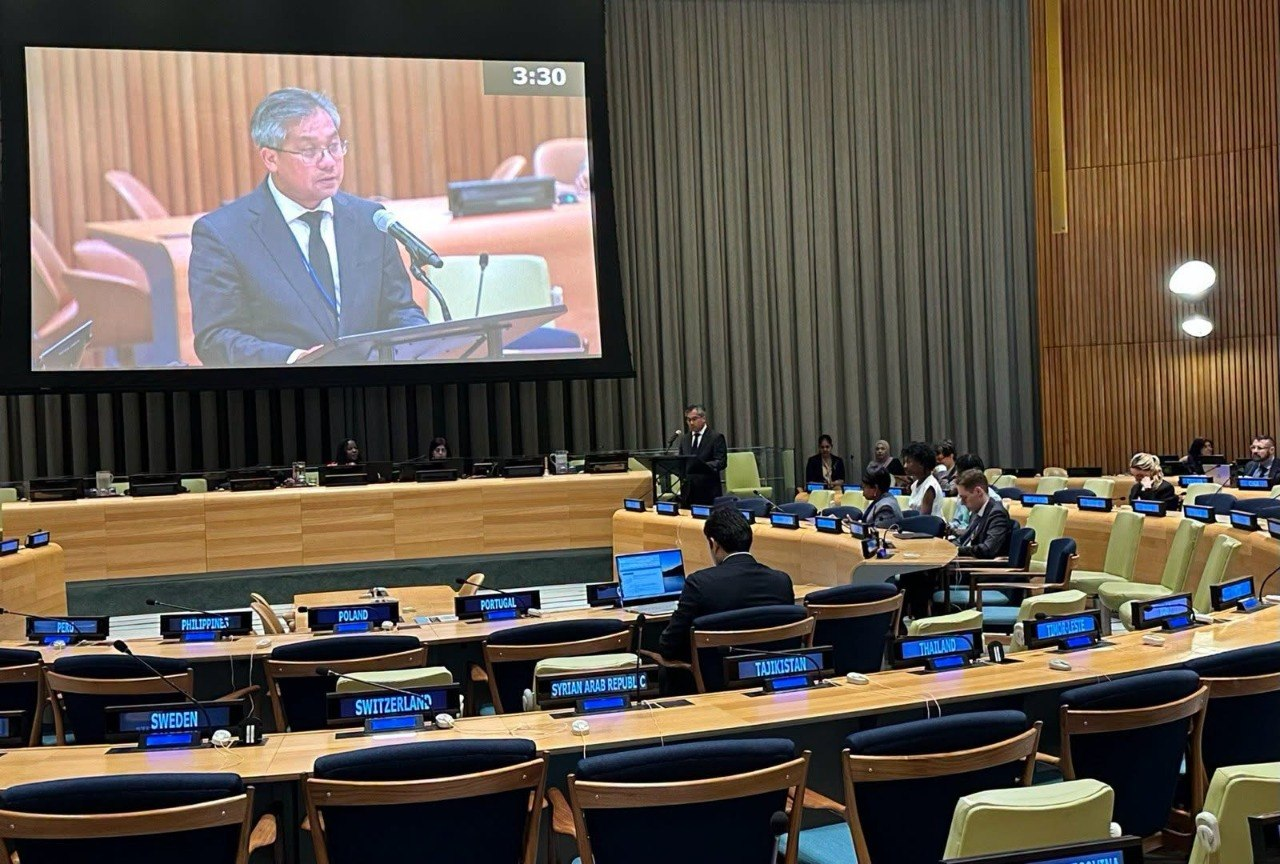
The Impact of Ambassador Kyaw Moe Tun’s UN Representation on Myanmar’s Crisis
Following the military coup on February 1, 2021, U Kyaw Moe Tun, Myanmar’s ambassador to the United Nations, announced in late February of that year that he would not support the military council that seized power and that he had joined the Civil Disobedience Movement (CDM). When the National Unity Government (NUG) was formed in mid-April 2021, he subsequently declared his support for the NUG.
When the UN General Assembly convened in September 2021, the UN Credentials Committee decided to allow U Kyaw Moe Tun to remain as Myanmar’s ambassador. That arrangement continued through the 2025 General Assembly.
During those years, whenever the Credentials Committee considered who should represent Myanmar, even Russia and China—two permanent members of the UN Security Council with close relations with Myanmar’s military authorities—agreed that U Kyaw Moe Tun should continue to be recognized, although certain restrictions were placed on some of his functions and voting rights.
However, after Myanmar’s military authorities held elections late last year and early this year, convened parliament, and appointed Min Aung Hlaing as president, they now appear to be stepping up efforts to remove U Kyaw Moe Tun at the upcoming UN General Assembly.
On September 13, the Foreign Ministry under Min Aung Hlaing’s government issued a statement saying it was working with the International Criminal Police Organization, INTERPOL, in an effort to have U Kyaw Moe Tun arrested.
After joining the CDM in 2021, U Kyaw Moe Tun was charged under several provisions of law in a court in Naypyidaw, and an arrest warrant was issued against him. The charges reportedly include offenses such as high treason that could carry the death penalty.
More than five years after those charges were initially filed, the authorities now say they are pursuing diplomatic efforts to have him arrested through INTERPOL and the United States National Central Bureau, or USNCB.
U Kyaw Moe Tun has also been accused of managing bank accounts administered by Myanmar’s Permanent Mission to the United Nations and continuing to use Myanmar state-owned offices, residences and vehicles. On that basis, cases have also been brought against him under provisions concerning the alleged misuse of public property.
This situation has existed for roughly five years. The question, therefore, is why the authorities are only now seeking action through organizations such as INTERPOL and the USNCB.
One possible conclusion is that the political environment in the United States is no longer what it was previously, and that Myanmar’s military-backed government may now be attempting, with support from China and Russia at the UN Security Council, to challenge U Kyaw Moe Tun’s continued position.
There is also a broader question: even if U Kyaw Moe Tun does not have full voting rights at the United Nations, how much does his continued ability to represent Myanmar actually contribute to the effort to overthrow military rule or to the success of the armed resistance?
The UN’s decision to allow U Kyaw Moe Tun to remain Myanmar’s Permanent Representative should not be interpreted as formal recognition of the National Unity Government. Rather, it can be understood as a refusal to allow the military authorities that seized power to replace the existing Myanmar representative who joined the CDM with their own nominee.
There are historical precedents in which representatives of former governments continued to hold their countries’ seats at the United Nations for years, even after those governments had lost power at home.
One notable example occurred after the Chinese Civil War. Although the Chinese Communist Party won the war and established its government in 1949, the United Nations did not give it China’s seat for more than two decades. Instead, the government led by the Kuomintang, which had lost the civil war and retreated to Taiwan, continued to represent China at the UN.
It was not until 1971 that China’s seat at the United Nations was transferred from the Taiwan-based government to the Communist government governing mainland China.
Another example is Cambodia. The Khmer Rouge ruled Cambodia under a brutal dictatorship from 1975 to 1979 and was responsible for the deaths of around two million people—roughly a quarter of the country’s population.
Even after the Khmer Rouge government was overthrown, the United Nations did not recognize the government backed by Vietnam. Instead, it continued to recognize an opposition coalition that included the Khmer Rouge and was associated with Prince Sihanouk, known as the Coalition Government of Democratic Kampuchea, until 1992.
Both of these examples occurred during the Cold War. Rivalries between communist and capitalist blocs, as well as ideological and geopolitical competition, heavily influenced decisions over representation at the United Nations.
Myanmar’s current situation is different. The world is no longer divided as clearly between capitalist and communist blocs as it was during the Cold War, making it difficult to view Myanmar’s representation dispute through the same black-and-white framework.
Nevertheless, geopolitical bloc rivalry continues. There is competition between Russia and the United States and between China and the United States, while Myanmar’s military authorities maintain close relations with both Russia and China.
Although the United States is currently competing strategically with these two major powers that maintain close ties with Myanmar’s military, Washington also appears to place less emphasis on the United Nations than it did during the Cold War.
This is an era in which major powers increasingly pursue their own interests directly rather than relying primarily on diplomacy through the United Nations to manage the global balance of power. Relations between the United States and some of its Western European allies have also become more strained. In such an environment, Myanmar’s crisis—and political maneuvering over Myanmar at the United Nations—may no longer carry the same strategic weight it once might have.
If U Kyaw Moe Tun is allowed to continue representing Myanmar, it can still provide the National Unity Government with a degree of diplomatic strength and political advantage internationally.
However, his continued representation should not be regarded as a factor capable, by itself, of producing a significant change in Myanmar’s political and military situation on the ground.
Among the forces capable of directly influencing developments inside Myanmar, the policies and attitudes of powerful neighboring countries such as China and India are arguably more consequential than diplomatic maneuvering over Myanmar’s representation at the United Nations.