
Myanmar Spring Chronicle – Scenes from September 5
(MoeMaKa), September 2, 2026
The Burden on the Shoulders of Myanmar’s People
Reading the news over the past few days has been deeply troubling. Among the reports are the announcement that Teng Hui, a Chinese-invested garment manufacturer in Yangon, will cease operations; complaints from drivers that a small cargo truck traveling from eastern Shan State to southern Shan State has to pay as much as 2.4 million kyats in checkpoint fees; and reports that a single air ticket from Myitkyina to Yangon now costs between 2 million and 3 million kyats.
The first story concerns Teng Hui, a garment manufacturer operating in Hlaing Tharyar Township in Yangon. The employer has reportedly informed its workers that the company will shut down. The reason given is that H&M, the Swedish-based fashion retailer that was one of the factory’s main customers, is no longer placing orders.
Teng Hui reportedly operates around five factories in Hlaing Tharyar and employs approximately 3,000 workers. Its closure therefore means that around 3,000 garment workers could lose their jobs.
Reports say the closure resulted from the loss of orders from H&M. Some news reports suggest that H&M stopped placing further orders from Myanmar amid concerns over labor-rights violations and pressure from international labor organizations.
Myanmar’s export-oriented garment industry—which broadly includes the production of clothing, footwear and bags—employs hundreds of thousands of workers. Around 90 percent of them are women, many of whom have migrated from places such as the Ayeyarwady Region, Rakhine State and central Myanmar to work in these factories.
The official minimum daily wage is 6,800 kyats. Even with overtime and other allowances, workers generally earn only around 250,000 to 300,000 kyats per month. At today’s prices, this is barely enough to survive, even with extremely careful spending.
At the same time, labor-rights organizations have been unable to operate freely under the military authorities, while labor activists have faced arrests. As a result, international labor organizations have called for measures resembling sanctions or other forms of pressure.
This raises a difficult question: when international fashion companies decide to stop ordering products manufactured in Myanmar, does this actually place effective pressure on Min Aung Hlaing’s military government? Or does it primarily result in thousands of ordinary workers losing their jobs at a time when their prospects of finding alternative employment are extremely limited?
Millions of Kyats in Checkpoint Fees
Another report, published by the Shan Herald Agency for News, concerns cargo transportation from Tachileik in eastern Shan State to Mong Hsu in southern Shan State.
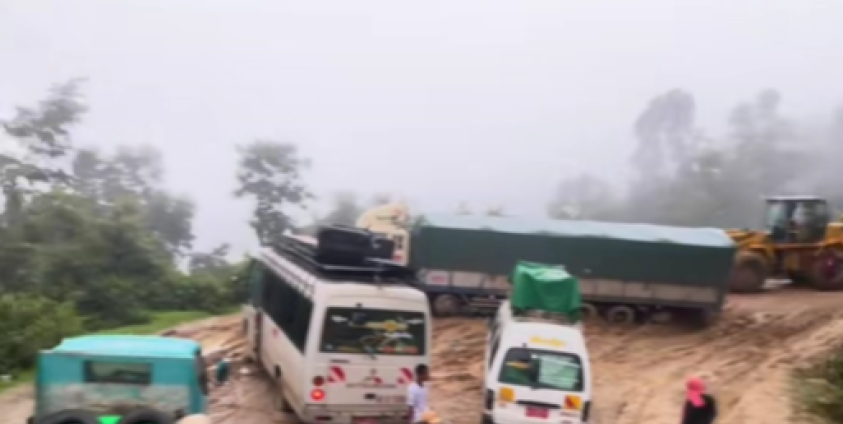
According to the report, a small cargo vehicle traveling along this route must pay approximately 2.3 million to 2.4 million kyats in checkpoint fees. The checkpoints along this particular route are reportedly operated by the military authorities. Drivers say that paying around 2.3 million kyats merely to pass through checkpoints makes transporting goods economically unsustainable.
Along the road connecting eastern Shan State with Mong Hsu, payments reportedly have to be made at military checkpoints around Mong Hpayak, Kengtung, Mong Ping, Tarkaw and Kali. Averaged across these five locations and their checkpoints, the payments amount to more than 400,000 kyats per location.
For a small truck transporting goods between Tachileik and Mandalay, checkpoint expenses could reportedly reach at least 3 million kyats.
Although the military authorities are believed to be aware that soldiers and officials stationed at checkpoints demand extraordinarily large payments, there appears to be little meaningful action against the practice.
The amount collected at a single checkpoint in one day could potentially reach tens or hundreds of millions of kyats. It is believed that these proceeds are distributed through different levels of the armed forces, from lower-ranking personnel to senior officers. In effect, allowing such collections provides financial benefits that help maintain loyalty to the military authorities and encourage personnel to continue defending the regime.
The burden, however, ultimately falls on the public.
And these multimillion-kyat checkpoint charges are not unique to Shan State.
Along routes such as Myawaddy–Hpa-An–Yangon, the amounts demanded can be considerably higher. On that route, payments are collected not only by the military but also by ethnic armed organizations allied with it in areas under their control.
Similarly, along the Mandalay–Myitkyina route, collections are no longer imposed solely by the military. Locally organized PDFs and PDF forces under the NUG also collect payments described as “taxes.”
On the Mandalay–Muse route, the military collects payments in areas it controls, while ethnic armed organizations impose their own collections in territories under their control.
The Cost Is Passed on to Ordinary People
In areas such as northern Shan State, no single armed organization controls the entire border-trade route. Rival armed groups may restrict trade in order to prevent opposing forces from obtaining tax revenue. Goods may be prohibited from entering particular areas, contributing to sharply higher prices for Chinese-made products.
For years, people living in Kachin State, upper Sagaing Region, northern Shan State, Rakhine State and Chin State have had to purchase food, fuel and basic consumer goods transported from lower Myanmar at extraordinarily high prices.
This illustrates one of the fundamental burdens imposed on civilians by the civil war.
People are already losing jobs and livelihoods because of the conflict. Businesses and sources of income have been suspended, destroyed or lost. Yet on top of these hardships, ordinary people are effectively being forced to shoulder additional costs associated with the war and the armed organizations fighting it.
As Myanmar’s civil war approaches its fifth year, the population has been carrying the burden of war in almost every possible way.
They have paid with their lives.
They have paid with the money and property they spent years accumulating.
They have paid with the education of their children and the next generation.
And they have paid through the deterioration of healthcare and other basic necessities of life.
There is a saying that nothing is more valuable than life itself. Yet amid the present hardship, some people have begun to lament that merely remaining alive—when they cannot afford medical treatment or even eat enough food—can feel worse than death.
That is the immense burden now resting on the shoulders of Myanmar’s people.