
Myanmar Spring Chronicle – Scenes from September 9
(MoeMaKa), September 10, 2026
Prospects for the Myanmar Military’s Offensive in Rakhine State
Beginning in late 2023 and early 2024, the Arakan Army (AA) captured one town after another across Rakhine State. More than two years later, approaching three years since that campaign began, the coup military launched a new operation on September 4 aimed at retaking territory it had lost in Rakhine State.
Of Rakhine State’s 17 townships, the military currently controls the main towns and surrounding areas in only three. In an effort to recapture lost towns and territory, it has begun conducting operations through three main forms of attack: ground offensives, naval and artillery fire support, and airstrikes.
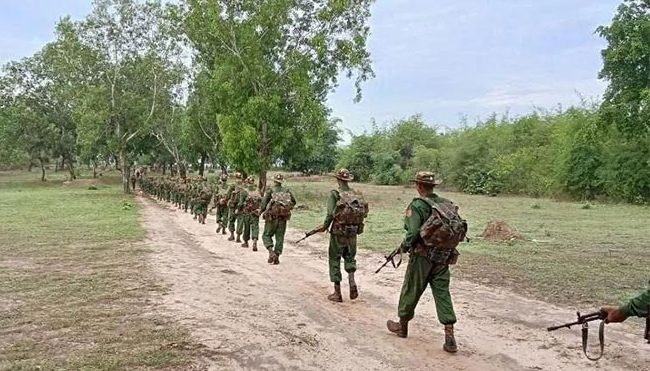
Since September 4, military forces have been attacking Ponnagyun, which borders Sittwe. According to reports, as of around September 8, the military had yet to achieve any major breakthrough, while fighting remained intense.
Analysts believe the military appears to be preparing broader offensives into Rakhine State by reinforcing several land approaches with thousands of troops and providing them with air support. These routes include the Ann mountain pass connecting Rakhine with southern Chin State and Minbu Township in Magway Region; the road from Oke Shit Pin in Bago Region toward Taungup; and approaches from the Gwa area on the Ayeyarwady Region border into southern Rakhine State.
The military also appears to be considering an advance toward northern Rakhine from Kanpetlet, Mindat and Matupi in southern Chin State, as well as another route from the Magway–Ann border area.
However, it remains unclear how many troops have actually been deployed at each approach. Some of these deployments could also be military deception intended to confuse the AA about where the main offensive will come from.
After being unable to mount a major counteroffensive into Rakhine State for more than two years, the military has now launched what its supporters are calling the “4926 Operation” following Ye Win Oo’s appointment as commander-in-chief. This has prompted speculation over whether the newly appointed military chief is attempting to demonstrate his capabilities through the offensive.
However, having only recently assumed the position, Ye Win Oo is unlikely to have reached the point where he can manage the armed forces entirely according to his own preferences. It is also difficult to assume that Min Aung Hlaing has already granted Ye Win Oo complete authority to make independent decisions on all military matters.
The Rakhine offensive may also reflect an attempt by the newly formed, military-backed government following the election to regain control over territories lost during the civil war, at a time when it has begun receiving a degree of diplomatic recognition.
Another possible factor is Myanmar’s commitments to India concerning projects such as the Kaladan project and the Kalay–Tamu section of the trilateral Asian highway project. Regaining control over relevant territory may therefore be connected to efforts to fulfill those commitments. As a neighboring country with interests tied to these projects, India could potentially also provide military technology or sell military equipment connected to such operations.
At the same time that the military is conducting operations in Rakhine State, fighting is continuing around Bhamo and Shwegu in Kachin State.
After launching offensives during 2025 and recapturing many areas along the Ayeyarwady River in Mandalay Region that had previously been controlled by MDY PDF forces, the military has increasingly sought to expand control over areas linking Sagaing Region and Kachin State.
Although it still cannot control the vast territory of Sagaing Region as a whole, the military appears increasingly focused on securing strategic areas along the Kachin–Sagaing border and the Mandalay–northern Shan State frontier, as well as the Ayeyarwady river route and the Mandalay–Myitkyina highway. Its efforts to secure ground and river-based supply and transportation routes are becoming increasingly apparent.
In other words, while the military is attempting to regain territorial control through offensives in upper Myanmar, it has now simultaneously opened another offensive front in Rakhine State in western Myanmar.
Given that the military had lost control of nearly all of Rakhine State, most observers had long expected that it would eventually attempt a counteroffensive. The AA, which now controls most of the state, is also likely to have anticipated that it would one day have to confront such an operation.
During the period in which the AA has controlled nearly all of Rakhine State, it has continued recruiting personnel. As a result, its manpower is believed to have increased significantly compared with two years ago.
A U.S.-based organization monitoring armed conflicts recently reported that the AA has become one of the strongest non-state armed forces in Southeast Asia. According to estimates cited by the research organization, the AA may now have approximately 40,000 troops.
Nevertheless, several structural advantages enjoyed by the military must also be taken into account.
The military occupies the advantageous position of functioning as the state authorities. Despite losing large areas of territory, it can still manage revenues obtained from natural resources and taxation. It retains control of major economic centers such as Yangon and Mandalay and has the ability to redeploy military forces across the country. It can also conduct operations with the support of both its navy and air force. These remain important advantages for the military.
For the ULA/AA, meanwhile, controlling roughly 90 percent of Rakhine State brings its own burdens.
During wartime, resources cannot simply be directed toward military operations. Revenue and other resources must also be distributed to maintain administration, healthcare, education and other public services. At the same time, active battlefronts consume ammunition, weapons, food and other supplies on a daily basis.
The longer the conflict continues, the heavier these burdens become. They can act like a weight pulling from behind, gradually slowing the organization’s ability to sustain its military and administrative operations.
Nearly a week has passed since the military launched what its supporters call the 4926 Operation, but it is still far too early to determine the outcome.
This is the first major offensive into Rakhine State in more than two years and is being conducted under the command of the military’s new commander-in-chief, Ye Win Oo. Whether the operation will enable the military to regain significant territory, or whether it will be contained by the AA, remains to be seen.