
Myanmar Spring Chronicle – Scenes from September 11
(MoeMaKa), September 11, 2026
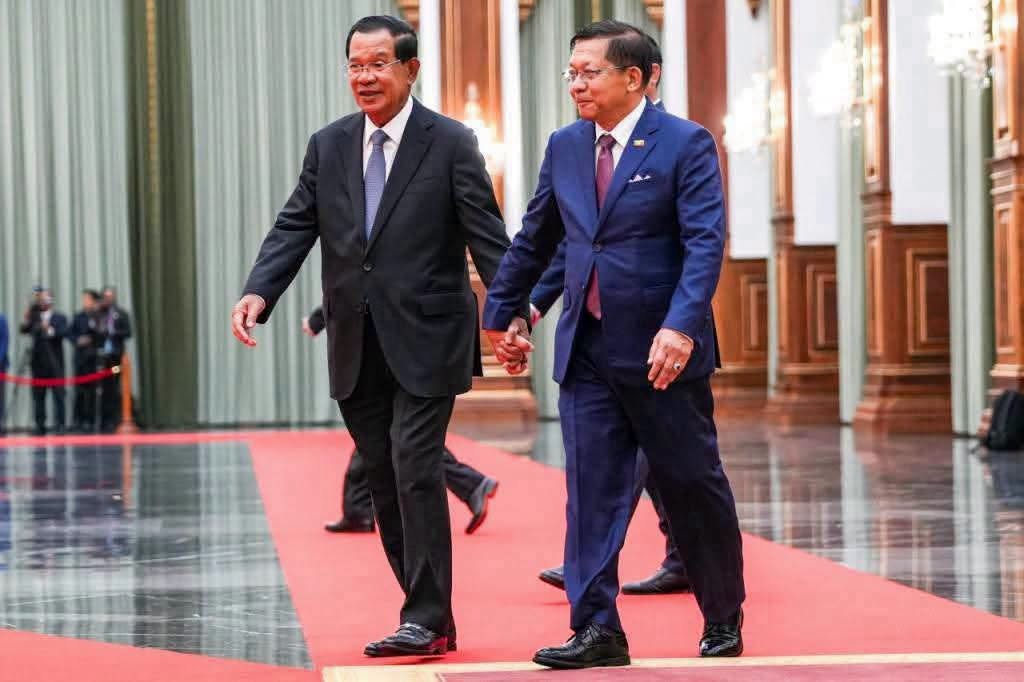
Myanmar Military Leader Min Aung Hlaing Visits Cambodia
Myanmar military leader Min Aung Hlaing, who assumed the presidency a few days before the Thingyan holiday in early April, has now made official visits to eight countries in just over five months since taking the post.
Since the military seized power in February 2021, Min Aung Hlaing has held various positions—including chairman of the military council, prime minister, and acting president—under arrangements largely determined by the military leadership itself. During this period, he has traveled to India, China, Laos, Thailand, Russia, Belarus and Vietnam. On September 11 and 12, he is visiting Cambodia, an ASEAN member state in Southeast Asia.
His first official overseas trip after becoming president was to India. India is not only Myanmar’s neighbor but also one of the world’s largest economies and most populous countries, and is often described as the world’s largest democracy by population. Indian Prime Minister Narendra Modi formally invited Min Aung Hlaing after his transition from a military leadership position to the presidency.
The fact that the world’s most populous democracy was among the first to officially receive Myanmar’s military leader effectively opened the door for some other neighboring and regional countries to extend similar invitations. Thailand, which had not formally invited him as a national leader throughout the years following the 2021 coup, also did so after his visits to India and China.
China, meanwhile, has continued to support Min Aung Hlaing’s military government largely because of Myanmar’s geopolitical importance. Myanmar provides China with an alternative energy corridor through the Kyaukphyu–Kunming oil and gas pipelines, while additional infrastructure, including planned railway connections, could further strengthen those strategic links. Beijing appears to believe that supporting the strongest central governing force in Myanmar serves China’s national interests.
The official invitations extended to Min Aung Hlaing by India and China shortly after he became president can therefore also be viewed as encouraging some other countries in the region to resume more normalized relations with his government.
Cambodia is the eighth country Min Aung Hlaing has officially visited. During the trip, he met Hun Sen, who remains Cambodia’s most influential political leader, and Hun Sen’s son, Prime Minister Hun Manet. According to statements from Min Aung Hlaing’s government, discussions included restoring Myanmar’s previous rights and role within ASEAN and seeking Cambodia’s continued support for Myanmar at the United Nations and the International Labour Organization (ILO).
Reports also said Min Aung Hlaing expressed a desire to exchange information and cooperate in combating online scams, online gambling and transnational crime.
This issue is particularly noteworthy because Myanmar and Cambodia are among the major centers in Southeast Asia for online scam operations commonly known by the Chinese term kyar phyant. In Myanmar, numerous ethnic armed organizations—both allied and non-allied with the government—operate in areas where scam compounds have flourished, with some armed groups accused of providing protection for these operations. Cambodia has similarly seen extensive scam operations, particularly in areas along the Thai border and in coastal cities such as Sihanoukville.
Unlike Myanmar, however, Cambodia has no major armed forces outside the state military and is not experiencing a civil war. The ability of large scam syndicates to operate there therefore raises questions about weak law enforcement and whether officials at different levels of government may be involved.
Last year and earlier this year, border disputes between Thailand and Cambodia led to armed clashes between the two countries. After mediation involving ASEAN and the United States resulted in ceasefires, Thai authorities said there was evidence that scam syndicates had also been operating in some of the affected border areas.
Myanmar and Cambodia therefore share the distinction of being among Southeast Asia’s largest centers for scam syndicates. Both governments have faced questions over whether government officials or senior figures within their security forces may have some form of involvement with these networks.
Min Aung Hlaing’s official visit to Cambodia may consequently be regarded as a diplomatic achievement for his government. At the same time, critics are likely to point to the uncomfortable fact that the leaders of two countries widely associated with major online scam operations are discussing cooperation against those very crimes.
Cambodia has previously attempted to bring Myanmar’s military government back into full participation in ASEAN.
More than four years ago, when Cambodia held the rotating ASEAN chairmanship, Hun Sen—who had ruled Cambodia for decades—tried to facilitate Myanmar’s return to full representation within the regional bloc.
In January 2022, Hun Sen traveled to Naypyidaw and met Min Aung Hlaing in an effort to pave the way for Myanmar’s military council to participate again in ASEAN meetings. However, Myanmar’s military leadership failed to implement even meaningful portions of ASEAN’s Five-Point Consensus and maintained a hardline position. As a result, Hun Sen’s efforts produced no significant breakthrough before Cambodia’s ASEAN chairmanship ended.
Hun Sen eventually appeared to conclude that Myanmar’s military leadership prioritized gaining the upper hand in the domestic war over improving its international diplomatic position. He ended his efforts with remarks essentially suggesting that if Myanmar’s own stakeholders were not concerned enough about their country’s future to resolve the crisis, there was little that outsiders could do.
Those were Cambodia’s diplomatic experiences with Myanmar roughly four years ago.
The situation is different in 2026. Following an election and Min Aung Hlaing’s assumption of the presidency, Cambodia has now invited the military leader for an official visit. The question to watch is whether Cambodia’s leaders will have any greater success this time in persuading Myanmar’s military leadership to change its approach.