
Myanmar Spring Chronicle – Scenes from September 29
(MoeMaKa), September 30, 2026
Malaysia Sends Back Nearly 1,500 Asylum Seekers in First Batch by Ship
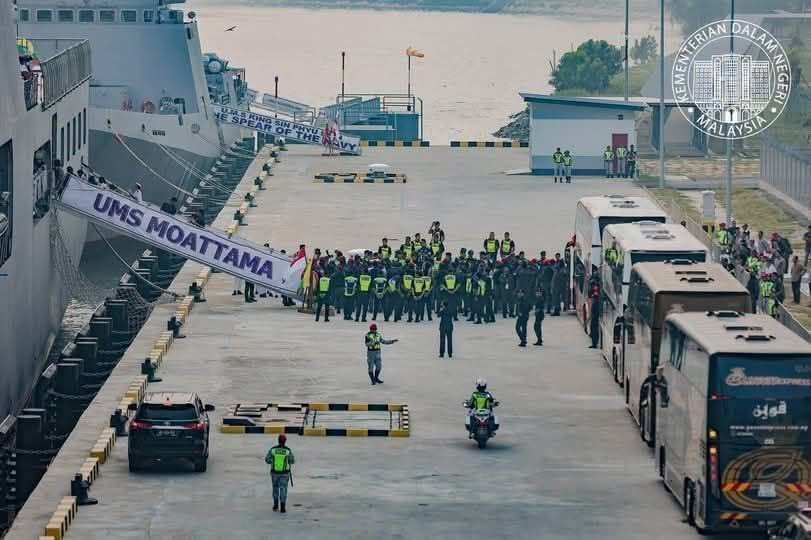
Following discussions and an agreement between the governments of Malaysia and Myanmar on a plan to return refugees and asylum seekers from Myanmar, Malaysia began sending the first group of 1,476 people back to Myanmar on September 29.
Malaysia has long been a destination for Rohingya from Maungdaw and Buthidaung in northern Rakhine State, as well as those living in refugee camps in Bangladesh, who risk their lives traveling overland or by sea in search of refuge.
At present, Malaysia and Myanmar’s military government have reportedly agreed to return 5,000 refugees and asylum seekers. Of those, nearly 1,500 are being transported back to Myanmar in the first group aboard three Myanmar naval vessels, according to news reports.
Regarding the Rohingya refugee issue, Malaysia has traditionally been one of the ASEAN countries that has expressed its position relatively openly. The Office of the United Nations High Commissioner for Refugees (UNHCR) in Malaysia has registered Rohingya from Myanmar and refugees from other ethnic communities, particularly Chin, and has assisted some of them in seeking resettlement in third countries.
Against this background, Rohingya who have faced human-rights abuses and religious discrimination and persecution in Myanmar have been making dangerous journeys across the sea in small, fragile boats to reach Malaysia since before 2010.
Over roughly the past decade, the number fleeing to Malaysia increased amid communal conflicts in northern Rakhine State and the violence against Rohingya civilians during Myanmar military operations in 2016 and 2017. Allegations of genocide arising from the events are being considered in proceedings before the International Court of Justice (ICJ).
Rohingya from northern Rakhine State and refugee camps around Cox’s Bazar in Bangladesh have had to depend on boats arranged by human traffickers or trafficking networks that transport them through Myanmar and Thailand to reach Malaysia. Some pay traffickers upfront, while others pay the remaining trafficking fees gradually after reaching their destination.
There have also been numerous reports of people being killed, arrested, starving or dying in jungle camps while traveling overland through Myanmar and Thailand before attempting to enter Malaysia illegally through the Thai-Malaysian border near Hat Yai.
Similarly, those traveling by sea from northern Rakhine State or the Bangladesh border toward Malaysia often travel aboard overcrowded and unseaworthy motorboats. News reports have documented boats sinking at sea and people losing their lives, with casualties ranging from hundreds to potentially thousands in some years.
UNHCR in Malaysia has continued working to facilitate the resettlement of Rohingya refugees and Chin refugees facing religious persecution in countries willing to accept them. The number of refugees heading toward Malaysia also increased after the Myanmar military’s 2017 operations in northern Rakhine State against the armed group ARSA.
Following the military operations and killings in northern Rakhine State in late August and early September 2017—events described as genocidal by various parties—more than 700,000 Rohingya fled to Bangladesh. The resulting Rohingya refugee crisis became one of the world’s largest refugee crises in the period following the Syrian civil war.
When the more than 700,000 refugees who arrived in Bangladesh in late 2017 are combined with Rohingya refugees who were already there, Bangladesh has hosted close to one million Rohingya refugees. The international community widely recognized and praised Bangladesh for accepting them.
However, nine years after the crisis, there remains little sign or hope of a durable solution for refugee repatriation. Both the host country and the refugees themselves are consequently facing increasingly difficult circumstances and fewer options.
This illustrates the burden faced by Bangladesh in hosting around one million Rohingya refugees and the uncertainty surrounding a lasting solution. Malaysia does not host as many refugees as Bangladesh, but its refugee population has grown from tens of thousands toward the hundreds of thousands. At the same time, opportunities for third-country resettlement have declined. Malaysia has increasingly come to view the situation as a burden, and it has now begun working with Myanmar’s military authorities on refugee returns.
International human-rights organizations and United Nations bodies have urged that any refugee returns be carried out with dignity and that returnees not face arrest, torture or killing after being sent back.
There are also concerns about what will happen to the asylum seekers now being returned to Myanmar: where they will be accommodated after arrival, and whether younger people among them could be recruited for military service.
If the first group of 1,476 is successfully returned, Malaysia intends to proceed with sending back more than 3,500 others under the agreement.
This has also raised questions about why Malaysia, which has maintained a degree of diplomatic distance from Myanmar’s military government alongside the broader international community and ASEAN, has negotiated with the authorities to return refugees.
Armed conflict continues in northern Rakhine State. There have also been allegations of human-rights abuses against Rohingya by the Arakan Army, the ethnic armed organization currently controlling much of the area. Meanwhile, declining international assistance for Rohingya refugees in Bangladesh has made daily survival increasingly difficult. These conditions can further encourage people to attempt to reach Malaysia.
Under such circumstances, Malaysia may believe it needs to send a message discouraging additional refugees from risking their lives and spending what little money they have on human traffickers in an attempt to reach the country.
That message, in this case, is being conveyed through repatriation.
The fact that Malaysia is screening and returning even people who have already reached the country could be interpreted as intended to discourage people in northern Rakhine State and refugee camps in Bangladesh from attempting to travel to Malaysia.
To send that message, however, Malaysia appears to have temporarily set aside humanitarian, human-rights and international-standard considerations by negotiating with Myanmar’s military government and implementing this return program. That is the conclusion that the current circumstances appear to suggest.