
Myanmar Spring Chronicle – Scenes from September 21
(MoeMaKa), September 22, 2026
Forced Military Recruitment and the Growing Business of Human Trafficking for Conscription
More than two and a half years have passed since Myanmar’s military authorities announced in February 2024 that the conscription law had come into effect and began calling up men between the ages of 18 and 35 for military service.
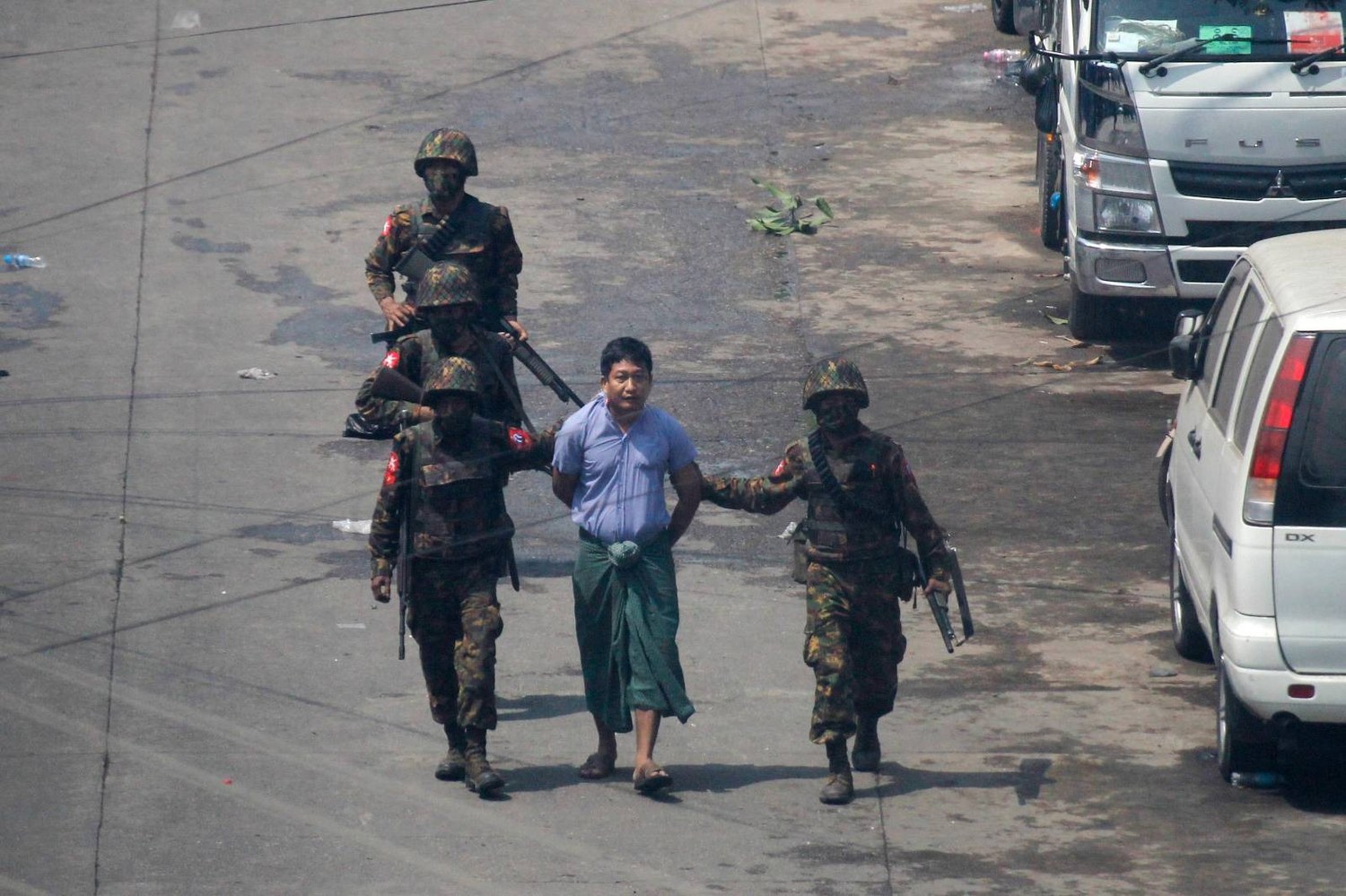
Initially, many assumed recruitment would primarily operate through rotations or lotteries. Instead, young people are now being detained in cities and villages, at checkpoints, and even while traveling to and from work.
At the same time, various groups have emerged that effectively operate as brokers for military recruitment. Ward and village administrators, hundred-household heads and others have been accused of arbitrarily detaining young people and sending them into military service in exchange for money. What began as conscription has increasingly developed into an entrenched system of coercive recruitment and profiteering.
Conscription Amid a Manpower Crisis
The conscription law was activated in early 2024, just months after Operation 1027 began in northern Shan State. At the time, thousands of junta troops in the region were surrendering and the military was facing rapidly worsening manpower shortages.
Against this backdrop, the military began implementing conscription with a reported target of recruiting approximately 5,000 young people each month.
Recruits were sent to military training schools for roughly three months before being deployed to active battlefronts. From recruitment to frontline deployment, the entire process could take only about three months.
The conscription program has now reportedly reached around its 29th or 30th intake. Based on the stated monthly recruitment targets, nearly 150,000 new soldiers may have been recruited so far.
Relatively few women appear to have been recruited. Given the nature of Myanmar’s battlefields, the military appears to have concentrated primarily on male recruits.
Although the conscription law reportedly extends eligibility to age 45 for certain professionals—including doctors, IT specialists, engineers and others with specialized skills—in practice, recruitment appears to have prioritized men between 18 and 35 for combat roles.
Expectations That Did Not Materialize
When the military first activated the conscription law, some within the Spring Revolution movement believed the policy might inadvertently benefit the resistance.
One expectation was that young people seeking to avoid military conscription might instead join the People’s Defense Forces. Another was that those who could not avoid being conscripted might defect to resistance forces once they reached the front lines.
There have indeed been cases of conscripts defecting after deployment, including some who entered military service through the lottery system or replaced selected recruits after receiving payments amounting to millions of kyat.
But the number of such defections has not been large enough to seriously undermine the military’s recruitment objectives.
The realities of a military governed by strict orders also make such expectations difficult to realize. Once soldiers are placed on a battlefield where survival depends on shooting before being shot, the idea that recruits can simply switch sides—or turn their weapons against commanders and openly defy orders—has proven far more difficult in practice than in theory.
Conscription Becomes a Business
Over the more than two years since conscription began, an entire network of people appears to have found ways to profit from the system.
Ward administrators, police stations, military recruitment personnel, Pyu Saw Htee members and auxiliary firefighters have all been linked to activities surrounding conscription.
Practices outside the formal procedures have reportedly become widespread. These include removing names from recruitment lists for payment, arranging substitutes, detaining more people than required and then releasing some in exchange for money.
Payments reportedly range from tens of millions to even hundreds of millions of kyat in some cases.
Such practices have emerged not only in major cities but also in towns and rural areas across Myanmar.
Young People Flee the Country
Hundreds of thousands of people are believed to have left Myanmar in recent years through various means in order to avoid conscription.
Most have fled to neighboring Thailand and, from there, some have traveled onward to countries such as Malaysia.
Those who cannot afford the cost of leaving the country, or who have family members they must care for, often have little choice but to remain.
Forced recruitment has consequently contributed to worsening labor shortages in urban businesses and rural agriculture.
The shortage is particularly acute among young male workers, the demographic most vulnerable to military recruitment.
Even Military-Supporting Families Are Affected
Forced conscription is no longer affecting only people who oppose the military.
Families that have traditionally supported the armed forces have also been caught up in the system.
A recent incident in Naypyidaw illustrates the problem. A mother posted photographs on social media and publicly complained after authorities detained a son who had been supporting and caring for her, intending to force him into military service.
The following day, the mother herself was reportedly arrested.
She already had more than one son serving in the military. But when the remaining son who cared for her was taken for conscription, she could no longer remain silent and spoke publicly about what had happened.
Another case reported several weeks earlier involved an auxiliary fire-service sergeant in Yangon’s Insein Township.
The man was accused of detaining young men from Ayeyarwady Region inside a house and effectively selling them into the military conscription system for money.
The case reportedly came to light after authorities investigated missing-person reports.
Kidnapping and Trafficking Around Conscription
The disorder surrounding military recruitment has increasingly produced serious crimes, including human trafficking, arbitrary detention and kidnapping.
The military authorities are unlikely to be unaware that some people have turned recruitment into a profitable business. Yet there has been little evidence of systematic intervention to stop the practice.
The military desperately needs personnel.
As a result, authorities appear willing to overlook how recruits are obtained, even when those methods involve coercion and profiteering.
Forced conscription has consequently developed a bad reputation not only among military opponents but also among some military supporters.
Military leaders are likely aware of the growing resentment. Nevertheless, obtaining sufficient manpower for the battlefront appears to take priority.
Apart from occasional intervention in particularly extreme cases, there has been little meaningful effort to curb the abuses.
The apparent calculation is that virtually everything else can be sacrificed if necessary to obtain enough troops for the military’s multiple battlefronts.
Nowhere Feels Safe
For people living in active conflict zones, the danger comes from fighting and displacement.
But even in cities where there is no active fighting, arbitrary detention for military recruitment has created a different form of insecurity.
Young and middle-aged people across Myanmar increasingly face the possibility of being taken for military service regardless of where they live.
And forced recruitment is not confined to territory controlled by the military authorities.
Various ethnic armed organizations operating in their own territories have also imposed forms of military recruitment.
This is particularly visible in areas connected to active battlefronts, including parts of Shan, Kachin and Rakhine states, where communities face continuing insecurity related to recruitment.
Reports have also documented compulsory recruitment by some ethnic armed groups.
A recent BBC Burmese report, for example, described young people attempting to leave Rakhine State for central Myanmar being detained by the Arakan Army (AA).
Similarly, reports of compulsory recruitment by the Kachin Independence Army (KIA) have periodically emerged from the Hpakant area.
The Human Cost of a Continuing Civil War
As long as Myanmar’s civil war continues, deaths, injuries and permanent disabilities will continue to deplete the ranks of armed organizations.
That creates an ongoing demand for new personnel.
Under such circumstances, forced recruitment by armed groups on different sides of the conflict is likely to remain difficult to avoid.
What began with the activation of the conscription law has therefore evolved into something much broader: a system in which military manpower shortages, coercive recruitment, corruption, profiteering and insecurity increasingly reinforce one another.
For ordinary people—particularly young men—the result is that even living far from an active battlefield no longer necessarily means being beyond the reach of the war.