
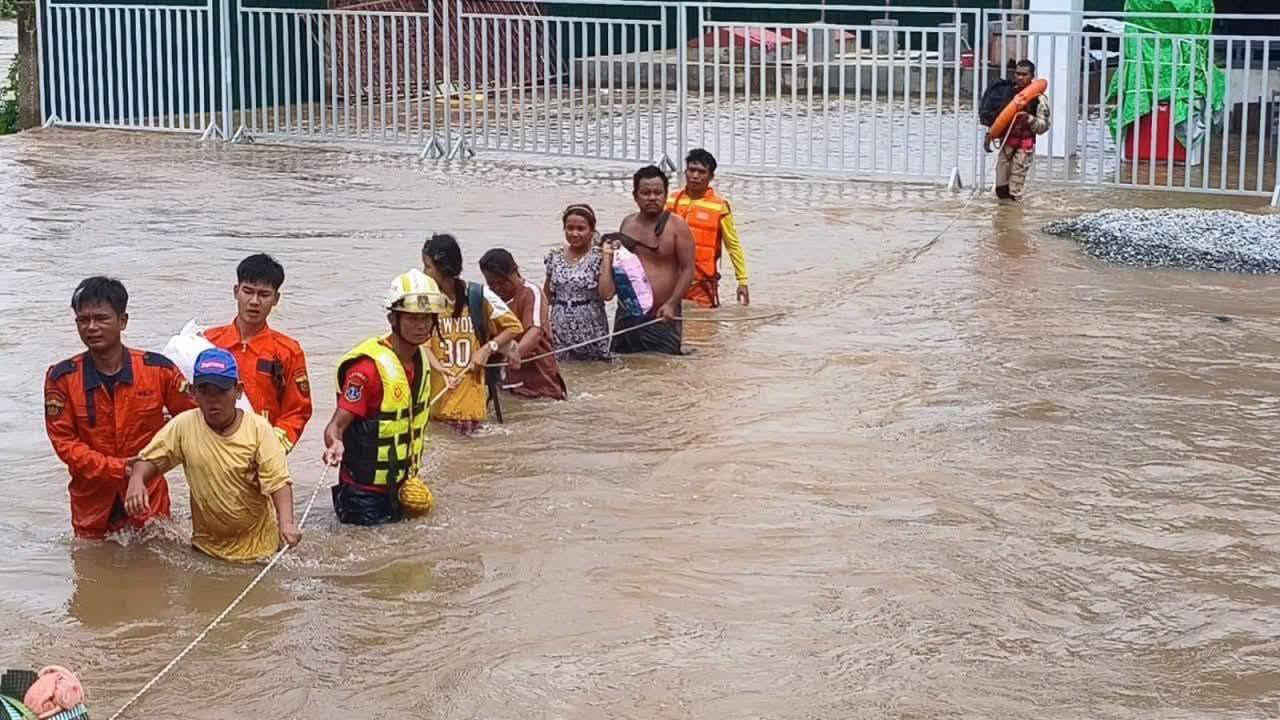
Myanmar Spring Chronicle – Scenes from August 10
(MoeMaKa), August 11, 2026
Will the Floods Slow Down the War?
Nearly five days have passed since widespread flooding began affecting many parts of Sagaing Region, which has 37 townships and is the largest region by area in Upper Myanmar. Most of the flooded areas are villages under the control or influence of armed People’s Defence Forces (PDFs).
Over the past five years, these areas have seen the formation of People’s Defence Forces at the village, township and district levels to resist the military that seized power in the coup. At the same time, the coup regime’s forces have repeatedly launched military columns into these areas, burning homes, seizing or destroying food supplies, and carrying out airstrikes.
These are also areas where some of the conflict’s most notorious atrocities have taken place. They include the massacre at Yin Paung Taing village, where dozens of people were killed after being accused of being PDF members or supporters, and the airstrike on Pazigyi village in Kanbalu Township, which killed more than 100 people.
Sagaing Region is commonly regarded as part of Myanmar’s central Dry Zone. Townships in central Sagaing such as Taze, Kanbalu and Kyunhla lie southwest of Banmauk, Indaw and Katha, townships bordering Kachin State.
The areas currently experiencing flooding are located along the Mu River basin and in areas supplied by the Thaphanseik Dam, which blocks the Mu River. They include parts of Ye-U, Khin-U, Taze, Depayin, Wetlet and Shwebo townships.
These areas are primarily agricultural, with some small-scale, hand-dug oil fields. Before the war, they offered relatively good employment opportunities, had comparatively dense populations, and enjoyed reasonably strong trade, agricultural production and household incomes.
Five years after the armed resistance began following the military coup, however, life in these areas has changed dramatically. Some residents have fled to towns to escape the fighting, while others have remained in their villages, trying as best they can to maintain their homes, livestock and farmland.
Among the Sagaing townships currently affected by flooding, some villages in Kyunhla and Kanbalu have relatively strong support for the coup military and have formed pro-military militias commonly known as Pyu Saw Htee. In most villages in the other townships, however, there are organizations under the National Unity Government (NUG), collectively known as the “Pa Thone Lone” groups, as well as areas dominated by other revolutionary armed organizations outside the NUG structure, such as the People’s Liberation Army (PLA).
The flooding has therefore raised an important question: do the revolutionary armed groups administering these territories have the capacity and resources to conduct effective flood rescue and relief operations?
At the same time, another question is emerging over the military regime, which calls itself the government. Is it deliberately neglecting flood-stricken communities in areas resisting its rule, hoping to exploit the disaster to undermine public confidence in the revolutionary armed forces?
On August 10, the NUG and the Sagaing Federal Unit government reportedly announced that they had jointly established an emergency response committee. Because the announcement came only after more than four days of flooding—nearly five days after the disaster began—there has also been criticism that the response was too slow. The situation has even created the impression that the various authorities may have been waiting to see who would take responsibility for these areas.
Whenever natural disasters, earthquakes or epidemics strike during a civil war, there is often a hopeful expectation that opposing armed forces might temporarily suspend military operations and cooperate on rescue and relief efforts or on preventing the spread of disease.
There is a notable precedent elsewhere in the world.
In Indonesia’s Aceh province, separatist rebels had fought the central government for 28 years. After the December 2004 earthquake and tsunami devastated the region, killing and affecting hundreds of thousands of people, the rebels and the Indonesian government moved toward a ceasefire while humanitarian relief and reconstruction efforts proceeded. The process eventually contributed to the end of the armed conflict in Aceh.
The tsunami disaster triggered by the earthquake and the subsequent end of the Aceh insurgency remain an important international example of how catastrophe can become a turning point in a long-running conflict. In Myanmar’s civil war, however, the conditions for such a positive ending do not yet appear to exist.
When the armed resistance was beginning in 2021, Myanmar was also experiencing a devastating wave of the COVID-19 pandemic that killed tens of thousands of people. At the time, a political party leader called on politically and militarily divided organizations across the country to cooperate in confronting a nationwide public-health emergency.
Most groups, however, largely ignored the appeal, and no meaningful cooperation of that kind emerged.
A similar situation occurred following the powerful Sagaing earthquake at the end of March 2025, which caused extensive destruction in Mandalay and Sagaing. As during the COVID-19 crisis, there was no significant move toward suspending armed clashes so that the opposing sides could cooperate on humanitarian rescue and relief operations.
Instead, the various sides appeared more inclined to treat such crises as opportunities to weaken their armed opponents.
The same dynamic appears to be present during the current flooding in Sagaing Region. The coup regime seems to expect that the disaster could weaken the revolutionary armed forces fighting against it. Meanwhile, it has released very little information about rescue operations or the provision of urgently needed food, medicine and other humanitarian assistance in these areas.
For the people in the flood-stricken parts of Sagaing Region, the consequences are especially severe.
Having already lost homes and livelihoods to years of war, they now face yet another round of destruction and loss caused by flooding. And when the waters eventually recede, their prospects of receiving meaningful assistance for recovery and reconstruction appear extremely limited.