
Myanmar Spring Chronicle – Scenes from August 4
(MoeMaKa), August 5, 2026
The Visit of UWSP/UWSA Leaders to Naypyidaw and Its Possible Implications
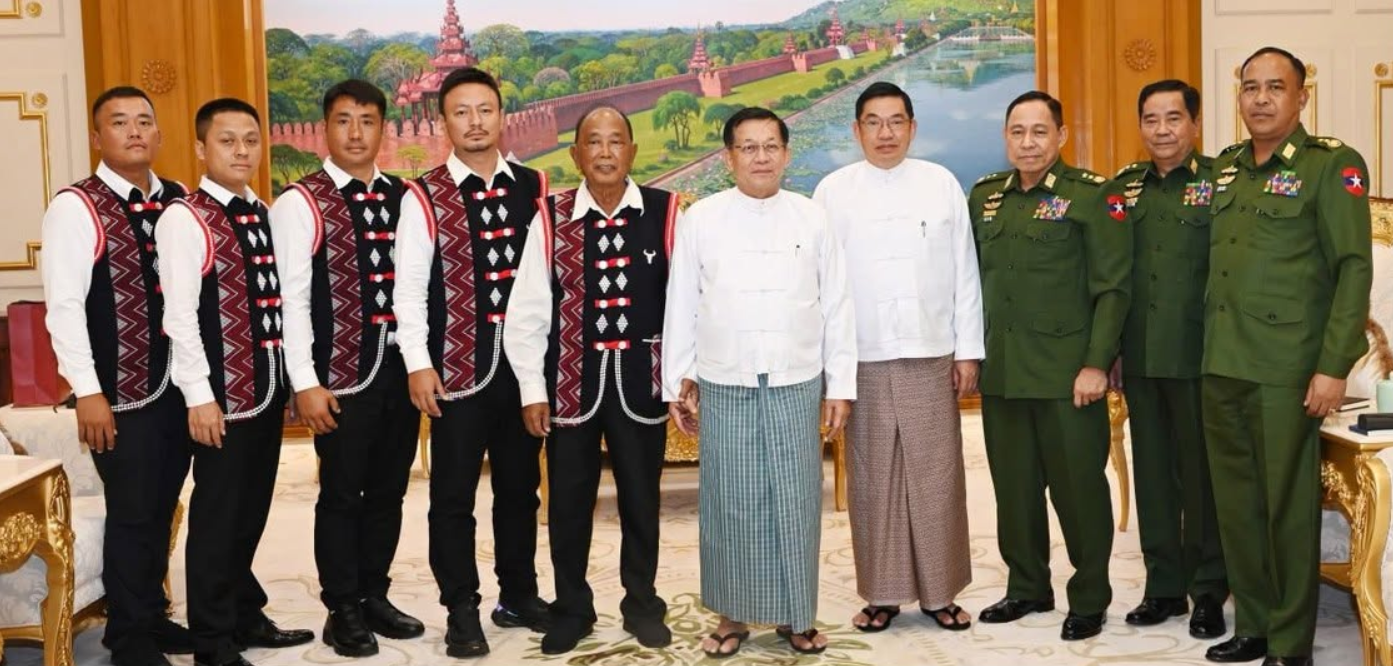
A delegation led by Vice Chairman U Kyauk Kaw An of the United Wa State Party/United Wa State Army (UWSP/UWSA) has arrived in Naypyidaw to participate in peace talks at the invitation of junta leader Min Aung Hlaing. According to news reports, the delegation held discussions on August 3 and 4 and met directly with Min Aung Hlaing.
This is not the first visit by UWSP representatives to Naypyidaw since the 2021 military coup. About eight months after the launch of Operation 1027 in 2024, another delegation led by UWSP Vice Chairman U Law Ya Khu also traveled to Naypyidaw and met with Min Aung Hlaing.
At that time, the military regime had not yet held its promised election and was suffering major setbacks during the early phase of Operation 1027. It had lost control of numerous towns, including Kunlong, Laukkai, Chinshwehaw, and Hseni in northern Shan State, while the Ta’ang National Liberation Army (TNLA) had captured Namkham and other towns.
Although the UWSA provided weapons, ammunition, and financial assistance to the Myanmar National Democratic Alliance Army (MNDAA), the TNLA, and the Arakan Army (AA) during Operation 1027, the military nevertheless sought to avoid direct confrontation with the UWSA—the strongest armed organization in northern Shan State—and instead maintained working relations with it.
In one of the military’s early press briefings following the launch of Operation 1027, officials claimed that Kokang forces led by the son of Peng Jiasheng had entered Myanmar through Nam Tit, an area controlled by the UWSA. Those remarks suggested that the junta harbored resentment toward the UWSP/UWSA over its perceived role in the offensive.
Now, more than two years after the UWSP’s June 2024 visit to Naypyidaw, the delegation has returned in response to Min Aung Hlaing’s 100-day peace dialogue initiative, following his assumption of the presidency.
Since its establishment in 1989 after the collapse of the Communist Party of Burma (CPB), the UWSP/UWSA has never fought the central government. At the same time, successive governments in Yangon—and later Naypyidaw—have never exercised meaningful administrative or military control over most of the Wa Self-Administered Division.
The UWSP/UWSA independently administers its own military, finances, education system, healthcare services, and immigration affairs. Its armed forces, estimated at around 40,000 troops, possess modern military equipment including armored vehicles and helicopters purchased from China.
While the Naypyidaw government formally handles certain foreign affairs, such as issues involving Thailand, relations with China have largely been conducted directly between the UWSP/UWSA and Beijing, with little involvement from Naypyidaw.
In other words, although the Wa authorities do not seek formal secession from the Union, China exercises greater influence than Naypyidaw over security, financial, and immigration matters within the Wa region.
As a result, the Wa Self-Administered Division is effectively the only region in Myanmar that functions as a de facto confederation. Historically, because of its mountainous terrain, remote location, and difficult transportation links, successive Burmese governments have never been able to exercise tight administrative control over the area. These geographical realities have become one of the Wa region’s greatest strategic advantages.
During this latest visit to Naypyidaw, some reports indicate that the UWSP/UWSA again requested formal recognition of the Wa State, just as it did during its 2024 visit. According to those reports, the National Solidarity and Peacemaking Negotiation Committee (NSPNC) responded that any such change could only be carried out in accordance with the 2008 Constitution.
The military government also stated that the UWSP/UWSA reaffirmed during the talks that it remained committed to preserving the Union while cooperating within a federal framework.
When Min Aung Hlaing assumed the presidency, the UWSP/UWSA also sent him a congratulatory message. Among northern ethnic armed organizations, only the TNLA, which agreed to a ceasefire late last year, and the UWSP/UWSA publicly sent such congratulatory messages.
From the UWSP/UWSA’s perspective, these discussions appear intended to secure formal political recognition for the autonomous status it already enjoys, both from the Naypyidaw government and from other political and military actors operating in Shan State.
Should the Wa area eventually receive official recognition as a Wa State, it would likely not simply become another subdivision within Shan State. Rather, it could emerge as a separate state outside Shan State’s territorial framework.
The junta’s negotiating committee stated that it had continued discussions previously held in Panghsang regarding regional development and healthcare. During the current talks, NSPNC Chairman Lt-Gen Yar Pyae reportedly expressed hope that both sides would engage in open discussions on education, healthcare, transportation infrastructure, and regional development.
In reality, however, the Naypyidaw government has little practical role in providing healthcare, education, or development services throughout most of the Wa region. Government ministries likewise have no meaningful administrative presence there.
Like the UWSP/UWSA, the Ta’ang National Liberation Army (TNLA) also requested official recognition of a Ta’ang State during its visit to Naypyidaw about two weeks earlier. As in previous discussions, the NSPNC responded only that any changes must comply with the 2008 Constitution, without explicitly saying whether such a request would ultimately be accepted or rejected.
Overall, these requests suggest that ethnic armed organizations which captured and now control territory during Operation 1027 are seeking to obtain formal political recognition for their existing control.
At the same time, a fundamental question remains. Can Min Aung Hlaing’s government—having seized power through a military coup, organized elections widely criticized as lacking freedom and fairness, and continuing to govern without broad public support while relying on military force and having lost control of large parts of the country—be trusted? More importantly, how credible are the commitments and guarantees offered by a military government that has lost substantial territory and lacks popular legitimacy?
If you’d like, I can also produce a more polished publication-style English translation suitable for a news outlet or policy journal, with smoother flow and terminology consistent with international reporting.