
Myanmar Spring Chronicle – Scenes from August 22
(MoeMaKa), August 23, 2026
Ngapali Bombed as Myanmar Military Uses Airstrikes to Pressure AA Toward a Ceasefire and Territorial Concessions
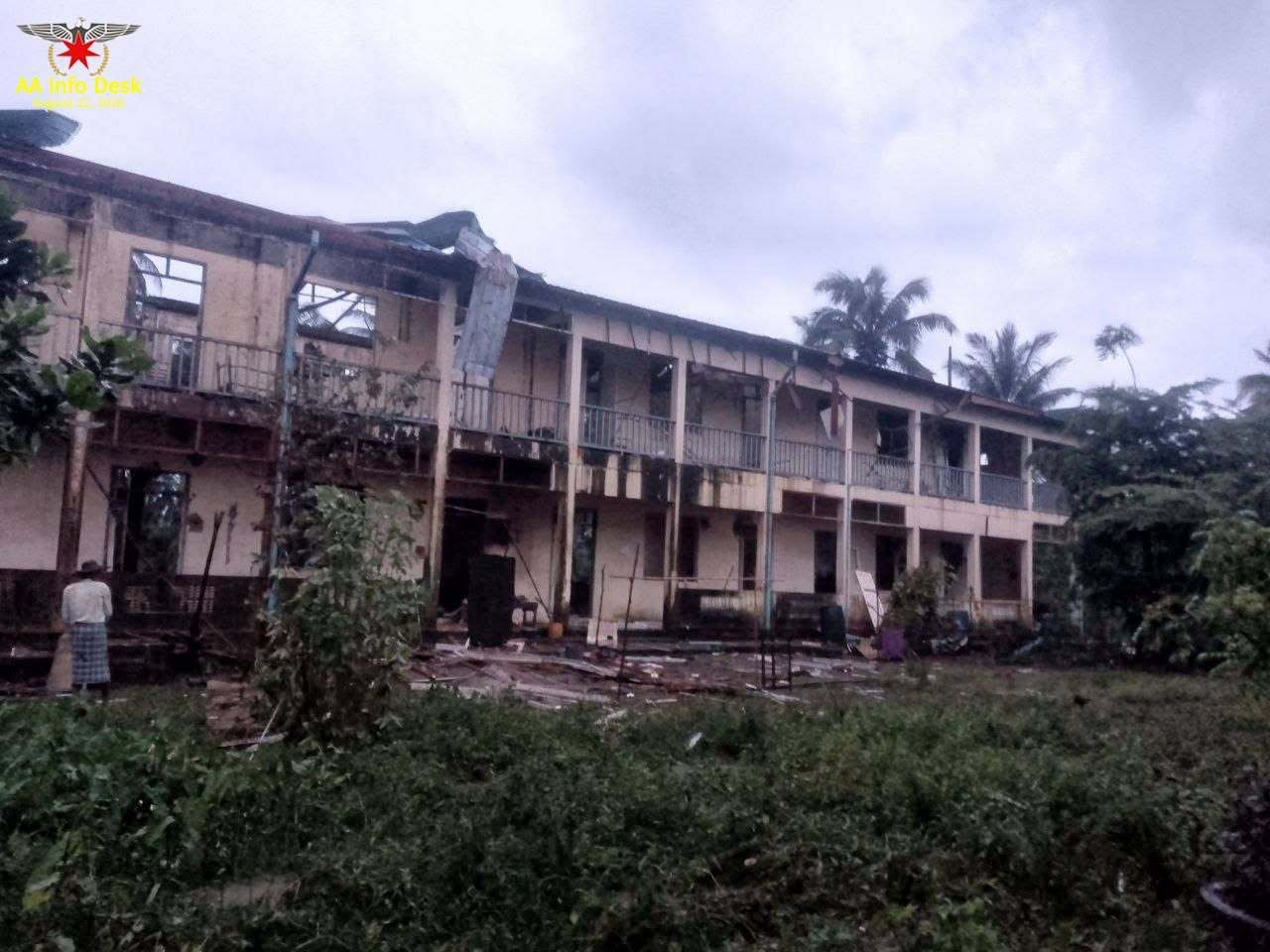
The Arakan Army (AA) said that at around 2 a.m. on August 21, before dawn, the Myanmar military carried out a major air assault on Ngapali Beach in Thandwe Township, southern Rakhine State, which is under AA control. According to the AA, around 10 aircraft were involved and approximately 100 bombs were dropped.
The strikes reportedly targeted the former military positions of Infantry Battalion 55 and Light Infantry Battalion 566 near Ngapali Beach, as well as displacement camps and forested and mountainous areas near Zee Phyu Kone village. According to media reports, one civilian was killed and 14 others were injured.
The AA captured Ngapali Beach and surrounding areas of Thandwe Township after weeks of intense fighting in previous years. In addition to taking army battalion positions, the AA also seized a naval base in southern Rakhine State. Since then, its forces have expanded operations southward through Gwa and toward northwestern parts of Ayeyarwady Region.
The military has repeatedly launched airstrikes on AA-controlled areas including Thandwe, Taungup, Ann, Mrauk-U, Kyauktaw and Ponnagyun. These attacks appear intended to pressure the AA, which has maintained several fronts for years around the border areas of Bago, Magway and Ayeyarwady regions.
Some previous airstrikes have reportedly caused heavy casualties, with civilians and prisoners of war killed in numbers ranging from dozens to, in some incidents, more than a hundred.
The AA currently controls about 90 percent of Rakhine State. The military retains control over several strategically important areas, including Sittwe, the state capital; Manaung; and the area around the port facilities linked to Chinese investments and the starting point of the China-Myanmar oil and natural gas pipelines. The AA also currently holds or operates in some areas beyond Rakhine State, including parts of Magway Region bordering Ann Township and parts of Ayeyarwady Region bordering Gwa Township.
The military’s air campaign is not limited to AA-controlled territory. In recent weeks and months, airstrikes have also been carried out in areas of Myawaddy Township in Karen State near the Thai border, as well as in Sagaing, Tanintharyi, northern Shan State, Kachin State and Magway Region, where resistance forces and ethnic armed organizations are active.
The AA is currently fighting on four or five fronts and has expanded its operations into parts of Magway and Ayeyarwady regions. Against this background, it can be assumed that the military seeks both to pressure the AA into accepting a ceasefire and to regain some of the territory it has lost.
After Min Aung Hlaing stepped down from his position as commander-in-chief in April, his successor, Ye Win Oo, also faces pressure to demonstrate his military effectiveness. Achieving gains on fronts where the military is confronting the AA would therefore be particularly important for the new commander.
Compared with air operations against other PDF forces and ethnic armed organizations, the attack on Ngapali stands out because of the unusually large number of aircraft and bombs reportedly used in a single day. The scale of the operation suggests that regaining territory in Rakhine State and increasing pressure on the AA to accept a ceasefire are significant military objectives.
Continued airstrikes could make it increasingly difficult for the AA to establish normal administration and movement in the territories it controls, gather its forces openly, stabilize those areas, and create conditions in which Rakhine civilians can resume normal livelihoods.
At the same time, the military cannot easily use Chinese pressure against the AA in the same way it has done with ethnic armed organizations in northern Shan State. AA-controlled Rakhine State does not share a border with China and is geographically distant from it. Northern Rakhine instead connects through Paletwa in southern Chin State toward India, providing an alternative route for border trade and imports of essential consumer goods.
Although some AA forces remain in northern Shan State, they generally operate within territories controlled by allied northern ethnic armed organizations. This gives the AA a greater degree of insulation from direct Chinese pressure.
Before ceasefire agreements were reached with the Myanmar National Democratic Alliance Army (MNDAA) and the Ta’ang National Liberation Army (TNLA), the military had also conducted repeated airstrikes against their territories. Eventually, the combination of military air pressure and Chinese diplomatic pressure contributed to ceasefire agreements.
The key question now is how long Rakhine State and the AA can withstand the military’s continuing air campaign. At the same time, the AA appears to be responding by expanding further into parts of Ayeyarwady, western Bago and the Magway-Rakhine border areas, creating additional pressure on the military.
For the foreseeable future, the conflict therefore appears likely to continue as a contest between the military’s reliance on air power to pressure the AA and the AA’s efforts to expand its ground operations beyond Rakhine State.