
Myanmar Spring Chronicle – Scenes from August 13
(MoeMaKa), August 14, 2026
Myanmar’s Nearly 80-Year Civil War and the Meaning of “Peace”
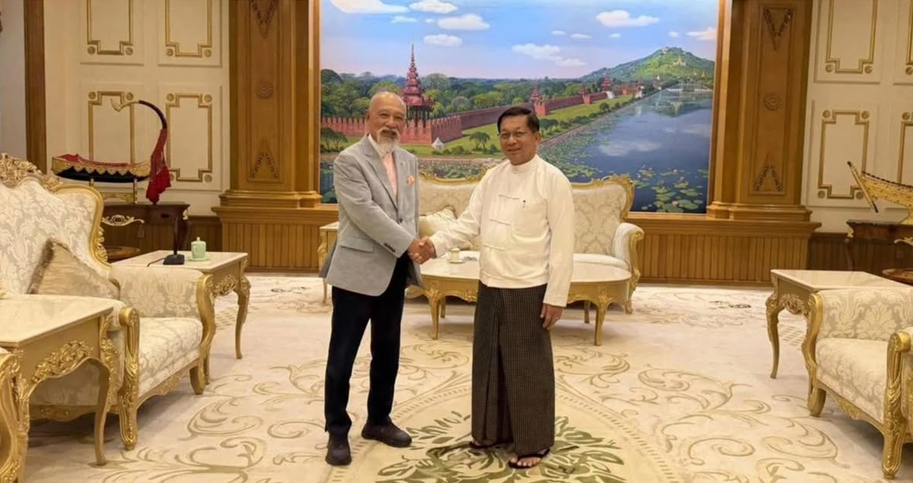
Yohei Sasakawa, Honorary Chairman of Japan’s Nippon Foundation, visited Naypyidaw on August 10 and met with military leader and President Min Aung Hlaing. Following the visit, Sasakawa reportedly said that he would continue supporting Myanmar’s peace process.
Sasakawa, Honorary Chairman of the Nippon Foundation, a Japanese international humanitarian organization, was appointed Special Envoy for National Reconciliation in Myanmar during the administration of President Thein Sein. He has visited Naypyidaw on several occasions, including in connection with efforts to secure a ceasefire between the Arakan Army (AA) and the military in Rakhine State in 2022, as well as over fighting and humanitarian assistance in Rakhine State in the period before Operation 1027 began in 2023.
The Nippon Foundation is a Japanese organization engaged in humanitarian assistance, but it is not a Japanese government development agency like the Japan International Cooperation Agency (JICA).
Over the past decade and more, as peace talks emerged between Myanmar’s armed groups and the military/government, the Nippon Foundation has provided humanitarian assistance in conflict-affected areas. There have also been instances in which it facilitated communication and coordination between opposing sides, particularly in efforts to arrange ceasefires between the AA and the military.
At the same time, because Sasakawa has appeared to maintain a close personal relationship with military leader Min Aung Hlaing, some analysts and critics have viewed him as a peace intermediary who tends to lean toward the military.
Sasakawa also visited Myanmar before the November 2020 election. During that trip, he traveled to Rakhine State and called for elections to be held in townships that had been excluded from the list of areas where voting would take place. Following the 2021 military coup, he returned to Myanmar in November of that year and traveled to Sittwe, where he met with Rakhine political parties. In February 2022, he again visited Sittwe and urged the AA and the military to maintain their ceasefire.
In Myanmar, where civil war has continued for more than seven decades and is now approaching eight decades, words such as “peace,” “ceasefire,” and “dialogue” have become sensitive terms. For many people, they have acquired troubling or even negative connotations.
From the era of the AFPFL government through successive governments led by military generals under the banner of the Burma Socialist Programme Party (BSPP), numerous armed organizations fought against the central government. These included not only ethnic armed organizations but also the Communist Party of Burma (CPB), the Red Flag Communist Party, and U Nu’s Parliamentary Democracy Party/Patriotic forces, among others. Throughout these seven to eight decades, Myanmar repeatedly witnessed ceasefire negotiations, armed groups surrendering and “returning to the legal fold,” and the emergence of new armed organizations that resumed fighting.
After the 1962 military coup, during the period of rule by the Revolutionary Council, talks were held in Yangon in 1963 with ethnic armed organizations as well as the Communist Party of Burma and the Red Flag Communists. Those negotiations eventually collapsed, after which the military launched renewed offensives.
Several months after the 1988 military coup, ethnic forces within the Communist Party of Burma rebelled against the party leadership, causing what had been the largest armed force fighting the central government to collapse. Separate Kokang, Wa and Kachin armed organizations subsequently emerged.
The coup government known by its Burmese acronym Na Wa Ta—the State Law and Order Restoration Council (SLORC)—then reached ceasefire arrangements with these groups, recognizing “special regions” under agreements that did not require them to surrender their weapons or relinquish their territories. Meanwhile, the military launched offensives against other ethnic armed organizations that had not entered into ceasefire agreements.
Against this historical background, in which peace initiatives, ceasefires and military offensives have repeatedly alternated, “ceasefire” and “peace” have sometimes come to be used almost interchangeably. History has also taught armed organizations that a ceasefire with one group can create the conditions for the military to launch offensives against another group that remains at war.
The ceasefire and peace negotiations initiated under President Thein Sein’s government in 2011 can, however, be regarded as more open than those of the two preceding eras and as having included an intention to continue searching for political solutions to the country’s underlying problems.
Armed organizations were brought together in efforts to negotiate a collective ceasefire, while political dialogue was also envisioned to shape the country’s future. Unlike during the SLORC and SPDC military governments, when ceasefires were accompanied by economic concessions while political issues and the question of a future federal union were largely left untouched, the period from 2011 through the end of 2020 offered at least some hope that Myanmar’s civil war—already more than six decades old and approaching seven—might finally be brought to an end.
Yet successive governments and successive eras have witnessed repeated ceasefires and peace negotiations without bringing the civil war to an end. As a result, the public has gradually lost much of its confidence in both ceasefire negotiations and peace talks.
The military and other armed organizations have also, at times, accepted ceasefire agreements for tactical reasons: when facing difficulties or crises, when confronting too many enemies simultaneously, or when calculating the immediate or short-term benefits that a temporary halt in fighting might provide.
There have also been historical instances in which armed organizations, when their interests conflicted with those of other armed groups—most plainly over territorial control and administrative authority—found themselves entering ceasefires with another adversary.
For these reasons, the words “ceasefire” and “peace” are no longer simple or inherently reassuring terms in Myanmar. Instead, they have become words that can provoke suspicion: What interests lie behind them? Are there undisclosed objectives?
Myanmar’s civil war is now approaching its 80th year. In other words, one of the world’s longest-running civil wars continues with no clear end in sight. Questions are increasingly being asked about whether it can realistically come to an end even within the next one or two generations.
The very word “peace” has, for some, come to imply not simply an end to war but political maneuvering, deception, or a temporary period in which forces regroup, rebuild their strength and prepare for the battles to come.
Yet there is one undeniable reality: the various armed organizations, political leaders, and institutions—including the military, which has repeatedly taken control of the central government—all bear varying degrees of responsibility for shaping the future of this country and for creating the conditions in which the people who live on this land can earn their livelihoods in peace, live with security, and improve their quality of life.