
Myanmar Spring Chronicle – Scenes from August 14
(MoeMaKa), August 15, 2026
Myanmar Military Government Responds to U.S. Embassy Statement
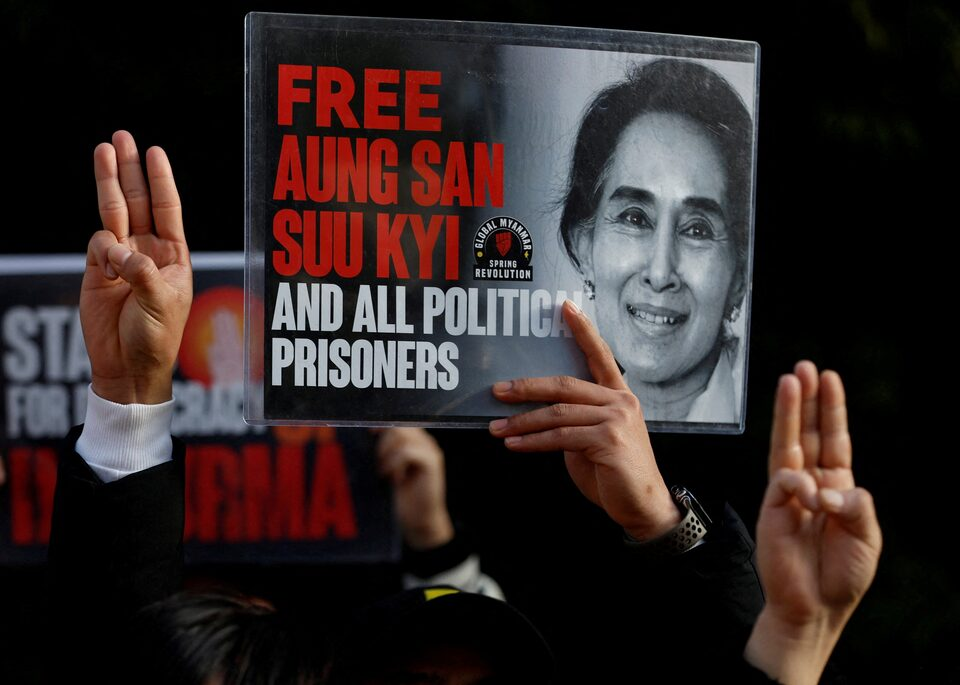
Following a recent visit by the International Committee of the Red Cross (ICRC) to Daw Aung San Suu Kyi, the U.S. Embassy in Yangon issued a statement dated August 7 welcoming the meeting. The statement began: “The United States welcomes the visit by an ICRC representative to Daw Aung San Suu Kyi.” It also expressed hope that the visit would pave the way for broader access to all political prisoners and reiterated the U.S. call for Daw Aung San Suu Kyi’s “immediate and unconditional release.”
The statement also called for the release of all those unjustly detained and urged the military to engage in dialogue with all groups in order to bring an end to the conflicts taking place across Myanmar.
One week after that statement, on August 14, the Myanmar Embassy in Washington, D.C., issued a response titled “Statement by the Embassy of Myanmar (Washington) Regarding Remarks by the U.S. Department of State and the Chairman of the Senate Foreign Relations Committee Concerning the Meeting Between Daw Aung San Suu Kyi and the ICRC Resident Representative.”
In its statement, the Myanmar Embassy noted that the U.S. Department of State and the chairman of the Senate Foreign Relations Committee had posted messages on social media welcoming the meeting. While acknowledging what it described as these “positive remarks,” the embassy objected to the demand for Daw Aung San Suu Kyi’s immediate and unconditional release, arguing that such a demand “has implications for the relevant judicial process and the fundamental principles of the rule of law of a sovereign country.”
The statement went on to say that while Myanmar “takes note of and acknowledges the positive remarks made by the United States,” it was “displeased with the unconstructive demands.”
In the past, the U.S. Department of State, some members of Congress, and bodies such as the Senate Foreign Relations Committee have issued statements and demands concerning Myanmar’s military government. However, the military authorities have not generally responded point by point or publicly articulated their position in this manner.
It is also noteworthy that the latest response was issued not by the Ministry of Foreign Affairs in Naypyidaw, but by the Myanmar Embassy in Washington, D.C. From a diplomatic-protocol perspective, this could be interpreted as a somewhat softer approach. Had the statement been issued directly by the ministry in Naypyidaw, it would likely have carried a greater sense of seriousness and urgency.
In the final two paragraphs of the response, the military government portrayed itself as a government that came to power through a free and fair multiparty election. It cited the claim that more than 13 million of Myanmar’s 24 million eligible voters had cast ballots, presenting this as evidence that the current administration is an elected government chosen by the people.
The statement concluded by saying: “We look forward to cooperating with the United States in areas where cooperation is possible.”
This response could be interpreted as a sign of growing confidence on the part of military leader Min Aung Hlaing, who became president in recent months, following his official visits to China, India, Laos, and Thailand.
Last year, when President Trump increased tariffs on various countries, Min Aung Hlaing sent a letter to the U.S. president asking that tariffs on Myanmar be set at only 20 percent. At the time, he also said that, if necessary, the Myanmar government was prepared to dispatch a delegation as soon as possible to meet and negotiate with the relevant U.S. officials.
However, President Trump did not respond to that letter, and circumstances did not allow a Myanmar delegation to be sent.
Compared with the tone used roughly a year ago, when the military government announced that it had written to Washington seeking negotiations over tariffs, the latest statement no longer carries the same deferential tone toward the United States.
Having maneuvered his way from military commander to the presidency, Min Aung Hlaing has repeatedly declared that the 2025/26 election was free and fair, comparable to elections held elsewhere in the world. He appears eager for his government to be internationally recognized as an elected administration. Yet fewer than ten countries have so far recognized him as president and extended invitations to him in that capacity.
There is a familiar saying in propaganda: if a falsehood is repeated often enough, people may eventually come to regard it as truth. In much the same way, the coup leader’s repeated characterization of the government formed after the recent election as one “elected through a free and fair election” appears to be little more than an effort to repeat that narrative until people come to believe it.