
Myanmar Spring Chronicle – Scenes from August 11
(MoeMaKa), August 12, 2026
Myanmar Military Government Pulls Back Hard on ASEAN’s Leash: The Impact of Thailand’s “Calibrated Re-engagement”
Myanmar Military Government Pulls Back Hard on ASEAN’s Leash: The Impact of Thailand’s “Calibrated Re-engagement”
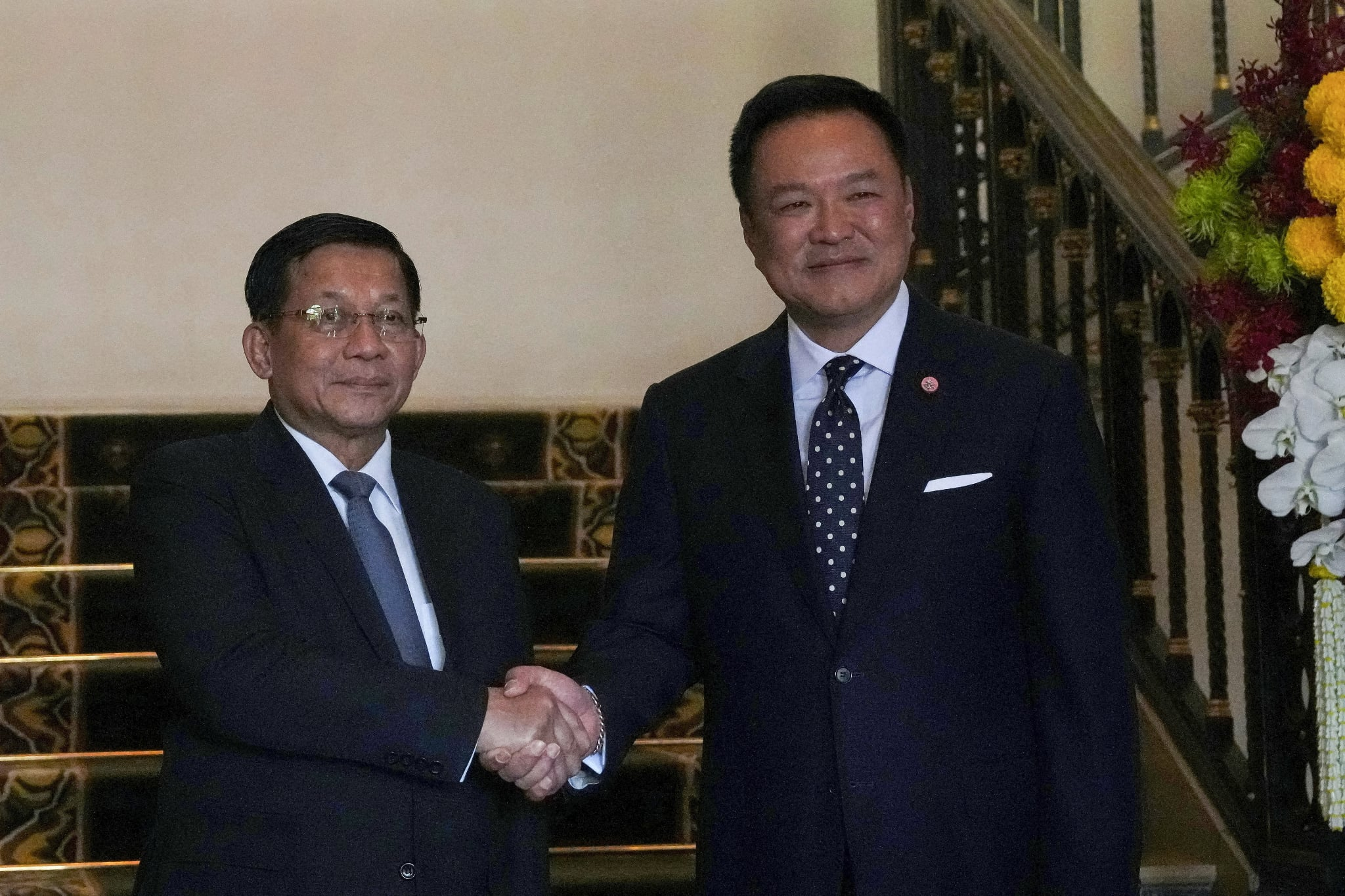
In recent days, Turkey’s state-owned public broadcaster TRT aired a discussion program on Myanmar’s political crisis, armed conflicts, ASEAN’s Five-Point Consensus, and Myanmar military leader Min Aung Hlaing’s visit to Thailand. The discussion examined, in particular, the implications of Thailand’s recent decision to invite Min Aung Hlaing as an official guest.
The program was titled “Is Myanmar’s military regime gradually breaking out of its international isolation?”—a framing broadly reflecting how Western media view recent developments.
The three invited panelists were Maung Zarni, a Myanmar-born founder of the Free Burma Coalition; Phil Robertson, director of Asia Human Rights and Labour Advocates; and Thitinan Pongsudhirak, professor of international relations at Thailand’s Chulalongkorn University.
The central question was whether Thailand’s decision to formally invite, receive, and hold talks with the government led by Myanmar coup leader Min Aung Hlaing could weaken the diplomatic isolation of his government and reduce pressure on it to implement ASEAN’s Five-Point Consensus.
During the discussion, Maung Zarni, who was born in Myanmar and now lives in the United Kingdom, was asked whether the Thai government’s invitation of Min Aung Hlaing as an official guest could help reintegrate the Myanmar military government into ASEAN. He responded that the question could only be adequately answered within a broader global context.
He argued that although Western countries have imposed sanctions on Myanmar’s military government, some of those same countries—particularly the United States and some Western European states—have continued to support countries such as Israel despite what he described as genocidal acts committed in recent years. In his view, this undermines their moral authority to punish Myanmar’s military government by excluding it from the international community.
Zarni also noted that the debate over whether to engage with Myanmar’s military rulers has persisted for nearly three decades, going back to 1997, when ASEAN debated whether to admit the military government led by Than Shwe. He described it as regrettable that the same question—whether to engage or not engage with Myanmar’s military authorities—remains unresolved while ordinary people continue to suffer.
He further criticized Thailand’s decision to officially invite Myanmar’s military leader as a guest of the government, questioning whether Thailand itself could be regarded as sufficiently democratic for such an invitation to damage its foreign-policy credentials on democratic grounds.
Because the TRT program was structured partly as a debate, there were also sharply differing views. Phil Robertson argued that Western countries do retain moral authority and that, because the military government continues to commit human rights violations, international pressure must continue in order to push it toward respecting human rights.
Does Thailand’s Invitation Mean ASEAN Is Ready to Accept Min Aung Hlaing Again?
If the question is whether Min Aung Hlaing’s official invitation to Thailand means ASEAN is preparing to fully accept him again, the answer is no.
Thailand’s current government faces a range of problems along its border with Myanmar: narcotics entering Thailand from the Myanmar side; human trafficking through Thailand associated with Chinese-run scam syndicates operating in Karen State and other border areas; cross-border air pollution from eastern Shan State; contamination affecting rivers, streams, and aquatic life; illegal arms and ammunition smuggling; and the continuing flow of Myanmar nationals crossing illegally into Thailand.
To address these issues, Thailand finds itself in a position where it has to deal with Min Aung Hlaing’s government, which remains the government in power and controls nearly half of Myanmar’s territory.
After forming a government in April, Min Aung Hlaing made official visits to India and China in May and June respectively, followed by a third trip to Laos. Thailand subsequently invited him, making it only the fourth country to formally recognize and receive him in this manner.
Nevertheless, Thailand is an influential ASEAN member, and its decision to begin formal engagement with Myanmar’s military government could place some degree of pressure on other ASEAN members.
At the same time, ASEAN’s maritime states—Indonesia, Singapore, and the Philippines—have maintained the position that, until Myanmar implements the Five-Point Consensus, representatives above the level of permanent secretary should not be invited to ASEAN leaders’ regular meetings.
Why Is Myanmar’s Military Government Now Pushing Back Against ASEAN?
For more than five years, Myanmar’s coup leader has failed to implement ASEAN’s Five-Point Consensus. He has repeatedly argued that the measures can only be carried out once the country has become stable.
Following his visit to Thailand, however, his government went a step further, declaring that there is no longer a need for ASEAN to appoint a special envoy on Myanmar.
What, then, has emboldened the military government to pull back so forcefully against ASEAN?
Thailand’s official invitation alone certainly does not explain it.
Since Min Aung Hlaing became president in April, official invitations from India, China, and Laos have strengthened the confidence of the former military leader now serving in civilian guise. These diplomatic visits appear to have given his government greater confidence to push back against ASEAN.
In particular, diplomatic recognition and official invitations from China and India—two major regional and global powers—have allowed the government to present itself, following the election, increasingly as though it were a legitimate government recognized by the international community.
Thailand appears to have observed the three countries that preceded it and then decided to shift its own Myanmar policy toward what it describes as “calibrated re-engagement.”
Bangkok apparently believes that engagement with Min Aung Hlaing’s government could help the two countries resolve problems requiring bilateral cooperation.
Thailand may also have additional reasons for strengthening relations with Myanmar. On its eastern frontier, armed clashes arising from its border dispute with Cambodia have disrupted cross-border trade and reduced the supply of Cambodian migrant labor. Closer relations with Myanmar could therefore help Thailand compensate for some of those pressures.
Testing ASEAN’s Limits
Min Aung Hlaing’s decision to pull back on ASEAN’s leash does not appear to indicate an intention to withdraw Myanmar from the regional organization altogether.
Rather, it appears to be an attempt to test the limits of ASEAN’s ability to influence Myanmar’s domestic affairs.
With ASEAN’s Five-Point Consensus having produced little progress over the past five years, the military government appears prepared to challenge ASEAN’s pressure while remaining within the organization—and to continue along this course for some time.