
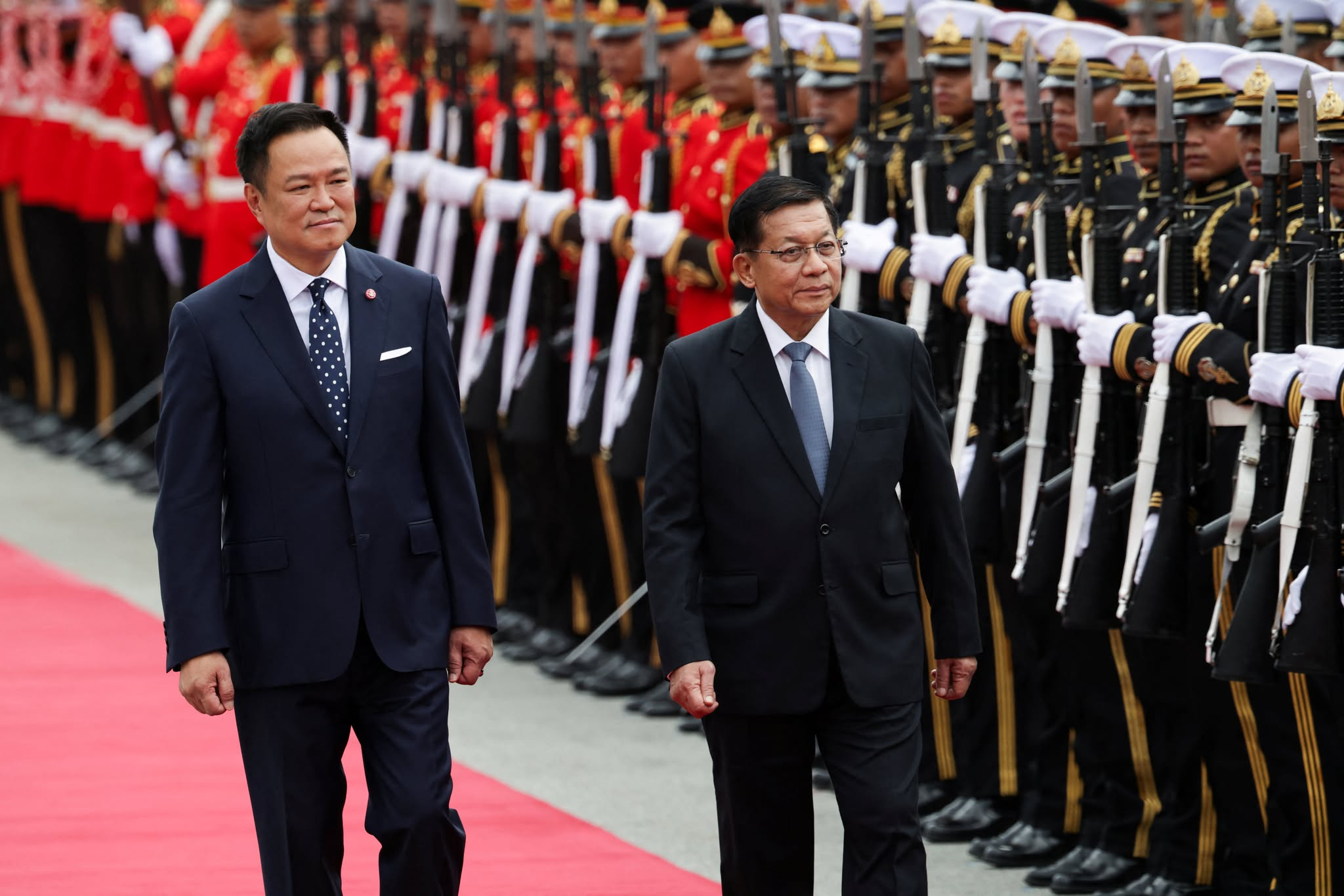
Myanmar Spring Chronicle – Scenes from August 6
(MoeMaKa), August 7, 2026
Min Aung Hlaing’s Official Visit to Thailand and a Shift in a Neighboring Country’s Policy
While Myanmar news media have focused on reports of protests outside the United Nations office in Bangkok during coup leader Min Aung Hlaing’s visit to Thailand—after he was invited by the Thai prime minister on an official visit—international media have framed the trip rather differently. Their headlines have generally portrayed Thailand’s official invitation as helping Myanmar’s military leader break out of the diplomatic isolation he had faced since the coup.
In this sense, Thailand’s decision to invite Min Aung Hlaing on an official visit has been described as a diplomatic success for the Myanmar military leader, more than five years after he seized power.
Myanmar media, meanwhile, have highlighted stories that resonate with the sentiments of much of the Myanmar public, which strongly dislikes Min Aung Hlaing. These include reports of Myanmar nationals in Thailand protesting against his visit. Some reports have even linked his arrival with a shooting at a school in a Bangkok district during the same period, using such incidents in headlines that portray his Thailand visit as less than successful. Such coverage has also appeared to satisfy many among the Myanmar audience.
Images of Min Aung Hlaing bowing deeply while shaking hands with the Thai prime minister have prompted criticism and commentary over the degree of deference he displayed. Likewise, the wording he used in the Thai Government House guestbook to express his pleasure at being invited has become widely viewed and shared on social media.
The government of Thailand’s current prime minister, Anutin, has decided to pursue a policy of “calibrated re-engagement” with the government led by Myanmar military leader Min Aung Hlaing. Despite differences with ASEAN’s position, Thailand has effectively moved a step ahead of the regional bloc by inviting Min Aung Hlaing on an official visit. In doing so, Bangkok has signaled a Myanmar policy distinct from that of ASEAN and some other countries in the region.
Laos also recently invited the Myanmar military leader on an official visit. However, because Laos’s decision carries less influence within ASEAN than Thailand’s, that visit did not attract nearly as much attention.
At a press conference, a foreign journalist asked the Thai prime minister whether inviting Min Aung Hlaing as a state guest amounted to rewarding the coup leader and his government with legitimacy. The Thai prime minister replied that this was not an issue of legitimacy.
The underlying meaning of the Thai prime minister’s response appears to be that Thailand faces a number of practical cross-border problems with Myanmar—including river pollution and contamination, transnational drug trafficking, cross-border haze, instability along the frontier, and the resulting influx of war refugees—and that these problems can only be addressed effectively by engaging with the Min Aung Hlaing government, which currently exercises governmental authority in Myanmar.
The current Anutin administration had also served in a caretaker capacity before Thailand’s most recent general election, at a time when Myanmar was preparing to hold its 2025–26 elections. During that period, current Thai Foreign Minister Sihasak said that elections were not the solution to Myanmar’s crisis.
At the time, Thailand appeared to signal that it would not recognize the election. Now, however, the Thai government has invited Min Aung Hlaing—who assumed the presidency following that election—as an official guest of the government.
There is therefore a considerable difference between the Anutin government’s attitude toward Myanmar’s military government before the election and its position today.
It is difficult to know precisely why the Thai government changed its stance toward Myanmar’s military authorities within roughly a year. One possibility is the fading prospect of a decisive military victory by Myanmar’s armed revolutionary forces. Another factor may be China’s decision to stand behind the military forces led by Min Aung Hlaing. Following his assumption of the presidency earlier this year, countries such as India and China also invited him as an official guest. These developments may have influenced the Thai government’s decision to pursue its current course.
It is also possible that the Thai government has concluded that Myanmar’s armed conflict is likely to become protracted, particularly because the revolutionary forces have been unable to present themselves as a single, unified organization. This may have encouraged Bangkok to promote a path toward negotiations.
In addition, Thailand may simply be placing greater emphasis on political pragmatism in order to address problems directly affecting the country. These include cyber-scam criminal syndicates operating along the border, narcotics trafficking, environmental contamination, and seasonal haze pollution along the Thai-Myanmar frontier adjoining eastern Shan State.
During the August 6 meeting, the Thai prime minister said the two countries aim to increase bilateral border trade from approximately US$7 billion to US$12 billion. However, the prospects for such an increase do not appear particularly strong. Myanmar’s military government continues to pursue policies aimed at conserving foreign currency, while Thai goods are being strictly seized and confiscated on the Myanmar side of the border.
Nevertheless, the Thai government appears to believe that cross-border problems—including cyber-scam operations, narcotics trafficking and river pollution—can only be addressed through direct engagement.
At the same time, some ethnic armed organizations have reached ceasefire agreements.
Myanmar’s armed anti-dictatorship forces are likely to expect the Anutin government to take a position based on human rights and opposition to military dictatorship, which they regard as a root cause of the country’s civil war. However, it is also impossible to ignore the fact that the Anutin government has chosen to engage with Min Aung Hlaing’s government in the belief that the parties involved in the armed conflict should meet and negotiate, and that Thailand’s immediate practical problems need to be addressed as quickly as possible.
Every country will ultimately prioritize its own national interests and seek solutions to problems that directly harm or affect it before giving priority to other concerns.
For Myanmar’s revolutionary forces, therefore, the important question is what they can credibly guarantee Thailand in terms of both its immediate and long-term interests—and whether they can demonstrate in practice that they are capable of producing tangible results.
Their ability to persuade the Thai government will depend not only on what they say they can offer, but also on whether they can demonstrate, through concrete actions and outcomes, that their policies and capabilities can serve Thailand’s interests in the real world.