
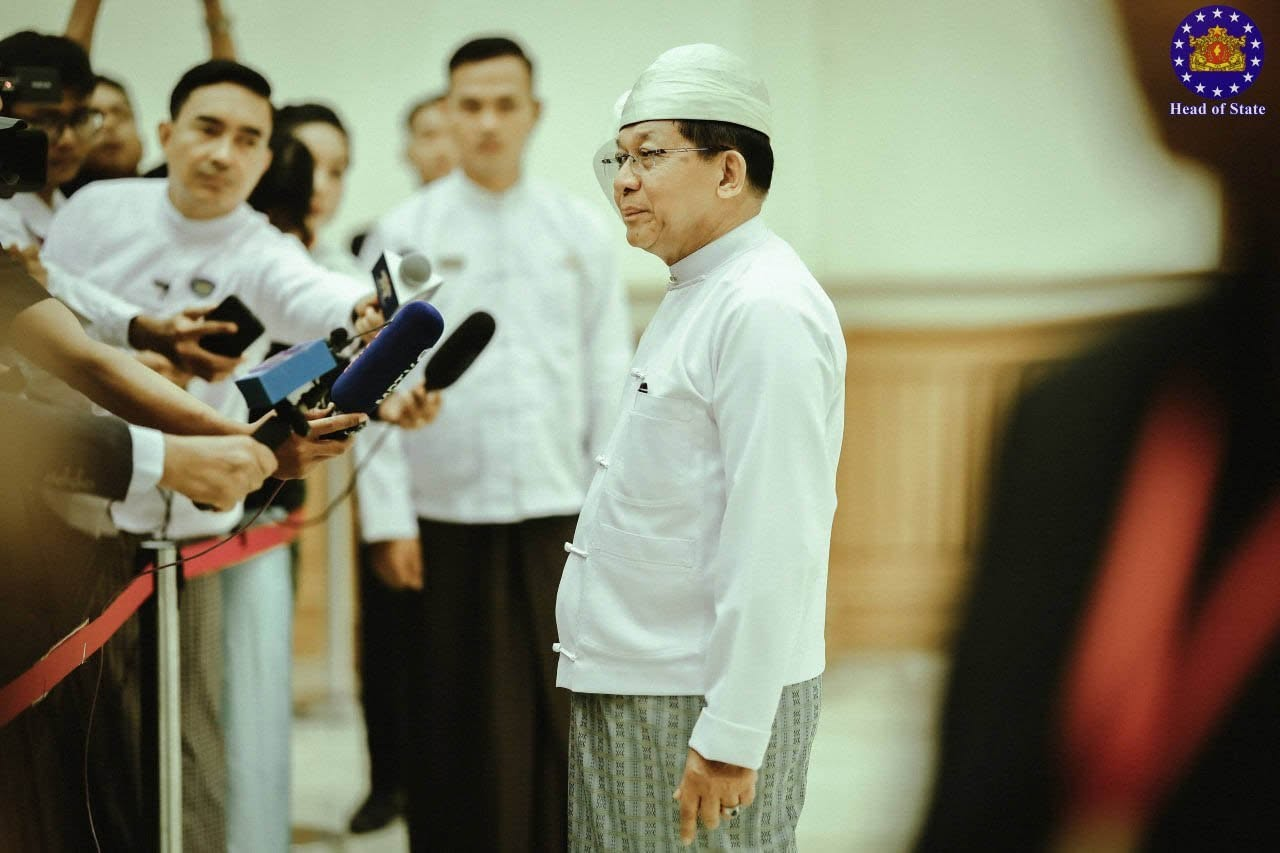
Myanmar Spring Chronicle – Scenes from August 1
(MoeMaKa), August 2, 2026
Min Aung Hlaing says the junta’s peace committee has held talks with 13 armed groups
In his state address on July 31, Min Aung Hlaing said that within the first 100 days after the military-organized election and the formation of a new government under his presidency, the junta’s National Solidarity and Peacemaking Negotiation Committee (NSPNC) had met with 13 ethnic armed organizations.
The meetings followed the junta’s late-April announcement of a 100-day peace dialogue initiative. However, most of the organizations involved are not currently engaged in active fighting against the military. Only three or four of the groups have been involved in armed clashes with the junta since the 2021 coup.
Among the 13 groups, six are signatories to the Nationwide Ceasefire Agreement (NCA) that have largely remained inactive since the coup. Another four non-NCA groups have also avoided major conflict with the military for years. Only three organizations are currently involved in post-coup armed resistance.
Among the NCA signatories, only the Restoration Council of Shan State (RCSS) and the New Mon State Party (NMSP) still possess relatively significant troop strength and territorial control. Other signatories such as KNU/KNLA (PC) and the Democratic Karen Benevolent Army (DKBA) have comparatively limited military and territorial influence.
Among the non-NCA groups, the participation of the Ta’ang National Liberation Army (TNLA) and the Myanmar National Democratic Alliance Army (MNDAA) was not unexpected, as both reached separate ceasefire understandings in 2025. What drew greater attention was the inclusion of the Chin National Organization/Chin National Defence Force (CNO/CNDF), a resistance group formed only after the 2021 coup.
Based in Falam Township, the CNO/CNDF is one of the newer Chin resistance organizations and is also part of the Chin Brotherhood (CB) alliance. Its decision to engage in talks with the military surprised not only other Chin organizations but also many resistance groups across the country.
At the same time, the military’s willingness to meet with a newly established resistance organization is itself unusual. Historically, Myanmar’s military has generally refused to recognize newly formed armed groups as legitimate negotiating partners until many years later, or after a change of government. During previous peace processes after 2011, for example, newer organizations such as the Arakan Army (AA) were excluded from formal peace negotiations despite becoming significant armed actors.
The announcement has reportedly triggered debate both among Chin armed organizations and within the CNO/CNDF itself. Questions have emerged over how other Chin resistance groups should respond to an organization that entered talks with the military. Within the CNO, discussions have reportedly focused on who authorized the negotiations, whether all senior leaders had been informed beforehand, and whether there had been internal consensus.
While it remains unclear whether internal disagreements exist within the CNO or how they will be resolved, the incident highlights challenges that other resistance organizations could also face in the future.
It has long been argued that the military would attempt to weaken the resistance by encouraging divisions through political engagement and negotiations. Nevertheless, many did not expect that some of the post-coup resistance groups would be willing to enter such talks.
The development also underscores that resistance organizations need not only military strategies but also clear political and organizational strategies. Without well-defined policies, ceasefire or dialogue proposals from the military could create confusion over how to respond, weaken internal unity, and make it difficult to explain decisions to the public they represent.
The military, drawing on decades of experience, is widely believed to have prepared both strategic and tactical approaches aimed at preserving its grip on power. For resistance forces, therefore, having confidence in the legitimacy of their cause alone is not enough. They must also understand the political dimensions of the conflict, anticipate negotiation tactics, and maintain unity while responding effectively to future political initiatives.