
Myanmar Spring Chronicle – Scenes from August 19
(MoeMaKa), August 20, 2026
Min Aung Hlaing Government Seeks Stronger Ties with Thailand, Russia and Cambodia
It appears that coup leader Min Aung Hlaing’s ambition is to travel around the world as the president of what he presents as an elected government. His path to the presidency—from the election in early April through the presidential vote in the Union Parliament—appears to have been carefully orchestrated according to a predetermined script to produce the desired outcome.
Beyond winning the election and being chosen as president by parliament, securing invitations for official visits from countries that have not shunned his government also appears to have been one of his priorities after assuming the presidency.
After becoming president in early April and following the Thingyan holiday, he began what was called a “100-day plan” to shape the new government. While issuing calls for peace, his government simultaneously intensified ground operations, offensives and airstrikes. On the international front, it also began actively engaging countries willing to extend official invitations, seeking to demonstrate that it was no longer diplomatically isolated.
Meanwhile, the government does not appear to regard the country’s domestic economic difficulties as serious problems. Shortages of raw materials, strict import controls and measures to conserve foreign currency have driven up the cost of imported industrial inputs. Efforts to reduce fuel imports have also contributed to rising prices for goods and services. Rather than addressing these underlying problems, Min Aung Hlaing’s government has focused on seizing allegedly illegal goods while largely ignoring consumer products imported through the payment of large bribes and then sold at exorbitant prices.
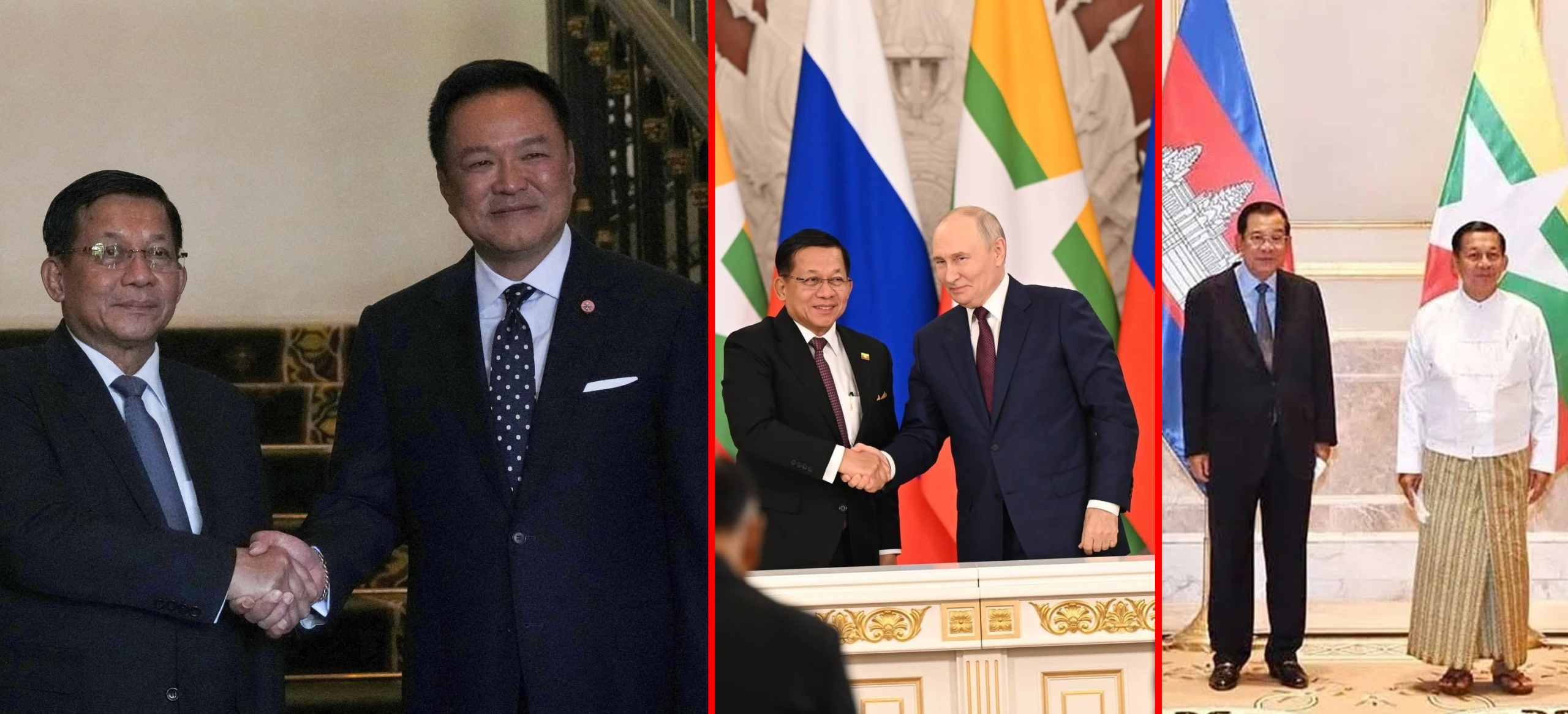
After Min Aung Hlaing formed his government in April, his first foreign trip was to neighboring India at the end of May. His second trip took him in June to China, another neighboring country and a major global power. In July, he traveled to neighboring Laos, an ASEAN member state. A month later, his fourth trip was to Thailand, another ASEAN member that shares a long border with Myanmar and faces significant cross-border crime involving Myanmar.
The Thailand visit was significant because it could put pressure on ASEAN’s decision to maintain a degree of diplomatic sanction against Myanmar. About two weeks after visiting Thailand, Min Aung Hlaing embarked on an official visit to the Russian Federation. He is also reportedly expected to stop in Belarus on his return journey.
Following this trip, it was announced that he would make an official visit the following month to Cambodia, another ASEAN member state.
Taken together, these developments suggest that Min Aung Hlaing—who continues to direct the military from behind the scenes—is seeking to demonstrate that neighboring countries, as well as allies such as Russia and Belarus, are prepared to officially receive his government. By securing official invitations from six or seven countries, he can showcase these visits to countries that have yet to recognize his administration. Another apparent objective is to diplomatically isolate the National Unity Government (NUG).
While military leader Min Aung Hlaing was visiting the Russian Federation, Myanmar military commander-in-chief Ye Win Oo also made an official visit to Thailand. He traveled there to attend the ninth Thailand-Myanmar High-Level Officials Meeting and met with the commander-in-chief of the Royal Thai Armed Forces and Thailand’s defense minister. According to news reports, the Myanmar side also requested Thai cooperation in cracking down on arms-smuggling routes along the two countries’ border.
At the same time that Min Aung Hlaing is taking increasingly frequent steps to gain greater diplomatic recognition, Myanmar’s revolutionary armed forces are also conducting international outreach through the Spring Coalition for Emerging Federalism (SCEF), which was newly established earlier this year.
SCEF recently visited Canada and is currently in Japan, where its representatives have been meeting members of the Myanmar community. SCEF is said to be built around three pillars: ethnic armed organizations, governments of federal units—territories commonly understood as regions under their administration—and women’s representative organizations. Unlike the National Unity Government, SCEF is not structured as a government but more as an alliance. Its overseas advocacy missions appear intended to build relations with foreign governments, parliaments and other institutions.
The visits to Thailand by coup leader Min Aung Hlaing and, more recently, Myanmar military commander-in-chief Ye Win Oo could have consequences for ethnic armed organizations based along the Thai border. As Thailand increases cooperation with the Min Aung Hlaing government, resistance forces may encounter greater difficulties transporting weapons and ammunition across border areas. They could also face greater obstacles in purchasing technological equipment and components—such as those used for drones—which have become increasingly important in modern warfare.
Although Thai governments change relatively frequently, senior Thai military officers are career officials and therefore tend to remain in their positions more consistently than politicians. The closer their relationships with Myanmar’s military leaders become, the more difficult the operating environment could become for Myanmar’s armed resistance forces.
The Min Aung Hlaing government’s efforts to escape diplomatic isolation and gain greater international acceptance should therefore not be viewed as diplomacy alone. These diplomatic developments could also have tangible consequences for the military situation on the ground, and this is something that deserves close attention.