
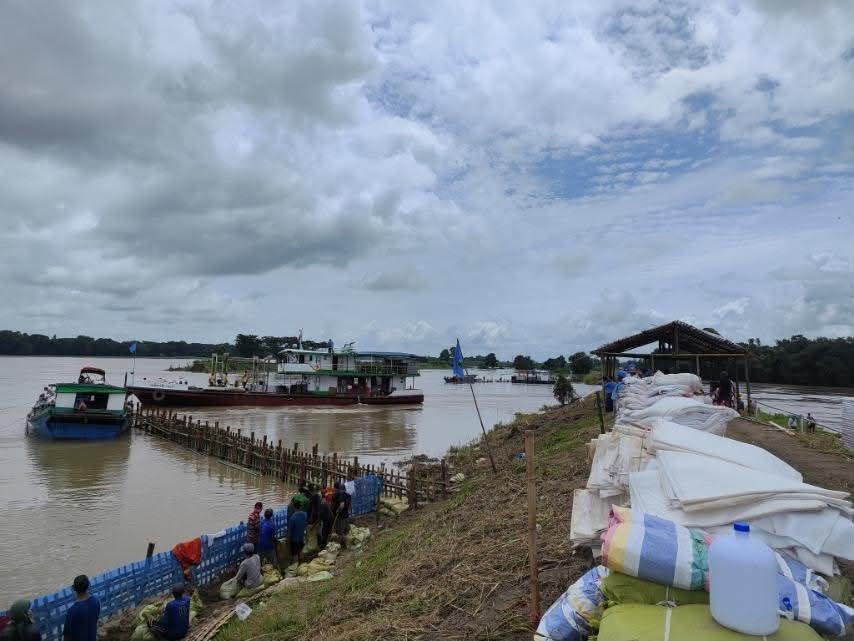
Myanmar Spring Chronicle – Scenes from August 5
(MoeMaKa), August 6, 2026
Flood Disaster Expands After Ngawun River Embankment Breach
The flooding caused by the breach of the embankment holding back the Ngawun River west of Laymyethna Township, which first collapsed on the night of July 30, continues to worsen. Water pouring through the breach has inundated towns, villages, and farmland, with the flooded area expanding each day. Reports indicate that floodwaters could eventually reach Ngathaingchaung and Kyonpyaw townships.
In the early days of the disaster, more than 6,000 people were affected. By the end of the first week, however, news reports estimated that the number had exceeded 30,000. The extent of the damage continues to grow, and it remains impossible to predict how severe the overall impact will become. As of August 5, authorities had still failed to seal the breached embankment, allowing water to continue flowing into surrounding areas. Communities as far as Ngathaingchaung and Kyonpyaw remain on alert as they face the risk of flooding.
The exact cause of the embankment failure remains unknown. According to a BBC Burmese report, likely contributing factors include prolonged heavy rainfall, unstable foundation soil beneath the embankment, substandard concrete used during construction, and inadequate maintenance over the years.
In a country governed by a military regime that allocates much of its national resources and tax revenue to the civil war, only a very small share of the budget is devoted to public services and infrastructure maintenance aimed at protecting citizens from disasters. Moreover, many civilian ministries responsible for public services, development, and river management have long been directed not by technical experts but by former military officers transferred into civilian positions. This has contributed to decades of declining institutional capacity across government ministries.
As a result, the lack of flood-control infrastructure and disaster preparedness in the low-lying communities of Myanmar’s delta region—where people live and farm below river level—is unfortunately not unusual.
The consequences of the Ngawun River embankment breach west of Laymyethna are becoming increasingly evident. Besides the risk of people being swept away or drowning, homes, schools, hospitals, religious buildings, roads, bridges, and railway lines are all at risk of severe flood damage. In many places, floodwaters have completely submerged single-story homes up to their rooftops, while in some areas even the upper floors of two-story houses are underwater. Food supplies and household provisions have also been destroyed.
Although some residents have taken temporary refuge on embankments or elevated roads, long-term survival will require relocating to villages and towns beyond the reach of the floodwaters. The western and southwestern parts of Laymyethna border Gwa Township, an area affected by armed conflict. Consequently, people displaced by both conflict and flooding face significant obstacles in seeking refuge there.
Unlike flash floods caused by heavy rainfall that typically subside after a few days, this river flooding could persist for at least two to three months. Local residents recall that after a similar embankment breach in 1991, floodwaters that entered during the middle of the rainy season did not fully recede until the end of Tawthalin and into the Thadingyut period.
Within just one week, some reports estimate that around 30,000 people have already been displaced.
According to the latest available figures, more than 10,000 acres of monsoon rice fields have been submerged. Since these fields cannot be replanted until the floodwaters recede—possibly months later—farmers are likely to face delayed planting schedules, shortages of rice seed, and a cascade of additional agricultural challenges.
Another major obstacle facing relief efforts is the military government’s fuel restrictions, which have made fuel difficult to obtain. Rescue vehicles and motorized boats are struggling to purchase fuel, preventing aid organizations from reaching flood victims despite having relief supplies ready for distribution.
News reports also show that volunteer groups and charitable organizations from other parts of the country are transporting food, medicine, and other essential supplies to the disaster zone. In Myanmar, it is common for ordinary citizens to help one another during natural disasters. However, these civil society and volunteer organizations generally operate independently, relying on their own limited resources and available information. There is no effective system for coordinating where assistance is sent, what types of aid are needed, or how resources should be distributed among organizations.
In reality, during disasters of this scale, only the government possesses the budget, administrative capacity, information networks, and coordination authority necessary to organize relief efforts effectively. It is also the government’s responsibility to do so. Yet there has been little evidence of coordinated assessments identifying which villages or neighborhoods need the most assistance or what forms of aid are most urgently required. Nor have officials provided clear information about the scale of government relief efforts.
This has raised questions about how much of the actual assistance needed is being provided by the military authorities administering the affected areas. According to information circulating on social media, approximately 100 soldiers, along with about 200 personnel—including engineers from the Irrigation Department and firefighters—have been deployed to the breach site. Whether these forces will be able to repair an opening roughly 100 feet wide, or whether the breach will continue to widen, remains to be seen.
Meanwhile, Senior General Min Aung Hlaing, who recently became president after forming a new government, appears to have prioritized an official visit to neighboring Thailand over personally overseeing the disaster response at the breached Ngawun River embankment. He was reportedly preparing to travel to Bangkok on August 6 following an official invitation from the Thai government.