
Myanmar Spring Chronicle – Scenes from August 27
(MoeMaKa), August 28, 2026
Central Bank Instructs Banks to Prevent Myanmar Banking Apps from Being Used Abroad
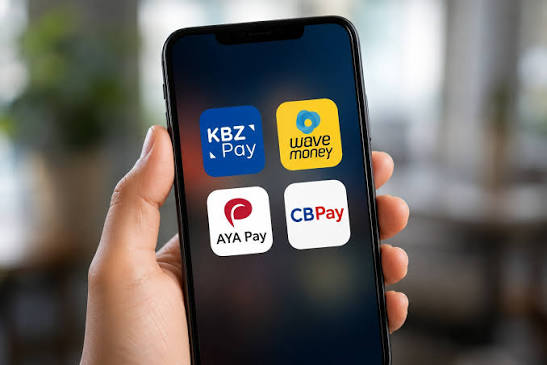
Reports have emerged that the Central Bank has instructed Myanmar banks and digital payment service providers to introduce technical restrictions to prevent their mobile banking applications and digital payment apps, such as K-Pay, CB-Pay, AYA-Pay and Wave Money, from being used outside Myanmar. The reports have raised concerns among users of digital payment services such as K-Pay who are living abroad that they may no longer be able to access the services. News reports also indicate that some users have begun transferring money out of their accounts because of these concerns.
Reports suggest that the restrictions preventing financial transactions involving Myanmar banks from being conducted from overseas are expected to begin on August 28. However, when news organizations contacted the relevant private banks, some banks responded that they had not yet received any such instruction.
As of the morning of August 28, mobile banking applications and K-Pay were still accessible and functioning.
K-Pay, Wave Money, CB-Pay and other Myanmar digital payment applications are widely used by Myanmar nationals living abroad. This is particularly the case in Thailand, where millions of Myanmar migrant workers are currently living. Among those millions of Myanmar nationals, the number of people using these applications could potentially be in the hundreds of thousands. They use banks and digital payment applications when sending remittances to family members who remain in Myanmar, as well as when transferring money to friends, acquaintances and relatives inside the country.
In addition, domestic digital payment applications are also used when contributing funds to the Spring Revolution, even when the NUG government’s SDB banking application is involved. Over the past several years, there have been numerous cases in which accounts suspected of being support accounts used to raise funds for the resistance inside Myanmar have been frozen, while account holders have been arrested and interrogated.
There are no available statistics from systematic studies showing how extensively digital payment accounts are being used to provide financial support or raise funds for the resistance. Nevertheless, it is believed that such accounts are being used to a certain extent, leading to speculation that this may be one of the reasons behind efforts to prevent applications such as K-Pay and Wave Money from being used outside Myanmar.
IT experts believe that the applications could be blocked from overseas access through technologies such as geo-blocking and location blocking. This would mean that if a user’s location is detected as being outside Myanmar, the user would not be allowed to access the application. They also say that even if users attempt to change their apparent server location by using software such as a VPN, there is a possibility that their IP addresses could be identified and subsequently blocked.
Among Myanmar’s digital payment applications, K-Pay, a service provided by Kanbawza Bank, is the most widely used, followed by Wave Money, associated with Yoma Bank. Using a conventional bank account online through mobile banking generally requires users to enter more detailed information and is not as simple or fast as payment applications that allow users to make payments and transfers by scanning a code or using a phone number. For this reason, conventional mobile banking tends to be less widely used for such transactions.
Some people have suggested another possible reason for restricting the use of these applications from abroad. They believe the authorities may be trying to prevent migrant workers from sending family remittances through convenient applications such as K-Pay and instead require them to send money back through banks and other official financial channels. However, no solid information or evidence has been found to confirm this explanation.
In recent years, it has become increasingly apparent that the military authorities have been attempting to cut off or gain control over financial channels through which armed resistance groups receive donations, routes through which they can collect taxes and other revenues, and areas containing natural resources that can provide them with income.
Border trade routes are one example. Some of these routes pass through territories controlled by ethnic armed organizations fighting the military. In situations where the military has been unable to seize those territories, it has imposed strict inspections and confiscated foreign goods transported through those areas.
Similarly, the military has often given greater priority to attacking areas containing gold mines, gold-dredging operations, other mines and gemstone-producing regions from which armed resistance organizations can collect taxes and generate revenue. Compared with other territories, these resource-producing areas are more frequently targeted for attacks and military offensives, as well as destruction through airstrikes.
When these circumstances are considered together, the move to prevent digital payment applications from being used outside Myanmar can be interpreted as an effort aimed at cutting off financial flows in order to gain a military and political advantage, rather than simply an attempt to enforce financial laws and regulations.