
Myanmar Spring Chronicle – Scenes from July 6
(MoeMaKa), July 7, 2026
What Has America Built in 250 Years, and What Has Happened to Myanmar?
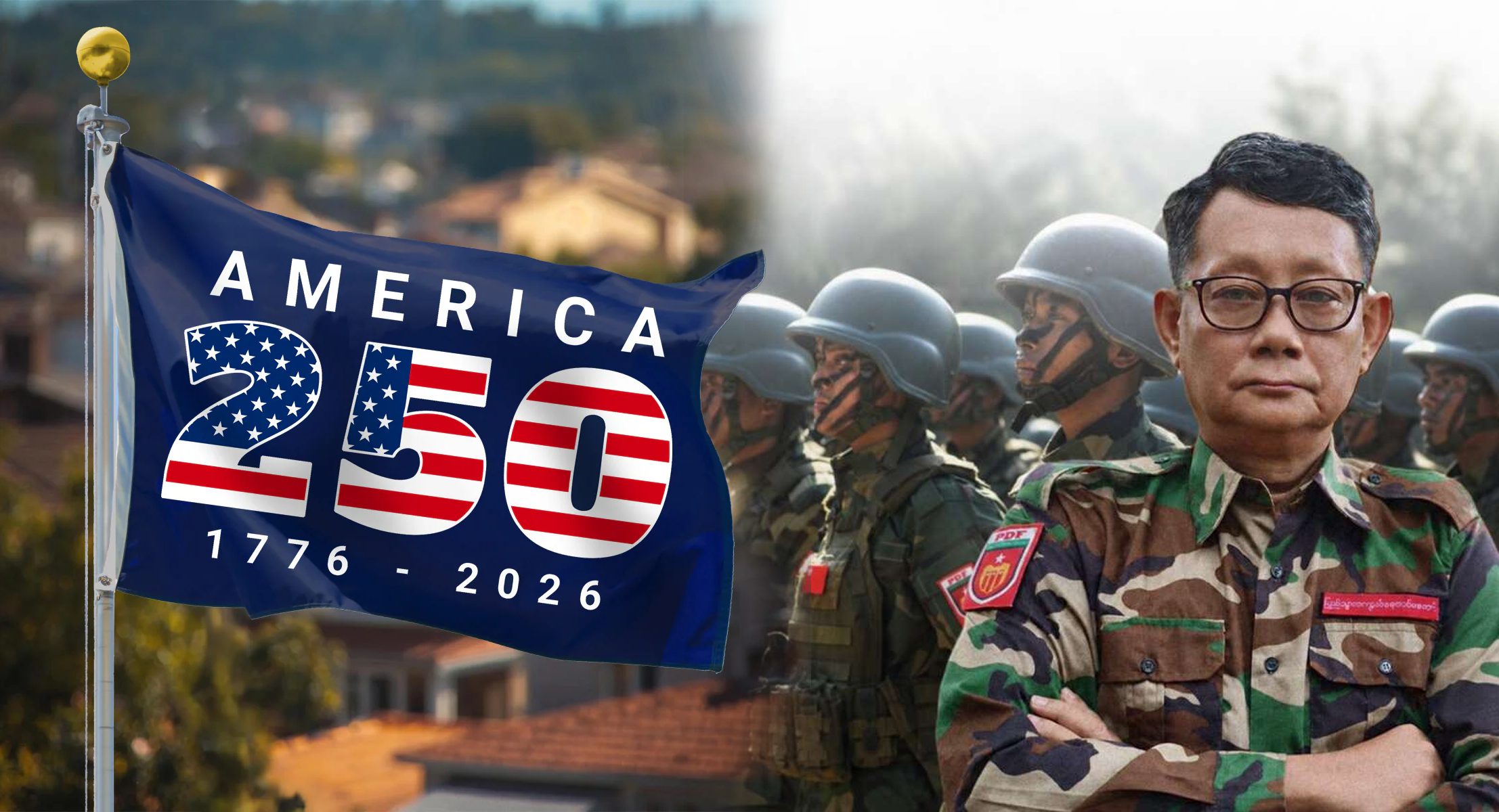
July 4, 2026 marked the 250th anniversary of the adoption of the American Declaration of Independence. On the other hand, although Myanmar gained the right to shape its own destiny nearly 78 years ago, it is still struggling to answer the question: Who should govern the country?
Across the United States, celebrations were held nationwide. Yet the political atmosphere in America remains cloudy. Under Trump, political disputes have intensified, but former presidents Clinton, George W. Bush, Obama, and Biden have reaffirmed their continued faith in American democracy and the Constitution.
Despite differences of opinion, legal disputes, and ideological conflicts, they said Americans can continue to live together and seek solutions through the foundation of the American political system: the freedom of each individual and the institutions that guarantee that freedom. They also warned that acts of destruction and injustice must not be ignored, but confronted and resisted at every moment.
Since the American Civil War of 1861–1865, Americans have not again fought one another in a full-scale armed civil war. However, racial discrimination, ethnic divisions, and clashes between conservative and progressive views have continued.
In 1861, Myanmar was still under a feudal monarchy, while the United States was already practicing a system in which presidents were elected through elections. After white Americans fought one another over whether Black enslaved people should enjoy the same freedoms as white people, the United States managed to avoid another civil war for more than 160 years.
In Myanmar, however, armed conflicts continue to this day — between the hills and the plains, Bamar and ethnic nationalities, the military bloc and other forces. Myanmar’s civil war has now lasted more than 70 years. Although the country gained the right to shape its own destiny in 1948, different ethnic groups and social classes are still fighting for that right.
A comparison of America’s 250 years and Myanmar’s parallel 250 years shows the following:
|
Year |
United States |
Myanmar |
|
1776 |
July 4 – Declaration of Independence |
Konbaung dynasty, reign of King Hsinbyushin |
|
1783 |
Britain recognized American independence |
King Bodawpaya ascended the throne |
|
1787–1789 |
Constitution and presidential system established |
Konbaung Empire grew stronger |
|
1824–1826 |
Beginning of the Jacksonian Democracy era |
First Anglo-Burmese War |
|
1852 |
Industrial development |
Second Anglo-Burmese War |
|
1861–1865 |
Civil War and abolition of slavery |
King Mindon’s reform period |
|
1885 |
Emergence as an industrial power |
Third Anglo-Burmese War; King Thibaw exiled |
|
1941–1945 |
World War II |
Japanese occupation and independence movement |
|
1948 |
Emergence as a global power after the war |
Independence; beginning of civil war |
|
1962 |
Civil Rights era |
General Ne Win’s coup |
|
1988 |
Democracy strengthened |
8888 popular uprising |
|
2010–2020 |
Technology age |
Semi-military democracy |
|
2021 |
Democracy continued |
Military coup |
|
2026 |
250th anniversary of independence |
Spring Revolution period |
One of the central lines of the 1776 American Declaration of Independence is: “All men are created equal.” Lincoln later described the 1776 Declaration as a guiding standard for future generations.
Yet at the time, the idea that “all men are equal” was closer to a dream than reality. Slavery still existed. Women still could not vote. Indigenous Americans were not included in equal citizenship. The 1776 Declaration was ahead of its time in principle, but behind in practice.
Myanmar’s independence in 1948 also expressed the ideas of the Panglong spirit and the Union spirit. The 1947 Panglong Agreement laid the foundation for federalism, but after independence in 1948, that promise was never fully implemented.
The question of how to unite Myanmar was answered with independence, parliamentary democracy, and federalism. But the dream of a land where all enjoy equal rights and justice never became reality.
America declared in 1776 that all people are equal. But to make those words real, it had to abolish slavery, go through civil war, and later continue with the Civil Rights movement. The Declaration did not become reality immediately. But the country gradually moved toward that ideal.
In Myanmar, the 1948 question — How should Myanmar be united? — had by 2008 become a different question: Who should govern the country?
The 2008 Constitution answered not so much the question of how power should be shared, but who would hold ultimate power. It formally embedded the military’s role inside the constitutional structure, above civilian authority.
The United States built a history around the idea that power derives from the people. Myanmar, by contrast, has shaped a history in which power flows not from the people but from privileged classes — especially the military bloc and the armed forces.
Myanmar gained independence in 1948. But nearly 80 years later, it has still not resolved the question: Who owns power? Even today, the people have not fully gained sovereign authority.
Therefore, when comparing America’s 1776 with Myanmar’s 1948 and 2008, the key issue is not the words written on paper. The real question is how far a nation can put its founding promises into practice.
Now, in 2026, more than five years into the Spring Revolution, Myanmar’s fundamental unresolved question remains: Who should govern the country?
Should the country be governed by the elected representatives from the 2021 election, the CRPH, and the NLD? Should it be governed by the National Unity Government? Should it be governed by the NUCC or some federal council? Should emerging federal units such as Sagaing, Magway, and Mandalay govern? Or should armed groups and EROs that control territory govern?
These questions reflect Myanmar’s present reality.
The military bloc, meanwhile, is trying to reinsert itself into this cycle of conflict by staging a 2026 election and claiming renewed legitimacy as a government.
For 250 years, the United States has gradually built institutions — elections, parliament, presidents, and governments — around the principle that power derives from the people.
Myanmar, however, has still not moved beyond the stage of choosing individuals, parties, and groups in its attempt to realize the principle that power comes from the people.
In other words, it may now be time to ask whether the representation of the people’s will has once again been pushed to the back seat.