
Myanmar Spring Chronicle – Scenes from July 29
(MoeMaKa), July 30, 2026
The Rohingya Refugee Crisis: A Crisis Within a Crisis
Recent news has once again drawn attention to the plight of Rohingya refugees. In Malaysia, police detained Rohingya refugees who had set up tents outside the UNHCR office in Kuala Lumpur while seeking assistance. Around the same time, Malaysian Prime Minister Anwar Ibrahim told the media that discussions with Myanmar’s authorities had resulted in an agreement for Myanmar to accept the return of approximately 5,000 Rohingya refugees.
How such a repatriation would be carried out in practice remains unclear. While 5,000 people is not an insignificant number, it represents only a small fraction of the hundreds of thousands of Rohingya refugees living abroad. Previous attempts to repatriate Rohingya refugees from Cox’s Bazar, Bangladesh, between late 2017 and early 2021 failed to produce meaningful progress. Given that history, many observers question whether the current agreement under Myanmar’s military-led administration can realistically be implemented.
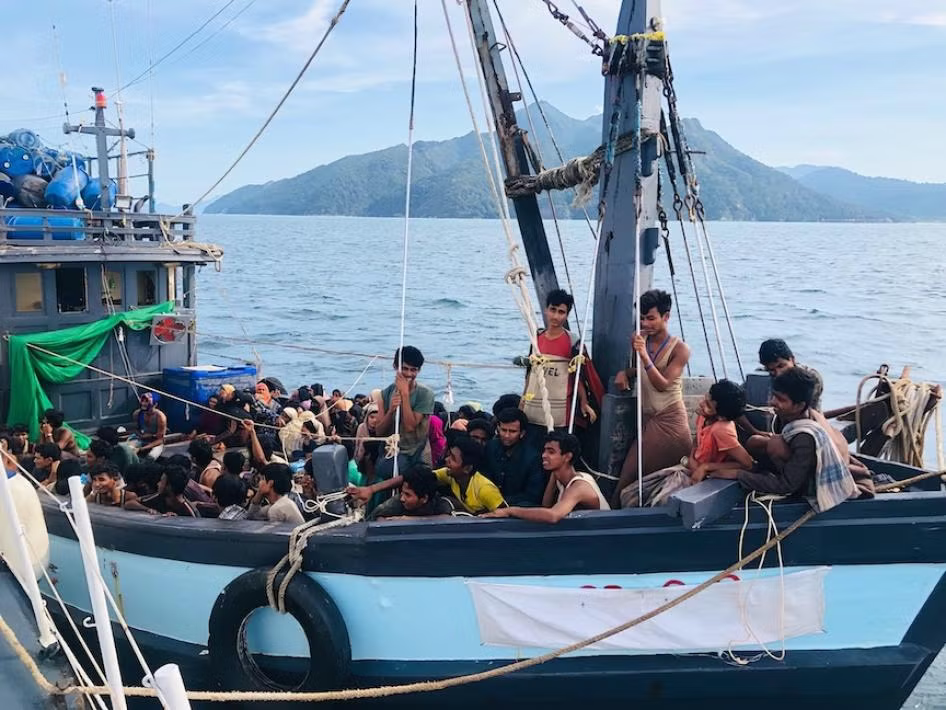
Just weeks before this latest development, reports also emerged that two boats believed to be carrying Rohingya refugees from areas near the Bangladesh-Myanmar border sank at sea, with more than 500 people feared dead.
Dangerous sea journeys undertaken by Rohingya refugees toward southern Thailand and Malaysia are not new. As far back as 2011, reports surfaced that the Thai navy had intercepted refugee boats, supplied them with food and medicine, and pushed them back into international waters. Other allegations included disabling boat engines by filling them with sand and incidents in which refugees were reportedly shot at, resulting in deaths.
Even before the 2012 communal violence in northern Rakhine State, many Rohingya had already been attempting dangerous journeys by sea to Malaysia and Indonesia. Facing severe restrictions on freedom of movement, access to higher education, and citizenship rights, many turned to human smugglers, who transported overcrowded boats across the Andaman Sea. Fatal accidents became tragically common and frequently made international headlines.
The communal violence between Buddhist and Muslim communities in Rakhine State in June 2012 significantly worsened the situation. Large numbers of Rohingya were displaced into camps, while access to education, employment, and normal livelihoods became even more restricted, intensifying an already longstanding humanitarian crisis.
The situation escalated dramatically in August 2017, when the Arakan Rohingya Salvation Army (ARSA) attacked police and border guard posts in northern Rakhine. The Myanmar military’s subsequent clearance operations led to the deaths of thousands of Rohingya civilians and forced between 700,000 and nearly one million people to flee to Bangladesh. From that point onward, the Rohingya issue became an international humanitarian and diplomatic crisis, with allegations of crimes against humanity and genocide, leaving one of the darkest chapters in Myanmar’s modern history.
These developments further accelerated the movement of Rohingya refugees to neighboring countries. In addition to dangerous sea routes, overland smuggling networks emerged, moving thousands through Myanmar and southern Thailand into Malaysia. Many later registered with UNHCR as refugees while seeking resettlement in third countries.
For many Rohingya, surviving the journey offered the possibility of escaping the severe restrictions they faced in northern Rakhine State. The hope of gaining freedom of movement, employment opportunities, and a more secure future often outweighed the enormous risks of illegal migration by land and sea.
Even before the 2021 military coup, Myanmar was already facing proceedings at the International Court of Justice (ICJ) over allegations of genocide, while efforts by Myanmar, Bangladesh, and the United Nations to repatriate nearly one million refugees had remained stalled for years. The military takeover in 2021 made finding a durable solution even more difficult.
As conflict spread across Myanmar following the coup, fighting also resumed in Rakhine State. During 2024, the Arakan Army (AA) gained control over large parts of the state. Amid the fighting between the military and the AA, reports indicated that the military recruited and armed some Rohingya as local militia forces, drawing them into the conflict. Critics argue that this strategy deepened tensions between Rohingya communities and the AA while further entangling the refugee issue with Myanmar’s broader civil war.
By arming members of a community it had previously oppressed, the military further complicated relations between Rohingya and Rakhine communities, making an already difficult problem even harder to resolve.
Today, fundamental questions remain unanswered. Who will ultimately be responsible for addressing the Rohingya issue: the ULA/AA, which controls much of Rakhine State, or the military-led administration in Naypyidaw, which continues to present itself as Myanmar’s de facto government?
As Myanmar continues to struggle with the fight against military rule and the pursuit of democracy, long-term solutions for the Rohingya—including citizenship rights and the safe, voluntary, and dignified return of nearly one million refugees from Bangladesh—appear more distant than ever. The Rohingya refugee crisis has become, in many respects, a crisis within a crisis.