
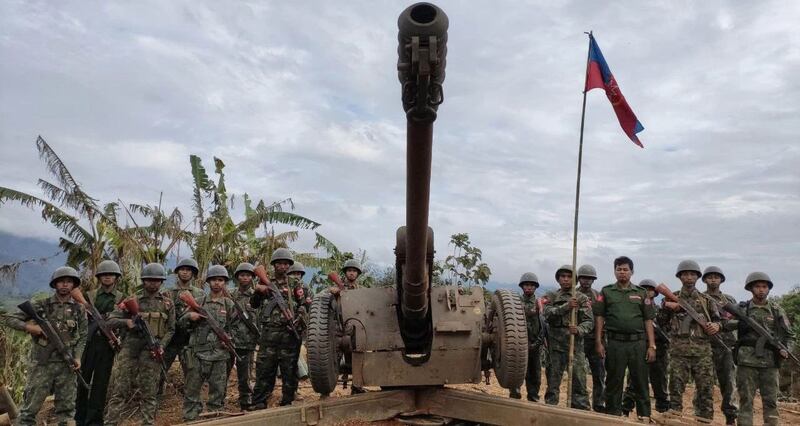
Myanmar Spring Chronicle – Scenes from July 15
(MoeMaKa), July 16, 2026
The Rise and Decline of Myanmar’s Anti-Junta Armed Resistance
Since around the middle of 2025, the military and political momentum of the armed groups fighting Myanmar’s military regime under Senior General Min Aung Hlaing appears to have weakened compared with its earlier peak. Judging by developments on the ground, it would be difficult to deny that the resistance’s upward trajectory, which reached its height in early 2025, has since leveled off and shown signs of decline.
Following the launch of Operation 1027 in northern Shan State on October 27, 2023, resistance forces rapidly opened multiple fronts. The Karenni offensive began on November 11, followed by the Arakan Army’s offensive in Rakhine State on November 13. These coordinated campaigns placed the military under severe strategic pressure. Throughout 2024, the junta suffered repeated defeats—not only strategically, but also in tactics, manpower, and increasingly in drone warfare.
During this period, the military lost numerous towns, regional commands, brigade headquarters, and eventually even the Western Regional Military Command in Rakhine State. In northeastern Myanmar, Lashio and its regional military headquarters also fell, while thousands of junta troops surrendered or were captured. With only Muse remaining under its control in much of northern Shan, resistance forces were even threatening Mandalay, Myanmar’s second-largest city.
The turning point came when the Myanmar National Democratic Alliance Army (MNDAA) agreed to a ceasefire with the military and later returned Lashio. That development gave the junta its first real opportunity to recover from what had been its most precarious situation.
The military successes that had steadily accumulated since late 2023 arguably reached their high point in January 2025. After that peak, the momentum stalled before gradually declining.
There is no single explanation for this shift. On the junta’s side, it managed to replenish troops and weapons while learning from previous battlefield failures. On the resistance side, several factors contributed: weakening alliance cohesion, China’s changing strategic approach toward Myanmar—which resulted in pressure on some ethnic armed organizations to accept ceasefires—and growing tensions over governance and ethnic-based administrative policies in newly captured territories that strained relationships among allies.
The MNDAA’s ceasefire and handover of Lashio, followed by the Ta’ang National Liberation Army (TNLA) agreeing to a ceasefire after losing control of Taung Hkam, Naungcho, Kyaukme, and Hsipaw and accepting arrangements involving Mogok and Momeik, significantly altered the overall balance of the armed resistance. These developments also affected other revolutionary groups that had operated alongside the two ethnic organizations.
As a result, what had once appeared to be a campaign capable of defeating the military regime in the near term has gradually evolved into a longer-term struggle. Despite these military shifts, however, there has been little significant change in the political unity among anti-junta forces.
Relations between the National Unity Government (NUG) and various ethnic armed organizations remain uneven. Each ethnic force continues to shape its policies according to the geopolitical realities of its own border region. Groups operating along the Chinese border often pursue different strategies from those based along the Thai or Indian borders.
This is reflected in political alliances. Organizations such as the National Unity Consultative Council (NUCC) and the State Coordination and Federal Council (SCEF), which are centered around the NUG and the CRPH, include the Kachin Independence Army (KIA), but most Chinese border-based ethnic organizations have not joined. Similarly, the United League of Arakan/Arakan Army (ULA/AA) maintains cooperation through alliances such as the Federal Political Negotiation and Consultative Committee (FPNCC) and the Northern Alliance, while remaining outside many other coalition structures. These differences largely reflect varying geopolitical interests and political objectives.
After more than five years of armed resistance, the success of Myanmar’s Spring Revolution increasingly depends on how these forces cooperate—or fail to cooperate. Moreover, the ultimate goals of the Spring Revolution do not necessarily coincide with those of every ethnic armed organization. The Spring Revolution seeks the complete defeat of military rule, the permanent removal of the armed forces from politics, and ultimately victory all the way to Naypyidaw. Some ethnic armed groups, however, may see their primary objective as securing lasting control over their own territories and establishing meaningful self-governance rather than overthrowing the junta nationwide.
In recent months, several international media outlets have published articles with headlines suggesting that Myanmar’s democratic resistance is losing momentum, describing both the changing battlefield situation and the fragmentation among resistance forces. Just as international media previously highlighted the resistance’s dramatic advances and growing optimism during its strongest period, they are now portraying its current slowdown.
Those actively participating in or supporting the Spring Revolution are understandably unlikely to welcome such assessments. Nevertheless, the revolution’s trajectory will not be determined by how international media describe it. Its future depends primarily on the decisions, leadership, and actions of the revolutionary forces themselves, as well as those of the military regime.
Rather than focusing on how foreign media characterize the conflict, the more important question is what lessons Myanmar’s anti-junta movement can draw from these changing circumstances and what adjustments it should make to strengthen its position going forward.