
Myanmar Spring Chronicle – Scenes from July 7
(MoeMaKa), July 8, 2026
The Changing Fortunes of Myanmar’s Battlefronts (Continued)
The internal leadership split within the Mandalay People’s Defense Force (MDY-PDF) in northern Mandalay Region, combined with the ceasefire reached by its ally, the Ta’ang National Liberation Army (TNLA), after losing Taung Hkam, Kyaukme, and Hsipaw while defending against junta offensives, has significantly affected the position and momentum of the MDY-PDF.
At one point, the MDY-PDF had advanced as far as the Sedawgyi Reservoir area near Mandalay and reached the border of Patheingyi Township, placing it in a position to threaten both Pyin Oo Lwin and Mandalay. However, following the TNLA ceasefire, the MDY-PDF gradually began losing territory under its control. By late 2025 and early 2026, it had lost areas including Madaya, Thabeikkyin, and Tagaung, which had previously been under its control. These areas contain long-established gold mines, and the group also lost access to tax revenues generated from those mining operations.
The territories previously controlled by the MDY-PDF in northern Mandalay Region serve as a strategic corridor linking northern Shan State with Sagaing Region, making them highly significant militarily. From late 2023 through most of 2024, the military junta was unable to dominate these areas, effectively disrupting its supply routes to Kachin State. At present, however, the junta has regained control over the route running east of the Ayeyarwady River, including the Mandalay–Mogok Road, and from there extending via the Indaw–Mogaung highway toward Kachin State.
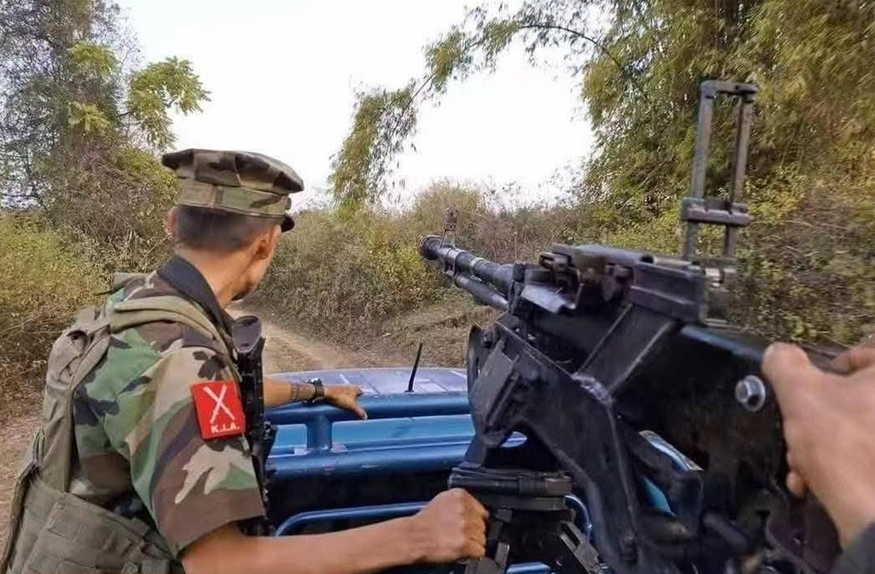
The loss of revolutionary-controlled territory stretching from eastern Mandalay Region to the Kachin border, as well as areas connecting northern Shan and Sagaing, has also affected the Kachin Independence Army (KIA). These areas had functioned as buffer zones, and their loss now leaves the KIA in a position where it faces the junta more directly.
Currently, the KIA remains engaged with junta forces around Bhamo, Shwegu, and Hpakant, while maintaining a relatively stable front around central Kachin State, including Myitkyina and Waingmaw. During the height of Operation 1027, the KIA succeeded in capturing territory controlled by the New Democratic Army-Kachin (NDAK), led by Zakhung Ting Ying, in northern Kachin. It also effectively contained junta operations in jade-producing Hpakant. However, after the military reinforced its forces in Hpakant in mid-2025, it has since managed to regain control over some of the areas it had previously lost there.
The areas discussed above are located in northern Myanmar, including Kachin State and the Kachin–Sagaing border regions. In northern Shan State, however, territorial control has shifted primarily between the Myanmar National Democratic Alliance Army (MNDAA) and the TNLA during the past year. The junta, by contrast, has not made any particularly notable territorial gains in northern Shan between late 2025 and the present.
Likewise, since mid-2025, there have been no significant new territorial gains by resistance forces in northern, eastern, or southern Shan State. In Karenni (Kayah) State, however, the military has managed to re-establish control over several areas.
The Pa-O National Liberation Organization/Army (PNLO/PNLA) has largely remained in a defensive holding pattern. It has not launched major offensives against the military, nor have large-scale clashes comparable to those seen in 2023–2024 occurred in areas such as Hsihseng and Hopong.
Similarly, the junta-aligned Pa-O National Organization/Pa-O National Army (PNO/PNA), which functions as a Border Guard Force, has not undertaken any major offensive operations.
In southern Myanmar, over the past year the Karen National Union/Karen National Liberation Army (KNU/KNLA) has continued attacking and capturing military outposts along the Thai–Myanmar border. In eastern Bago Region, particularly in the Sittaung River basin, NUG-affiliated PDF units have been conducting joint operations with the KNU/KNLA against military bases. Meanwhile, the military has succeeded in regaining control of the Asian Highway between Myawaddy and Kawkareik, reopening the route several months ago for the first time in more than a year.
In Mon State and Tanintharyi Region, fighting has continued this year between local defense forces, the KNU/KNLA, and junta troops. However, there have been no major changes in territorial control. After the KNU/KNLA captured the Mawtaung border trade post last year, the military launched a counteroffensive several months later and recaptured it.
Tanintharyi Region remains home to several units operating under the NUG Ministry of Defense (MOD), along with numerous locally organized resistance groups.
Looking at the country as a whole, the military junta has expanded its territorial control from early 2025 through mid-2026, particularly across central Myanmar’s Dry Zone, Chin State, Sagaing Region, and Mandalay Region. Its strategy has focused on regaining control of strategically important north–south highways and east–west transportation corridors. At the same time, it has sought to seize border trade routes and resource-rich territories that generate tax revenues for ethnic armed organizations. The implementation of the conscription law has also enabled the junta to substantially expand its manpower—from tens of thousands to potentially hundreds of thousands of personnel—providing it with much-needed relief from its previous manpower shortages.
Although the revolutionary armed resistance may not be able to launch another operation on the scale of Operation 1027, there remains the possibility of changing the current military balance if the various resistance organizations can coordinate effectively and carry out a unified strategic offensive.